
My first raised bed cucumber crop was a disaster, and it was entirely my fault. I planted six Marketmore 76 seedlings in a single 4×8 bed, let them sprawl across the soil, and by mid-July I had a tangled mat of mildewed leaves hiding about nine bitter, yellow-bellied fruits. I pulled the whole thing out in disgust and planted bush beans instead.
The next season I changed three things — spacing, a trellis, and a deep mulch layer — and harvested over 80 cucumbers from the same bed. That’s the frustrating part about learning to grow cucumber in raised beds: the plant isn’t difficult at all, but it’s unforgiving about the handful of things it actually cares about. Get those right, and cucumbers are one of the most productive crops you can put in a raised bed. Get them wrong, and you’ll fight powdery mildew and bitterness all summer.
Here’s exactly how I run cucumbers in my Zone 6 raised beds now — soil prep, timing, vertical training, watering rhythm, pest control, and harvesting — plus the mistakes I still see gardeners repeat every June.
Why Raised Beds Suit Cucumbers So Well
Cucumbers are shallow-rooted, thirsty, and extremely sensitive to cold soil. A raised bed solves two of those three problems for free.
Soil temperature is the big one. Cucumber seeds germinate poorly below 60°F and rot outright in cold, wet ground. A raised bed sitting 10 to 12 inches above grade warms up 10 to 14 days earlier than in-ground soil in spring. In my Zone 6 garden, my beds hit a reliable 65°F by mid-May while the ground next to them is still sitting around 55°F.
Drainage matters just as much. Cucumber roots want consistent moisture but hate standing water. Root rot and sudden wilt often trace back to soggy soil, not disease. A raised bed drains freely while still holding enough moisture in the top 8 inches where most cucumber feeder roots live.
The trade-off is that raised beds dry out faster in July heat. That’s manageable, but it means watering becomes a discipline, not an afterthought. I’ll cover that in detail below.
Building the Right Soil Mix
Cucumbers are heavy feeders with a big appetite for nitrogen early and potassium later. They also want loose soil — compacted beds produce stubby, misshapen fruit.
My working recipe for a new 4×8 bed, filled 12 inches deep:
- 50% quality topsoil or a bagged raised bed mix
- 30% finished compost — homemade if you have it
- 10% aged manure or composted leaf mold
- 10% coarse material like perlite, pine bark fines, or coarse sand for structure
For established beds, I top-dress with 2 to 3 inches of compost every spring and fork it into the top 4 inches. I don’t turn the whole bed anymore. Deep tilling destroys fungal networks that help cucumbers pull water in dry spells.
Target soil pH is 6.0 to 6.8. Cucumbers tolerate a little acidity but start showing yellow leaves and stunted growth below 5.5. A $15 soil test from your county extension office pays for itself the first season.
If you’re building soil from scratch, it’s worth reading through these soil secrets for boosting garden health and yields and this guide to preparing soil for a vegetable garden before you fill anything.
Pro Tip: I’ve found that mushroom compost is fantastic for cucumbers, but only if it’s fully aged. Fresh spent mushroom substrate carries high soluble salts that scorch young cucumber roots. I let mine sit under a tarp for four months, then work in no more than 1 inch per bed. Here’s more on whether mushroom compost is good for cucumbers.
I also keep a compost pile running year-round specifically to feed my cucumber beds. If you want to stop buying inputs entirely, this walkthrough of zero waste gardening explains how I closed the loop in my own yard.
Choosing Varieties That Actually Fit a Raised Bed
Not every cucumber belongs in a 4×8 bed. Variety choice affects spacing, trellis height, and how long your harvest window lasts.
Vining Varieties (My Preference)
Vining cucumbers climb, which is exactly what you want in a raised bed. They produce longer and heavier than bush types because you can keep adding vertical space.
- Marketmore 76 — 8-inch slicers, reliable, strong disease resistance, 65 days
- Straight Eight — classic American slicer, 58 days, needs steady water
- Boston Pickling — heavy producer of 3 to 5-inch fruits, 55 days
- Suyo Long — Asian variety, burpless, 12 to 18-inch fruits, handles heat well
- Diva — parthenocarpic (sets fruit without pollination), smooth and never bitter
Bush Varieties
Bush types stay around 2 to 3 feet wide and suit shallow beds or spots without trellis room.
- Spacemaster 80 — compact, 60 days, good for 8-inch-deep beds
- Bush Champion — quick, 55 days, decent for short northern seasons
- Patio Snacker — small fruits, great for edge planting
Parthenocarpic varieties are worth explaining: they set fruit without bee pollination. If you garden where pollinators are scarce, or you grow under row cover to block cucumber beetles, these are the ones to pick.
>> Cucumber seeds for planting
When to Plant Cucumbers in a Raised Bed
Timing kills more cucumber crops than pests do. Cucumbers are tropical in origin and sulk at any soil temperature below 60°F.
Direct seeding: Wait until soil temperature at 2 inches deep holds at 65°F for three straight mornings. In most of the country that’s 2 weeks after your last frost date.
- Zones 3–4: early to mid-June
- Zones 5–6: mid-to-late May
- Zone 7: early May
- Zones 8–9: mid-April, then a second sowing in early August for fall
- Zone 10: February–March, and again in September
Transplants: Start seeds indoors in 3-inch pots just 3 weeks before transplant. Longer than that and the roots circle, which cucumbers hate. They resent disturbance more than tomatoes do, so I use peat or coir pots and plant the whole thing.
I sow a second succession 4 weeks after the first every year. First planting usually breaks down by early August from mildew and cucumber beetles. The second one carries me to first frost. That single habit doubled my season.
If you’re weighing your approach, this comparison of starting a vegetable garden from seeds vs. plants is a helpful read.
Spacing and Layout: The Mistake I Made First
This is where my disaster crop went wrong. I crowded six vining plants into 32 square feet with no vertical support.
Correct spacing for trellised vining cucumbers: 12 inches apart in a single row along the trellis. In a 4×8 bed with a trellis on the north side, that’s 8 plants, and that’s plenty.
Correct spacing for sprawling vining cucumbers: 36 inches apart in all directions. A 4×8 bed holds maybe 3 plants that way. Not a good use of space.
Bush varieties: 18 to 24 inches apart, 2 rows of 4 in a 4×8 bed.
Airflow is the whole reason spacing matters. Powdery mildew — that white dusty coating on leaves — is a fungal disease that thrives where leaves stay damp and still. Crowded cucumbers create a humid microclimate that mildew loves. Wide spacing plus vertical training keeps leaves drying within an hour of morning dew.
Always put your trellis on the north side of the bed in the US, so the vines don’t shade whatever else you’re growing. My south side gets bush beans or lettuce that appreciates the afternoon shade cucumbers throw.
Trellising: The Single Biggest Upgrade
If you do one thing from this article, build a trellis. Vertical growing changed my cucumber results more than compost, fertilizer, or variety choice combined.
Why It Works
- Leaves dry faster, so mildew arrives 4 to 6 weeks later
- Fruit hangs straight instead of curling against soil
- No soil contact means no rot spots or slug damage
- Harvesting takes a third of the time — you can see every fruit
- Yield per square foot roughly triples
Trellis Options That Hold Up
Cattle panel arch: A 16-foot galvanized panel bent between two beds. Strongest option I’ve used. Holds cucumber, squash, and melons without sagging.
A-frame: Two 6-foot panels hinged at the top, set inside the bed. Easy to store, and you can grow lettuce in the shaded space underneath.
String trellis: Two 7-foot T-posts with heavy twine strung vertically every 12 inches. Cheap, and you cut it all down at season’s end.
Cucumbers climb with tendrils — thin curling threads that grab anything under about ¼ inch thick. They can’t wrap thick lumber. Give them twine, netting, or wire mesh. For the first 2 weeks, clip vines loosely to the trellis with plant clips or strips of cloth until they catch on themselves.
If vertical space is limited in your yard, these vertical garden ideas and the approach in growing squash in containers vertically translate directly to cucumbers.
Sunlight and Site Selection
Cucumbers want 8 hours of direct sun minimum. Six hours will produce a crop, but a noticeably smaller one with more misshapen fruit.
In Zones 8 and warmer, afternoon shade from 2 to 5 p.m. actually helps. Above 95°F, cucumber pollen becomes unviable and flowers drop without setting. I’ve seen Texas gardeners lose three weeks of production to a single heat wave. Shade cloth at 30% density solves it.
For a deeper look at light needs, see this breakdown of how much sun cucumbers need.
Watering Without Creating Bitter Cucumbers
Cucumbers are roughly 95% water. Inconsistent moisture is the direct cause of two problems gardeners blame on everything else.
Bitterness comes from compounds called cucurbitacins, which spike under drought stress and heat. A plant that dries out hard, then gets flooded, produces bitter fruit — especially near the stem end.
Misshapen fruit — the pinched, curved, nubby ones — usually come from either incomplete pollination or a dry spell during fruit development.
My watering routine in a raised bed:
- 1 to 1.5 inches per week from planting through flowering
- 2 inches per week once fruit is setting, split into 2 or 3 deep soakings
- Water at the base, early morning, never on the foliage
- In 90°F-plus weather, check daily — raised beds dry from the top down fast
I run drip irrigation on a timer: 30 minutes at 6 a.m., three days a week, bumped to five days in August. Soaker hose works fine too. Overhead sprinklers are the fastest way to invite powdery mildew and downy mildew into your bed.
Push a finger 2 inches into the soil. Dry at that depth means water now. Damp means wait.
Mulching: Non-Negotiable in Raised Beds
I mulch cucumbers with 3 inches of straw once plants are 8 inches tall and the soil has fully warmed.
Mulch does four jobs at once. It cuts evaporation by roughly half, keeps soil temperature stable, blocks weeds that compete for water, and — most importantly — stops rain from splashing soilborne fungal spores up onto the lower leaves. That splash is how anthracnose and angular leaf spot usually start.
Straw, shredded leaves, and pine needles all work. Avoid fresh grass clippings in a thick layer; they mat down and go slimy. Black plastic is another approach that some growers swear by for early warmth — here’s more on growing cucumbers on black plastic.
For a broader look at mulch choices, read how to mulch your vegetable garden.
Feeding Cucumbers Through the Season
Cucumbers grow fast and feed heavily. My schedule:
At planting: 1 cup of balanced organic fertilizer (roughly 4-4-4) worked into each planting hole area, plus a shovel of compost.
At first true leaves: Nothing. Let roots chase nutrients downward.
At first flowers: Switch to lower nitrogen, higher potassium. Too much nitrogen now gives you gorgeous vines and almost no fruit. I use fish emulsion at half strength plus a potassium source like kelp meal.
Every 2 to 3 weeks during harvest: Liquid feed at half strength. Cucumbers pumping out fruit every few days burn through potassium fast.
Yellowing on the oldest, lowest leaves signals nitrogen shortage. Yellowing between the veins of new leaves usually means magnesium — a tablespoon of Epsom salt in a gallon of water fixes it in about ten days.
Pollination and Why Your Flowers Drop
Most cucumbers produce separate male and female flowers. The male flowers open first, often 7 to 10 days ahead of the females, on thin plain stems. Female flowers have a tiny cucumber shape at the base.
So if your first flush of flowers drops with no fruit, nothing is wrong. Those are males. Be patient.
Real pollination problems show up as fruits that start growing, then shrivel and yellow at the blossom end. That means the female flower got only partial pollination. Cucumbers need multiple bee visits per flower to fill out properly.
Fixes that work:
- Plant borage, dill, calendula, or alyssum at the bed corners to draw bees
- Skip insecticides during morning bloom hours
- Hand-pollinate: pick a male flower, strip the petals, brush the pollen onto the female stigma between 7 and 10 a.m.
- Grow parthenocarpic varieties if pollinators are scarce
Pests and Diseases in Raised Beds
Cucumber Beetles
Striped and spotted cucumber beetles are the number one threat. They chew leaves, but the real damage is bacterial wilt, which they transmit. An infected plant wilts from the tips down and dies within two weeks, no recovery possible.
My approach: floating row cover from transplant until the first female flowers appear, then remove it for pollination. Yellow sticky traps on stakes. Hand-picking at dawn when beetles are slow. If it gets bad, kaolin clay spray coats leaves and deters feeding without harming bees.
Squash Vine Borer and Squash Bugs
Less of a cucumber problem than a squash problem, but they’ll move over. Check leaf undersides weekly for bronze egg clusters and scrape them off.
Powdery Mildew
White powder on upper leaf surfaces, usually arriving in humid late summer. Prevention beats cure: spacing, trellising, morning watering at the base. Once it appears, a milk spray (1 part milk to 9 parts water, sprayed on a sunny morning) slows it meaningfully. Remove the worst leaves and get them out of the garden.
Downy Mildew
Angular yellow patches bounded by leaf veins, with gray fuzz underneath. More aggressive than powdery mildew. Resistant varieties are your best defense.
For diagnosing stem problems specifically, this guide on cucumber stem diseases is worth bookmarking. And if plants stall out entirely, why cucumber plants aren’t growing covers the usual culprits.
For a general prevention strategy, see keeping bugs out of the vegetable garden naturally and this overview of common vegetable garden pests.
Companion Planting in the Cucumber Bed
Good neighbors for cucumbers in a raised bed:
- Radishes — some gardeners report they deter cucumber beetles; they also mature before cucumbers need the space
- Bush beans — fix nitrogen, low growing, no competition for the trellis
- Dill and borage — pull in pollinators and predatory wasps
- Nasturtium — trap crop for aphids
- Lettuce and spinach — thrive in the shade under a trellis
Keep away from potatoes (heavy competition, disease overlap) and avoid planting aromatic sage, which seems to slow cucumbers down in my beds.
Zucchini and cucumbers can share a bed if you give them room — the details are in planting zucchini and cucumbers together. The same goes for cucumber and watermelon together and eggplant with cucumbers.
Harvesting to Keep Production Going
Cucumbers are one of the few crops where harvesting is a growing technique. Every fruit left to mature signals the plant to stop producing new ones. One overlooked yellow cucumber can shut down a vine for a week.
Pick at:
- Slicers: 6 to 8 inches, firm and dark green
- Picklers: 3 to 5 inches
- Burpless/Asian types: 10 to 14 inches, still slim
Check every single day during peak season. Cucumbers can gain an inch in 24 hours in July heat.
Cut the stem with pruners or a knife, leaving ¼ inch attached. Twisting fruits off tears the vine and opens a wound for disease.
Harvest in the morning when fruits are cool and at their crispest. A healthy 8-plant trellised bed should give you 60 to 100 cucumbers over the season.
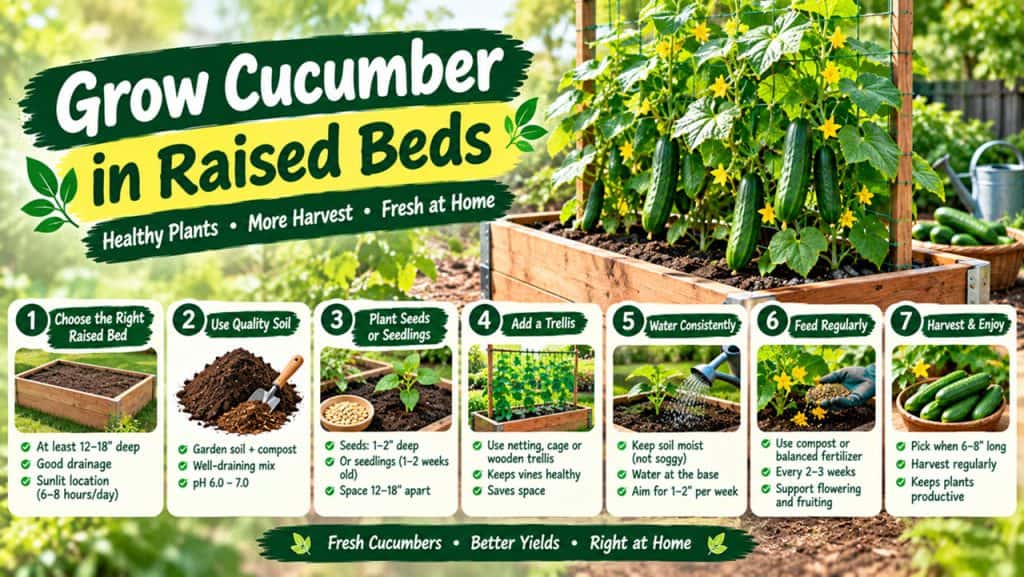
Things I Wish I’d Known Sooner
- Don’t plant until soil hits 65°F. Cold soil stunts cucumbers permanently — a plant set out too early never catches up to one planted two weeks later.
- One overripe cucumber stops the whole plant. Harvest daily and remove any yellow or oversized fruit immediately, even if you compost it.
- Never water the leaves. Overhead watering is the single fastest route to powdery and downy mildew in a raised bed.
- Rotate beds every year. Cucumber diseases overwinter in soil. I move cucurbits to a different bed on a 3-year rotation.
- Succession sow in early July. Your spring planting will fade by mid-August. A second round keeps cucumbers coming until frost.
- Trellis before you plant, not after. Driving posts into a bed full of established roots damages the shallow feeder roots cucumbers depend on.
Frequently Asked Questions
How many cucumber plants can I fit in a 4×8 raised bed?
With a trellis, plant 8 vining cucumbers 12 inches apart in a single row along the north side. Without a trellis, drop that to 3 plants spaced 36 inches apart. Bush varieties fit 8 plants in two rows at 18 to 24 inches apart.
How deep does a raised bed need to be for cucumbers?
A minimum of 10 inches, though 12 to 18 inches is better. Cucumber feeder roots stay in the top 8 inches, but a deeper bed holds moisture longer and keeps roots cooler during August heat waves.
Why are my raised bed cucumbers bitter?
Bitterness comes from cucurbitacins triggered by drought stress, temperatures above 90°F, or wildly inconsistent watering. Keep soil evenly moist with mulch and deep soakings. Peeling the fruit and trimming an inch off the stem end removes most of the bitterness.
Can I grow cucumbers in a raised bed without a trellis?
Yes, but expect roughly a third of the yield, more misshapen fruit, and powdery mildew arriving several weeks earlier. If you skip the trellis, use bush varieties and space them at least 24 inches apart for airflow.
What should I plant after cucumbers in the same raised bed?
Follow cucumbers with a legume like bush beans or peas to restore nitrogen, or a light-feeding fall crop such as lettuce, spinach, or radishes. Don’t replant any cucurbit — squash, melon, or cucumber — in that bed for at least three years.
Growing cucumbers in raised beds comes down to warm soil, generous spacing, a solid trellis, steady water, and daily harvesting. Trellis your vines and water at the base, and you’ve already solved 80% of the problems most gardeners run into. I hope you found this article helpful.
You may also like:
- The easiest vegetables to grow in raised beds
- How to plant squash in a raised bed
- Is mushroom compost good for raised vegetable beds?
- Fresh vegetable garden ideas for your backyard
- Small space vegetable gardening tips

Hello there! I’m Elsa, and gardening is my passion. As an avid gardener, I created GardeningElsa.com to share my knowledge and experience with fellow enthusiasts. My website is a comprehensive resource for gardeners of all levels, offering expert advice on a wide range of topics, including plants, flowers, herbs, and vegetable gardening. Whether you’re a beginner looking to start your first garden or a seasoned pro seeking to expand your knowledge, GardeningElsa.com has something for everyone. Read more about me.