Gardeners often debate the merits of mushroom compost versus mulch for improving their soil and plants. Both serve important roles in the garden, but they work in different ways. Mushroom compost is a nutrient-rich soil amendment that improves fertility, while mulch is a protective layer placed on top of the soil.
Mushroom compost comes from mushroom farming waste. It contains straw, manure, and mushroom mycelium. This mix creates a fertile soil additive packed with nutrients plants love. Gardeners mix it into their soil to boost plant growth and health.
Mulch, on the other hand, is any material used to cover the soil surface. It can be organic, like wood chips or straw, or inorganic, like rocks or rubber. Mulch protects soil, retains moisture, and can improve appearance. Using both compost and mulch gives gardens the best of both worlds – rich soil and a protective cover.
Understanding Mushroom Compost
Mushroom compost is a nutrient-rich soil amendment made from waste products of mushroom farming. It offers many benefits for gardening but also has some potential drawbacks to consider.
Composition and Properties
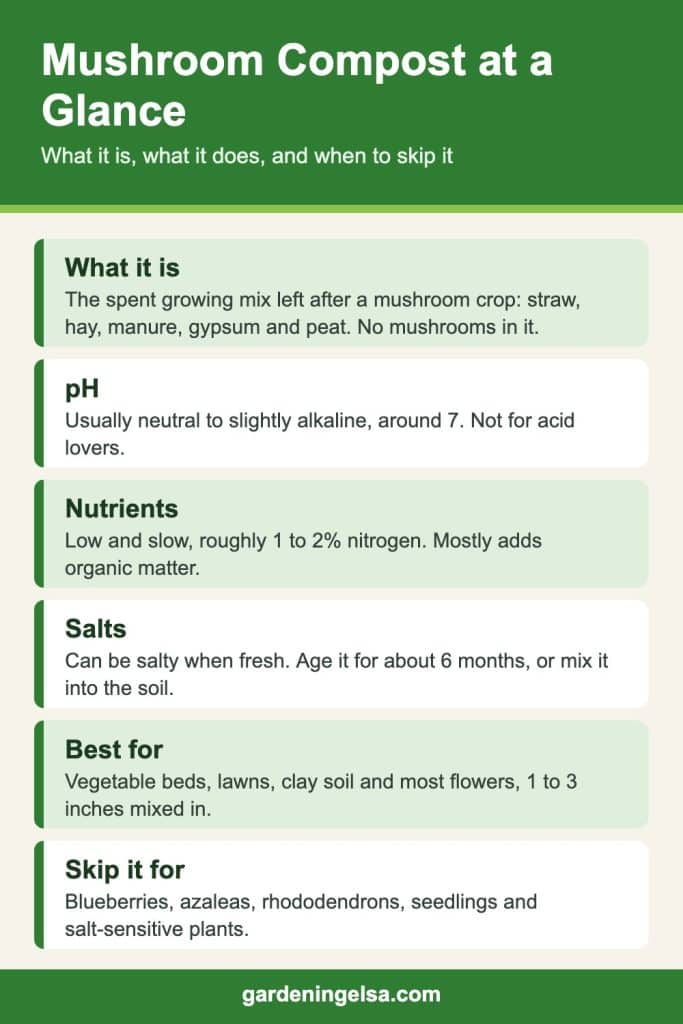
Mushroom compost is made up of organic materials like straw, manure, and gypsum. These ingredients are mixed and aged before being used to grow mushrooms. After the mushroom harvest, the leftover material becomes mushroom compost.
The compost is high in organic matter and contains important nutrients for plants. It typically has a pH level between 6.5 and 7.5, making it slightly alkaline. Mushroom compost is also full of helpful soil microbes that support plant growth.
One key feature is its high salt content. This comes from the materials used in mushroom farming. The salts can be good for some plants but may harm others.
Benefits in Gardening
Mushroom compost improves soil structure and helps retain moisture. This makes it great for sandy soils that dry out quickly. It also adds organic matter to clay soils, making them less compact.
The compost releases nutrients slowly, feeding plants over time. It’s rich in nitrogen, which helps plants grow green and leafy. Gardeners often use it to boost vegetable gardens and flower beds.
Mushroom compost can be mixed into soil or used as a top dressing. It works well for lawns, trees, and shrubs too. The compost helps suppress weeds and keeps soil temperatures steady.
Potential Drawbacks
The high salt levels in mushroom compost can damage some plants. Seedlings and young plants are most at risk. It’s best to use the compost sparingly or let it age before applying to sensitive plants.
Some gardeners find the alkaline nature of mushroom compost problematic. It may not suit plants that prefer acidic soil. In these cases, other types of compost might be a better choice.
Fresh mushroom compost can have a strong smell. This usually fades as the compost ages. The odor might be unpleasant for some people, especially when first applied.
Check out Is Mushroom Compost High in Nitrogen?
The Role of Mulch in Gardens
Mulch serves as a protective layer over soil in gardens. It offers many benefits for plant health and landscape maintenance.
Types of Mulch
Organic mulches include wood chips, bark, leaves, and straw. These break down over time, adding nutrients to the soil. Wood chips are long-lasting and good for paths or around trees. Leaf mulch works well in vegetable gardens. Straw helps retain moisture and suppresses weeds.
Inorganic mulches don’t decompose. These include rocks, gravel, and landscape fabric. They’re best for permanent landscaping areas. Rocks can help with drainage in wet spots. Landscape fabric blocks weeds but allows water through.
Some gardeners use newspaper or cardboard as mulch. These are cheap and biodegradable options.
Advantages for Soil Health
Mulch keeps soil moist by reducing water evaporation. This means less watering for gardeners. It also regulates soil temperature. Mulch insulates roots from extreme heat and cold.
Organic mulches improve soil structure as they break down. They add organic matter, which feeds beneficial soil organisms. This leads to healthier plants over time.
Mulch also stops weeds from growing. It blocks light that weed seeds need to sprout. This cuts down on the need for weeding or herbicides.
Considerations for Use
Apply mulch in a 2-4 inch layer around plants. Don’t pile it against plant stems or tree trunks. This can cause rot or pest problems. Refresh mulch yearly as it breaks down or blows away.
Organic mulches may attract pests like termites. Keep mulch at least 6 inches away from building foundations. Some mulches can affect soil pH as they decompose. Pine needles, for example, can make soil more acidic.
Cost and availability vary by mulch type. Wood chips are often free from local tree services. Bagged mulch from stores costs more but is convenient for small areas.
Check out Is Mushroom Compost Good for Raised Vegetable Beds?
Comparing Mushroom Compost and Mulch
Mushroom compost and mulch are both useful soil amendments, but they serve different purposes in gardening. Let’s look at how they compare in terms of nutrients, pH effects, and usage.
Nutrient Content and Soil Enrichment
Mushroom compost is rich in nutrients. It contains nitrogen, potassium, and calcium. These elements help plants grow strong and healthy.
Mulch, on the other hand, is not as nutrient-dense. Its main job is to protect the soil surface. It slowly breaks down over time, adding some nutrients to the soil.
Mushroom compost acts as a soil improver. It boosts soil fertility quickly. Mulch enhances soil quality gradually as it decomposes.
For fast nutrient boost, mushroom compost is better. For long-term soil health, both have benefits.
pH Impact on Soil
Mushroom compost can change soil pH. It often makes soil more alkaline. This is good for plants that like less acidic soil.
Mulch has a smaller effect on soil pH. Its impact depends on the type of mulch used. Some mulches, like pine needles, can make soil more acidic.
Gardeners should test their soil pH before using mushroom compost. This helps avoid making soil too alkaline for some plants.
Mulch is safer to use without pH testing. It won’t change soil pH as much as mushroom compost.
Usage and Application Differences
Mushroom compost is mixed into the soil. It’s great for improving topsoil quality. Gardeners often use it when planting new plants or prepping garden beds.
Mulch is spread on top of the soil. It forms a protective layer. This layer helps keep moisture in the soil and stop weeds from growing.
Apply mushroom compost once or twice a year. Mix it into the top few inches of soil. Mulch needs to be reapplied as it breaks down, usually once a year.
Mulch is better for walkways and around trees. Mushroom compost is ideal for vegetable gardens and flower beds.
Check out Is Mushroom Compost Good for Clay Soil?
Practical Guidance for Gardeners
Mushroom compost and mulch are key tools for gardeners. Used correctly, they can boost soil health and plant growth. Here’s how to get the most from these gardening allies.
How to Use Mushroom Compost Effectively
Mushroom compost is rich in nutrients. Mix it into garden soil before planting. Use 1 part compost to 3 parts soil. This improves soil structure and feeds plants.
For existing plants, spread a 1-2 inch layer around the base. Keep it away from stems to prevent rot. Mushroom compost works well for vegetables, flowers, and shrubs.
Water the area after applying compost. This helps nutrients soak into the soil. Reapply every spring for best results.
Mulching Techniques for Optimal Results
Mulch helps retain moisture and suppress weeds. Apply a 2-4 inch layer around plants. Leave a gap near stems and trunks to prevent rot.
Organic mulches like bark chips or straw break down over time. They add nutrients to the soil. Inorganic mulches like gravel last longer but don’t feed plants.
Refresh mulch yearly. Add more as it breaks down. This keeps the layer thick enough to be effective.
Balancing Compost and Mulch in a Garden
Compost and mulch work well together. Use compost to feed the soil and mulch to protect it. Apply compost first, then cover with mulch.
For new beds, mix compost into the soil. Then add a layer of mulch on top. For established plants, spread compost around the base. Cover with mulch after.
Use compost in spring to boost nutrient levels. Apply mulch in summer to retain moisture. This combination supports healthy plant growth year-round.
Check out Mushroom Compost vs Organic Compost
Economic Aspects
The choice between mushroom compost and mulch has financial implications for gardeners. Costs, availability, and the potential for DIY options are key factors to consider.
Cost Comparison
Mushroom compost is often pricier than basic mulch. A bag of mushroom compost can cost $5-10, while wood chip mulch may be $3-5 per bag. Bulk prices vary, with mushroom compost around $30-50 per cubic yard and mulch $20-40. Availability affects costs. Mushroom compost may be less common in some areas, driving up the price. Mulch is widely available and can even be free from some local sources.
Compost tea, made from steeping compost in water, offers a cost-effective way to stretch compost further. A small amount of compost can produce many gallons of nutrient-rich tea for plants.
Making Homemade Compost and Mulch
DIY options can save money for both compost and mulch. A compost heap turns kitchen scraps and yard waste into free, nutrient-rich soil. It takes time but costs nothing beyond initial setup.
Homemade compost needs:
- Green materials (food waste, grass clippings)
- Brown materials (leaves, paper)
- Water
- Air circulation
Vermicompost uses worms to speed up the process. It works well for apartment dwellers with limited space.
Mulch can be made from fallen leaves, grass clippings, or shredded paper. These free materials work just as well as store-bought options for many garden needs.
Read Is Mushroom Compost Good for Flowers?
Mushroom Compost vs Mulch – Summary
Mushroom compost and mulch serve different purposes in gardening. This table summarizes their key differences:
| Aspect | Mushroom Compost | Mulch |
|---|---|---|
| Primary Use | Soil amendment | Surface cover |
| Composition | Spent mushroom growing medium | Organic or inorganic materials |
| Nutrient Content | High in nutrients | Low to moderate nutrients |
| Soil Improvement | Enhances soil structure and fertility | Minimal direct soil improvement |
| Moisture Retention | Improves water retention in soil | Reduces soil moisture evaporation |
| Weed Control | Limited weed suppression | Effective weed barrier |
| Application | Mixed into soil | Applied on soil surface |
| pH Level | Slightly alkaline | Varies by material |
| Cost | Generally more expensive | Often less expensive |
| Availability | May be limited in some areas | Widely available |
Mushroom compost boosts soil fertility and structure. It works well for improving poor soils and preparing garden beds.
Mulch protects soil, regulates temperature, and prevents weeds. It’s ideal for maintaining established gardens and landscaping.
Both products can benefit plants, but they’re used differently. Gardeners often use them together for optimal results.

Conclusion
Mushroom compost and mulch serve different purposes in gardening. Mushroom compost is a nutrient-rich soil amendment that improves soil quality and plant growth. It can be mixed into soil or used as a top dressing.
Mulch, on the other hand, is a protective layer spread on top of soil. It helps retain moisture, suppress weeds, and regulate soil temperature. Mulch can be organic or inorganic materials.
While mushroom compost can be used as mulch, it’s best suited for perennials, trees, and shrubs. For annual plants, it’s better to mix into the soil before planting.
Both mushroom compost and mulch offer benefits to gardens. Mushroom compost provides nutrients and improves soil structure. Mulch protects soil and plants while slowly breaking down to add organic matter.
Gardeners can use both products to create healthy, thriving gardens. The choice depends on specific plant needs and garden goals. Using mushroom compost as a soil amendment and a separate mulch layer often gives the best results.

Hello there! I’m Elsa, and gardening is my passion. As an avid gardener, I created GardeningElsa.com to share my knowledge and experience with fellow enthusiasts. My website is a comprehensive resource for gardeners of all levels, offering expert advice on a wide range of topics, including plants, flowers, herbs, and vegetable gardening. Whether you’re a beginner looking to start your first garden or a seasoned pro seeking to expand your knowledge, GardeningElsa.com has something for everyone. Read more about me.