
You can’t grow a new air plant from a leaf or stem cutting. Air plants (Tillandsia) don’t root from pieces the way pothos or succulents do.
The way to grow air plants from cuttings is to separate the pups, the baby plants that form at the base of a mature plant after it blooms, once they reach one-third to one-half the size of their mother.
That’s good news, because pups do most of the work for you. A healthy air plant can produce anywhere from 1 to 8 of them. With a little patience and a gentle twist, one plant becomes a small collection.
The Short Answer: Use Pups, Not Cuttings
Pups are the only practical way for a home gardener to multiply air plants. A pup is a complete, growing plant with its own center, so it keeps living after you remove it.
A loose leaf is a different story. It has no growing point, so it can’t make new leaves or roots. It will slowly dry out or rot no matter how carefully you treat it.
Here’s how the common methods compare:
| Method | Works for air plants? | Time to a full-size plant |
|---|---|---|
| Leaf cutting | No | Never forms a plant |
| Stem cutting | No | Air plants have no stem to cut |
| Separating pups | Yes | 1 to 3+ years to bloom size |
| Seed | Yes, but slow | Many years |
When people talk about air plant “cuttings,” they almost always mean pups that were cut free with scissors. That’s the method I recommend, and the rest of this page shows you how to do it well.
What Are Air Plant Pups?
Pups are small clones of the mother plant that grow from her base, often tucked between or under the lowest leaves. They match the parent exactly, and in time they flower and make pups of their own.
How Do Pups Differ From Leaves and Roots?
A pup has its own rosette, which is the circle of leaves around a central growing point. New leaves keep coming from that center, the same way they do on an adult plant.
A leaf is just one part of the plant with no center at all. Roots on air plants are wiry and short, and their only job is to anchor the plant to a branch or rock. Neither one can turn into a new plant.

You can tell a pup by its shape. Even when it’s tiny, it looks like a miniature version of the mother, with leaves pointing out from one spot.
Why Can a Pup Grow Without Soil?
Air plants are epiphytes, meaning they grow on trees, rocks, or even wires without taking anything from them. Tiny scales on the leaves called trichomes soak up water and nutrients from rain, mist, and dust in the air.
A pup has those same scales from the start. Once it’s big enough, it can drink and feed on its own, so it never needs soil or a pot.

That’s why you can set a separated pup on a shelf or a piece of wood and it keeps growing.
When Do Air Plants Produce Pups?
Most air plants make pups during or right after they bloom. Each plant flowers only once in its life, so the bloom is your signal that babies are on the way.
What Happens After the Mother Plant Flowers?
Many types blush red or pink before and during bloom, especially T. ionantha. Then a flower spike appears, and the bloom can last a few days or many months depending on the species.
Once flowering starts, the plant shifts its energy into making pups. Small bumps show up at the base and slowly turn into tiny rosettes. On some varieties, pups also form along the flower stalk.
The mother doesn’t die right away. She declines slowly over months to a couple of years while feeding her pups. You can read more about this stage in my guide to air plants after flowering.
How Many Pups Might Appear?
Expect anywhere from 1 to 8 pups, depending on the species and how well the plant has been cared for. Many common types settle somewhere around 2 or 3.
Pups don’t all arrive at once. You might spot one, then another a few months later. Look under dry lower leaves too, since pups like to hide there. Be careful not to pull those leaves off by accident.
When Is a Pup Ready to Separate?
A pup is ready when it’s one-third to one-half the size of its mother and feels firm. Size tells you it has enough stored energy to live on its own.
Look for a Pup One-Third to One-Half the Parent’s Size
You don’t need a ruler. Set the two plants side by side and compare. If the pup is still a small green nub, leave it alone.
A ready pup has a clear rosette shape and several full leaves. It should look plump and evenly colored for its type, with no soft or brown spots at the base.
Pulling a pup too early is the most common mistake I see. A tiny pup still depends on the mother for food and water, and it often stalls or shrivels once it’s cut off.

Why Waiting Longer Can Make Separation Easier
Bigger pups come away more cleanly. As a pup grows, the connection to the mother loosens, and sometimes it pops free with almost no effort.
A larger pup also handles the stress of separation better. It has more leaves to catch water and more stored food to fall back on. If you’re unsure, give it another month or two.
There’s no harm in waiting past the halfway mark. The only real downside is that the mother’s base gets more crowded and holds water longer after a soak.
How Do You Separate a Pup Safely?
Hold both plants at their bases, then gently twist the pup free or snip it off with clean scissors. Go slowly so neither plant tears.
Find the Connection and Support Both Plants
Lay the mother plant on a clean towel or hold her in one hand. Peel back any dry lower leaves so you can see exactly where the pup joins her base.
Grip the pup near its bottom, never by the leaf tips. Keep your other hand firmly on the mother’s base so you don’t bend or crush her leaves.
Twist Gently or Cut With Clean Scissors
Turn the pup slowly, wiggling it side to side a few times. If it’s ready, it will release with a light tug.
If it resists, stop pulling. Wipe a pair of sharp scissors or a small knife with rubbing alcohol and let it dry. Then make one clean cut as close to the connection as you can without slicing into the center of either plant.
After separating, set both plants in a bright, airy spot for a few hours to a couple of days so the cut ends dry and seal before you water.
What to Do If the Base Tears
A small tear isn’t a disaster. Trim away any ragged bits with your clean blade so the edge is smooth.
Keep the torn area dry for 2 to 3 days. Water trapped in an open wound invites rot. When you do water again, shake the plant well and dry it upside down so no water sits at the base.
Watch both plants for the next few weeks. A dark, mushy base or leaves falling from the center means rot has set in.
Should You Leave the Pups to Form a Clump?
You don’t have to separate pups at all. Left in place, they grow into a clump, and many growers prize these clusters over single plants.
When Keeping the Family Together Makes Sense
A clump makes sense if you want a bigger, fuller display. Over time the pups bloom and make pups too, and you can end up with a ball of plants that flowers in waves.
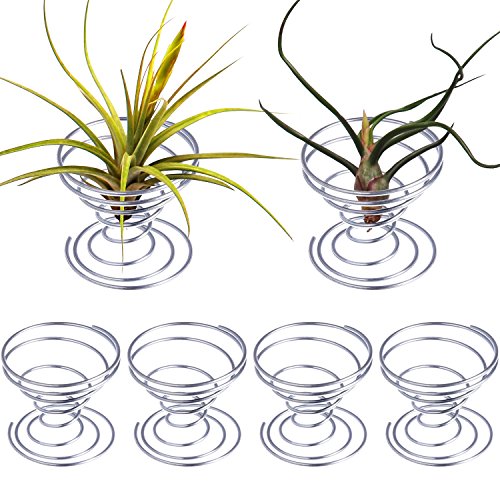
Some types clump especially well, including T. ionantha and its many forms, plus T. bergeri and T. schiedeana. A clump also spares you the risk of tearing a pup during removal.
The tradeoff is drying time. Dense clumps hold water in the middle, so give them a firm shake after watering and a spot with good airflow. Gently pull out the old mother once she turns brown and dry.
How to Mount a Growing Clump
Pick a mount with room to grow. Driftwood, cork bark, and stone all work well. Avoid pressure-treated wood, and never use copper wire, because copper is toxic to air plants.
Secure the clump with fishing line or non-copper wire, or glue only the very bottom with a waterproof, plant-safe glue. Keep glue off the leaves and let it cure before watering.
My guide on how to attach air plants to wood covers this step by step.
Mounted clumps are easiest to water by misting thoroughly 2 to 3 times a week, or by dunking the whole piece if the mount can handle it.
How Do You Care for a Newly Separated Pup?
Treat a new pup much like an adult plant, with a gentle first few days. Give it bright indirect light, steady water, and fast drying.
Give It Gentle Light and Good Airflow
Place the pup in bright indirect light, such as near an east window or a few feet back from a south or west one. Hot afternoon sun through glass can scorch young leaves.
Skip closed containers and stuffy corners. Moving air helps the pup dry quickly after watering, which is the best defense against rot.
If you grow under lights, a full-spectrum LED about 6 to 12 inches away for roughly 12 hours a day works well. More detail is in my post on air plant light needs.
Keep temperatures between 50 and 90°F, and bring any outdoor plants inside when nights drop below about 50°F.
Water It, Then Let the Base Dry Completely
Hold off on water for the first 2 to 3 days after a cut. After that, soak the pup for 20 to 30 minutes once a week.
Shake it gently, then set it upside down or on its side. The leaves should be fully dry within about 4 hours. Water in the morning so it has the whole day to dry.
Use rainwater, bottled spring water, or filtered or dechlorinated tap water. My full air plant care guide covers watering routines in more depth.
Adjust Care for Dry Homes and Different Air Plant Types
In very dry homes, such as heated houses in the Northeast and Midwest in winter or homes in the Southwest, add a light misting between weekly soaks. Humidity of 40 to 60% is nice, though airflow counts for more.
Silvery, fuzzy types like T. xerographica and T. tectorum handle more light and less water. Give them a quick dunk or rinse in place of a long soak. Greener types like T. bulbosa and T. brachycaulos want softer light and a bit more water.
If you live in USDA zones 9b to 11, pups can grow outdoors year-round