
Your rosemary tree looked perfect at the store, and now it’s browning, dropping needles or going soft at the base. The usual cause is a root ball that dried out completely once.
The next most likely are roots kept soggy inside a foil wrap, and a window too dim for a sun-loving Mediterranean shrub.
Start with this check: lift the pot. A healthy, watered 6-inch rosemary feels solidly heavy. If it feels as light as an empty pot, the roots are dry. If it’s heavy and the soil smells sour, they’ve been wet too long.
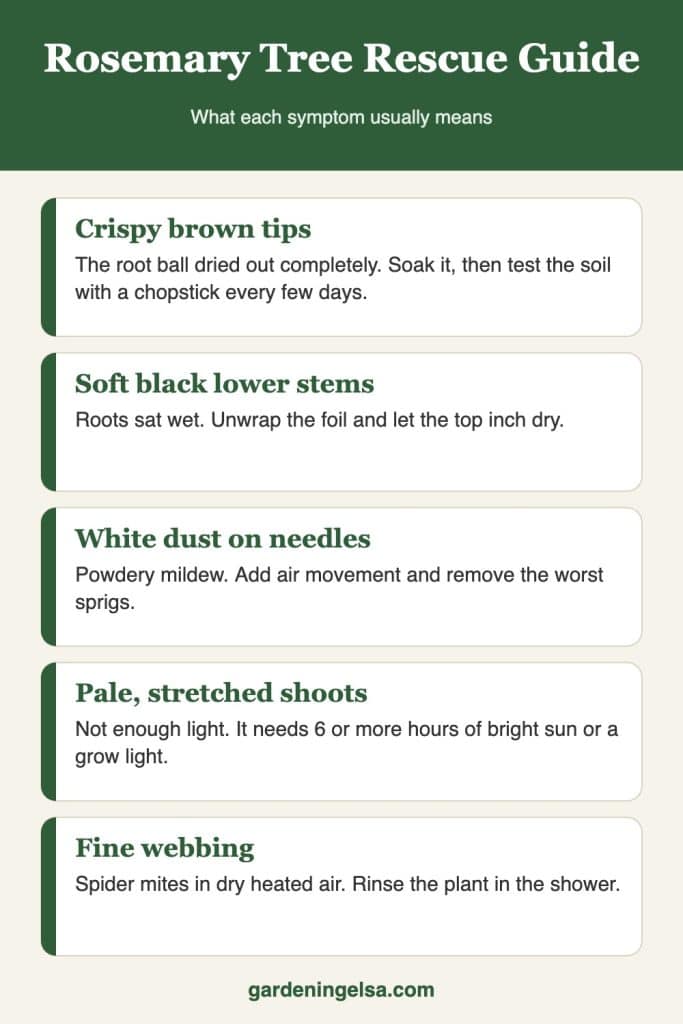
Read the Symptom First
| If you see… | It usually means… | Go to |
|---|---|---|
| Brown, crispy needle tips, starting on one side | Root ball dried out | Brown and Crispy From the Tips |
| Whole branches gray-brown and brittle | Dried out, and those stems are gone | Brown and Crispy From the Tips |
| Soft, blackened stems near the soil | Roots sat in water | Soft Base and a Sour Smell |
| White powder on needles and stems | Powdery mildew | White Dust on the Needles |
| Pale new shoots with gaps between needles | Too little light | Stretched, Pale New Growth |
| Speckled needles, fine webbing | Spider mites | Webbing or Sticky Needles |
Rosemary hides thirst. It doesn’t droop like a basil plant. By the time the needles show it, a dry root ball has already killed part of the plant.
A cheap moisture meter helps here, or a plain wooden chopstick. Push either one halfway down the pot every few days. Water when the meter drops into its dry band or the chopstick comes out clean and dry.

Brown and Crispy From the Tips
This is the big one. Rosemary, now classified as Salvia rosmarinus, is a Mediterranean shrub that tolerates drought outdoors, but not in a tiny pot.
It’s the most common way a holiday rosemary dies, and it happens fast. These plants are grown tight and rootbound, so a 6-inch pot can go from wet to bone dry in 3 or 4 days in a heated room.
Check: scratch a brown stem with a fingernail. Green under the bark means it’s alive. Tan and dry all the way through means that stem is dead.
What to do: if the root ball has pulled away from the pot sides, set the whole pot in a bowl of water for 20 minutes, then drain it well.
After that, water whenever the chopstick comes out dry from halfway down, which in a warm, sunny room can be every few days. Cut dead stems back to green wood.
How long: living stems show fresh green tips in 3 to 4 weeks. Dead ones never come back, so expect a lopsided tree for a while.
Soft Base and a Sour Smell
The opposite problem, and just as deadly. Most rosemary trees come wrapped in foil or plastic sleeves that catch every drop of water. The roots sit in a puddle, rot, and the plant browns from the base up.
Quick check: tip the pot and look in the sleeve. Standing water means rot is starting.
What to do: take the foil off, or poke drainage holes through it. Let the top inch of soil dry before watering again. If the roots are brown and mushy when you slide the plant out, trim the worst.
Repot into a terracotta pot one size up with a gritty mix: 2 parts potting soil to 1 part perlite or coarse sand. Clay dries faster than plastic, which suits rosemary.

How long: if a third or more of the roots are healthy and white, the plant usually steadies in 2 to 3 weeks.
Stretched, Pale New Growth
Rosemary needs at least 6 hours of bright light. Indoors in December, only a south-facing window comes close, and in most homes a grow light has to make up the rest.
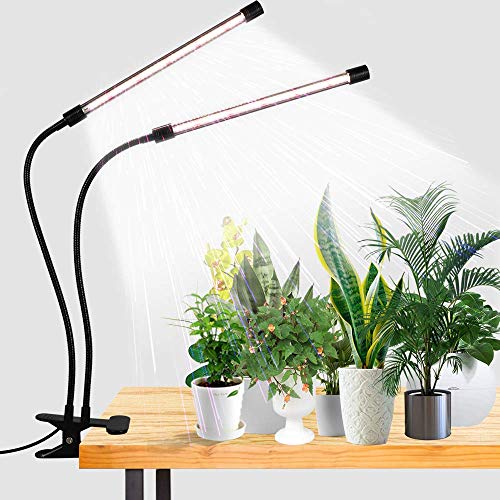
Anywhere else, new shoots grow long, thin and pale, and the cone loses its shape.
Quick check: hold your hand a foot above the plant at noon. If it casts a crisp, dark shadow, the light is decent. A faint, fuzzy shadow means it’s too dim.
What to do: move it into the brightest south window, close to the glass but not touching it.
If that isn’t possible, a grow light set 6 to 12 inches above the top for 12 to 14 hours a day solves it. Our indoor lighting roundup compares the common types.
How long: growth tightens up within a few weeks. Trim the cone every few weeks, never more than a third at once, and cook with what you cut; it’s the same culinary herb.
White Dust on the Needles
Powdery mildew. Annoying, rarely fatal. It looks like a fine dusting of flour that rubs off between your fingers. Still air is the trigger: a tree crowded among other plants, in low light, with damp air trapped between the stems.
Snip off the worst sprigs and throw them out, then give the plant some breathing room where air moves. A small fan on low a few feet away for a few hours a day is enough.
Water the soil, never the foliage, and new growth should come in clean within 2 to 3 weeks. Old spots don’t wash off.
Our guide to powdery mildew on indoor plants covers sprays if it keeps spreading.
Webbing or Sticky Needles
Dry heated air brings spider mites, which show up as faint pale dots on the needles and threads strung between them. Aphids and whiteflies leave sticky residue instead.
Either way, rinse the plant in a lukewarm shower, holding the soil in with a plastic bag. Repeat every 4 or 5 days for 2 weeks.
Our page on spider mites on houseplants has follow-up steps if they return.
This Part Is Normal
A few brown needles inside the cone, where light never reaches, are normal. So is a light needle drop in the first week after you bring it home. Store-sheared trees were grown in greenhouse light, and a house is a shock.
Slow growth from December to February is normal too.
Rosemary rests in short days, and it rests best cool: 60 to 65°F by day and 40 to 50°F at night, which an unheated sunroom or a bright spot near a cool window gives you. Don’t feed it until spring.
When to Start Over
If more than half the stems are brown and brittle all the way through, the plant won’t fill back in this winter. If the base of the main stem is soft and black, the roots are gone.
Before you toss it, take cuttings from any green tips: 4 inches long, lower needles stripped, pushed into damp perlite or seed-starting mix. They root in 3 to 6 weeks.
Or keep the green parts as kitchen rosemary and buy a fresh plant. The ASPCA lists rosemary as non-toxic to cats and dogs, so trimmings around pets aren’t a worry.
Next Season, Do This First
- Remove the foil sleeve on day one.
- Put it in your sunniest south window, or under a light.
- Lift the pot every few days and water before it gets light.
- Keep it in the coolest bright room, ideally 60 to 65°F by day and 40 to 50°F at night.
- Move it outdoors after the last spring frost, and bring it in before nights drop below 30°F if you’re colder than Zone 8.
For keeping it going year-round, see growing herbs indoors and our tips for overwintering potted plants. If you also have a cut tree this year, the fresh tree care routine keeps it green until you take it down.
What Else Could Be Wrong With Your Rosemary Tree?
Could the heat vent be the problem?
Yes. A tree within 3 feet of a register or radiator dries out in half the time. It looks like the crispy-tip pattern, but on the side facing the heat. Move it. That alone often fixes it.
Could it be too cold by the window?
Rarely. Rosemary handles 40°F without trouble. Needles pressed against frozen glass can scorch, though, so keep an inch or two of space.
Can fertilizer burn a rosemary tree?
It can. Feeding a plant that isn’t growing in winter builds salts that brown needle tips. Skip fertilizer until new spring growth, then use half strength once a month.
Could the string lights be drying it out?
They can, if they’re old incandescent mini bulbs. Those run warm enough to scorch the needles they touch. Use LED strands only, and switch them off at night.
Will it survive outdoors where I live?
Most rosemary is hardy in Zones 8 to 10. A few cultivars, such as ‘Arp’ and ‘Madalene Hill’ (often sold as ‘Hill Hardy’), survive Zone 7 winters in a sheltered, well-drained spot, and often Zone 6 with mulch. Holiday trees are rarely labeled with a cultivar, so don’t count on it. In Zone 6 and colder, keep it in a pot and bring it in for winter.

Hello there! I’m Elsa, and gardening is my passion. As an avid gardener, I created GardeningElsa.com to share my knowledge and experience with fellow enthusiasts. My website is a comprehensive resource for gardeners of all levels, offering expert advice on a wide range of topics, including plants, flowers, herbs, and vegetable gardening. Whether you’re a beginner looking to start your first garden or a seasoned pro seeking to expand your knowledge, GardeningElsa.com has something for everyone. Read more about me.