
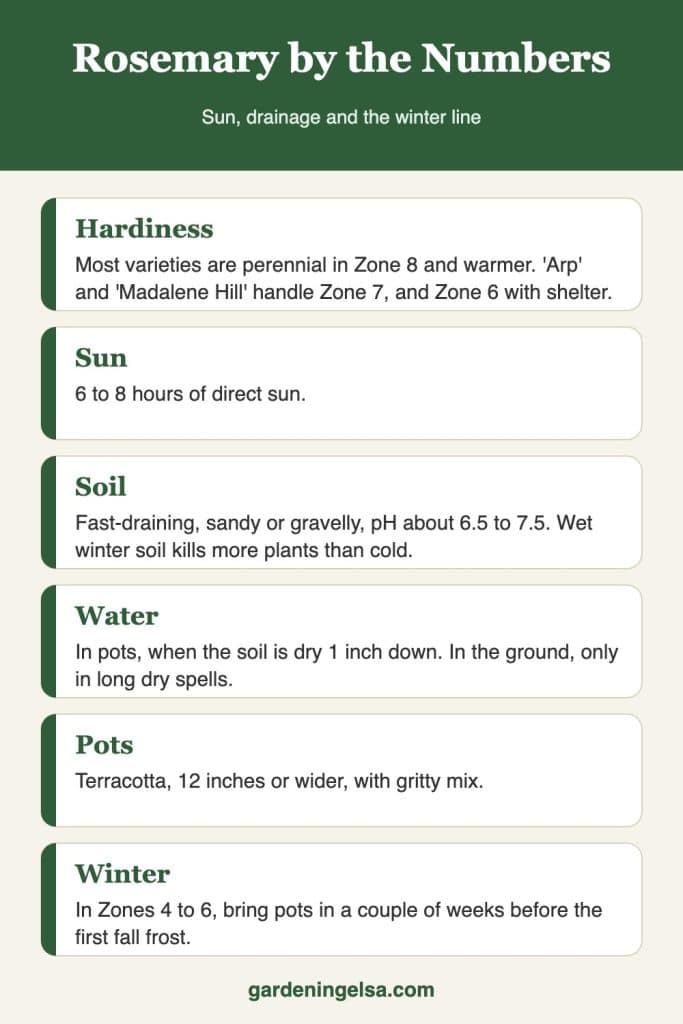
Rosemary stays outdoors year-round in Zone 8 and warmer, where winter lows bottom out between 10 and 20°F, and the hardiest varieties get through most Zone 7 winters, where lows reach 0 to 10°F.
Colder than that, grow it in a pot and bring it inside for winter.
In every zone it needs at least 6 hours of direct sun, 8 is better, and soil that drains fast. Wet roots in winter kill more rosemary than cold does.
By zone: Zones 4 to 6 grow it in pots and bring it in, Zone 7 plants a hardy variety in a sheltered spot, Zones 8 to 10 grow it as a shrub, and the humid Gulf Coast mostly fights drainage.
Where You Garden Decides How You Grow It
| Zone band | Hardiness | What to do | Watch out for |
|---|---|---|---|
| 3 to 5 | Won’t survive outdoors | Grow in a pot and bring it in before frost | Dim light and overwatering indoors |
| 6 | Only ‘Arp’ or ‘Madalene Hill’, heavily sheltered | Pots are safer. If planted, use a south wall | Wind and freeze-thaw |
| 7 | Hardy varieties survive most winters | Plant in spring so roots settle before winter | A single night near 0°F |
| 8 to 9 | Most varieties are perennial shrubs | Plant in spring or fall | Heavy clay and wet winters |
| 10 to 11 | Grows year-round | Fall planting is ideal | Summer root rot in humid areas |
In cold zones, the pot matters as much as the plant. A terracotta pot breathes and dries evenly, which is exactly what rosemary roots want. Go at least 12 inches wide, so the soil doesn’t dry to dust in a July heat wave.

You’ll see rosemary sold as Salvia rosmarinus as well as the older Rosmarinus officinalis. Botanists moved it into the sage genus in 2017. It’s the same plant.
How Cold Is Too Cold?
Most rosemary takes a light frost in stride, and the common upright types usually come through nights in the high teens once established. Below about 10°F, most varieties die back hard or die outright.
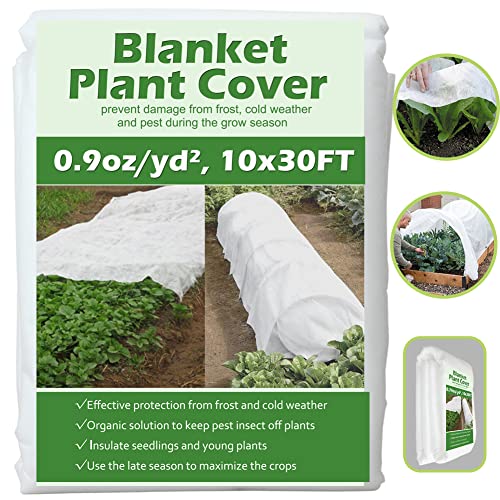
On the odd night that dips toward that line, frost cloth over the plant buys a few degrees.
‘Arp’ and ‘Madalene Hill’ are the toughest. (‘Hill Hardy’ on a tag is usually ‘Madalene Hill’ under another name.)
Nursery tags often promise -10°F for them. I’d treat that as optimistic: count on Zone 7, and Zone 6 only in a sheltered, well-drained spot. Creeping types such as ‘Huntington Carpet’ are the least hardy, so treat them as Zone 8 plants.
Zone note: a south or west wall can run several degrees warmer than an open bed on a still winter night, and it keeps the soil drier. In Zones 6 and 7, that wall often decides whether the plant lives.
Cold Zones (4 to 6): Grow It in a Pot
North of Zone 7, rosemary is a patio plant that winters indoors.
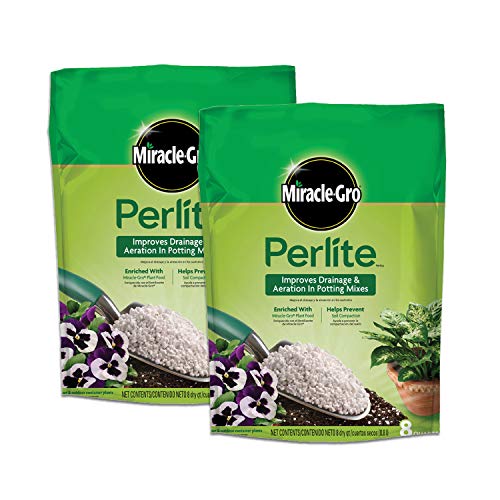
Use a gritty mix: roughly a third perlite stirred into regular potting mix, or a bagged cactus mix straight from the bag. Pot it in spring after your last frost and give it your sunniest spot.
Bring it inside a couple of weeks before your first fall frost date, usually early to mid-September in Zone 4, late September in Zone 5 and early October in Zone 6.
Indoors, it wants your brightest south or west window and a cool room, around 60°F by day and 45 to 50°F at night.
Water when the soil is dry 1 inch down, which can be every 2 to 3 weeks in winter. Skip the misting; damp needles invite powdery mildew.
Good air movement helps far more.
If your brightest window feels dim, add a grow light about a hand’s width above the tips and put it on a timer from 7 a.m. to 8 p.m.
The sheared plants sold in December have their own troubles, covered in our rosemary Christmas tree guide. To move pots in without pests, see how to bring plants indoors for winter.
Zone 7: Pick the Variety and the Spot
Zone 7 is where in-ground rosemary becomes realistic. Plant ‘Arp’ or ‘Madalene Hill’ in spring, after your last frost, so it has a full season to root before winter.
A raised bed, a slope or the base of a south-facing wall all help. Mulch with gravel rather than shredded bark, which holds moisture against the stems.
When a hard freeze is forecast, cover young plants overnight. Drape frost cloth all the way to the ground and pin the edges, so it traps heat rising from the soil, then remove it the next morning.
Stop heavy pruning about 6 weeks before your first fall frost, because fresh soft growth freezes first.
The South, Gulf Coast and West (8 to 10)
Here rosemary grows into a shrub 3 to 6 feet tall, and the problem is water, not cold.
Heavy clay calls for a mound or a raised bed. Along the Gulf Coast and in Florida, summer humidity brings root rot and fungal dieback.
Space plants 2 to 3 feet apart for airflow and keep it off the drip line you run for thirstier plants.
Fall is the best planting time in Zones 9 and 10, so roots grow through the mild winter. In the dry West and Southwest, rosemary is one of the toughest low-water shrubs you can grow, and alkaline soil suits it.
Planting, Watering and Pruning
Plant at the same depth it grew in the nursery pot and water deeply. Water every few days for 2 to 3 weeks while roots settle. After that, in-ground rosemary needs water only during long dry spells.
Skip fertilizer for in-ground plants. A potted plant gets one light feeding in spring.
Harvest or trim no more than a third of the plant at a time, cutting into green, leafy stems. Shape it in spring after flowering. Don’t cut back into old bare wood, because rosemary rarely sprouts from there.
Cuttings Beat Seed
Rosemary seed is slow and unreliable: often only about 1 seed in 3 sprouts, even at 80 to 85°F, and seedlings take a year or more to reach a real harvest. Named varieties also don’t come true from seed.
Cuttings are easy. In late spring or summer, take 4 to 6 inch soft tips, strip the lower 2 inches of needles and push them into damp, gritty mix.
Keep them in bright shade at 70 to 75°F. Most root in 2 to 4 weeks with bottom heat and take longer without it.
When the Calendar Lies
A warm October followed by a sudden 15°F night does more damage than a slow cooldown, because the plant never hardened off. From mid-fall, watch the 10-day forecast and cover or move plants ahead of the first hard freeze.
In spring, wait until nights stay above about 40°F before setting pots out for good. And in Zones 7 and 8, rosemary often looks bronzed by February.
Bend a thin twig. If it flexes before it snaps and the core is moist, it’s alive, so wait for new growth in April before cutting anything out.
Mark Your Calendar
- Early spring: plant in Zones 7 and 8. Move pots outside once nights stay above 40°F.
- Late spring: shape plants after flowering and take cuttings.
- 6 weeks before first frost: stop heavy pruning in Zones 6 and 7.
- 2 weeks before first frost: bring pots indoors in Zones 4 to 6.
For neighbors in a sunny, dry bed, see our guide to growing lavender and our picks for the best herbs to grow in pots. Just don’t pot rosemary with mint, which needs constant moisture.
Timing and Climate Questions About Rosemary
Can rosemary survive winter in a pot outdoors?
Only in Zones 8 and warmer. Roots in a pot are far more exposed than roots in the ground, so a pot left out in Zone 7 can freeze solid even when the same plant in a bed would live. Move it against the house or into an unheated garage.
Does snow hurt rosemary?
Snow itself is fine, and a blanket of it insulates the base. The damage comes from the clear, cold night that follows and from wet, heavy snow splitting the branches. Brush it off gently with a broom after a storm, and cover the plant before a still night below 15°F.
When does rosemary flower?
Mostly late winter through spring in mild zones, often with a lighter round in fall. Flowers are usually pale blue, though some varieties are white or pink.
Is rosemary safe for pets?
The ASPCA lists rosemary as non-toxic to dogs, cats and horses. A pet that eats a lot of any plant can still get an upset stomach.
Does rosemary grow in the Pacific Northwest?
Yes, in Zone 8 west of the Cascades, in a raised bed or on a slope. The cold is mild there. Steady winter rain is the real threat, so drainage matters more than variety.

Hello there! I’m Elsa, and gardening is my passion. As an avid gardener, I created GardeningElsa.com to share my knowledge and experience with fellow enthusiasts. My website is a comprehensive resource for gardeners of all levels, offering expert advice on a wide range of topics, including plants, flowers, herbs, and vegetable gardening. Whether you’re a beginner looking to start your first garden or a seasoned pro seeking to expand your knowledge, GardeningElsa.com has something for everyone. Read more about me.