
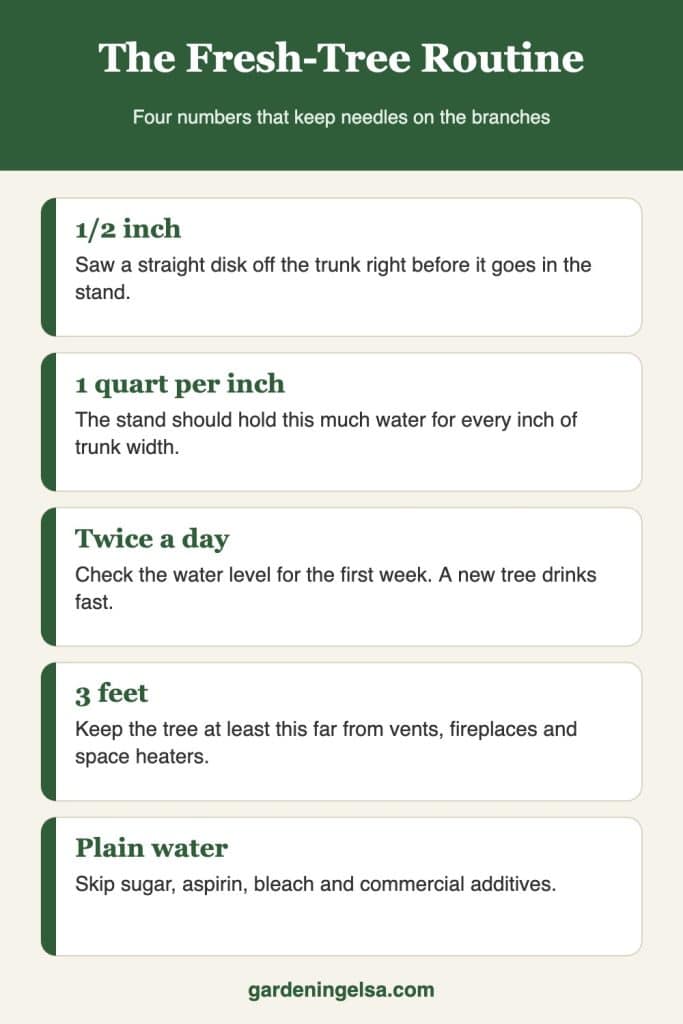
Start here: saw a 1/2-inch disk off the trunk, set the tree in a stand that holds 1 quart of water per inch of trunk width, and never let the water drop below the cut.
Keep it 3 feet from heat, and a fresh-cut tree usually stays green for 3 to 5 weeks.
This is for cut trees from a lot, a farm or a big-box garden center. Living trees in a root ball get their own section near the end.
What You’ll Need
- A tree stand with a reservoir of 1 gallon or more
- A folding saw or bow saw with a sharp blade
- Plain tap water, about a gallon on day one
- A long-spout watering can or a watering funnel
- A tree skirt or towel to catch drips
- A tree disposal bag for January
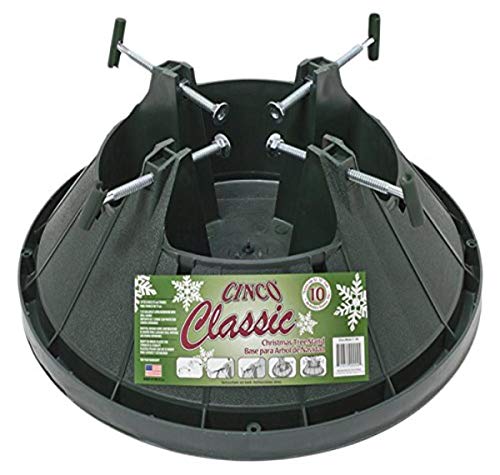
The stand matters more than anything else on the list. Measure the trunk at the lot, then buy the stand that fits it:
| Trunk width | Stand should hold | Day-one drink |
|---|---|---|
| 3 inches | 3 quarts | Up to 3 quarts |
| 4 inches | 1 gallon | About 1 gallon |
| 5 inches | 5 quarts | Up to 5 quarts |
| 6 inches | 1.5 gallons | Up to 1.5 gallons |
Many cheap stands hold less than half of that. A tree stand with a wide, deep bowl buys you a full day between top-ups.
Take a folding saw to the lot too, or use the lot’s saw if they’ll let you. Then you can make the fresh cut at home, right before the tree goes in.
Picking the Tree
Fresh beats species. A just-cut white pine outlasts a Fraser fir that sat on a lot since early November.
Run your hand along a branch toward you. A fresh tree drops a few needles, not a handful.
Bend a needle: fir and spruce needles should bend, not snap. Lift the tree a few inches and drop it on its trunk.
Some brown needles from the inside will fall. That’s normal.
Green needles raining down is not.
For needle hold, Fraser fir, noble fir and Nordmann fir are the best bets. Douglas fir and balsam fir smell wonderful and hold well if watered. Spruces drop faster once they dry, and blue spruce needles are sharp enough to make decorating a chore.
Measure your ceiling before you go. You want the top of the tree, plus the stand, plus the topper, at least 6 inches under it.
The Fresh Cut
A cut trunk seals itself with sap within a few hours. Once sealed, it can’t take up water, so the tree dries out even standing in a full stand.
Use the folding saw to take a straight disk, 1/2 to 1 inch thick, off the base. Cut straight across.

Don’t cut a V, don’t drill holes, and don’t whittle the bark off to fit a small stand. All three reduce how much water the trunk can draw.
Shortcut: if the lot makes the fresh cut for you, most trees still drink if they’re in water within 6 hours of that cut, so you can skip cutting again at home. Sooner is safer, because some trunks seal faster.
Stand it in a bucket in the garage if decorating has to wait.
Setting It Up
Pick the spot first. At least 3 feet from heat vents, radiators, fireplaces, wood stoves and space heaters, and out of a sunny south window. Heat dries the needles fast and raises the fire risk.
Set the stand, add the tree, tighten the screws evenly, and fill the bowl right away.
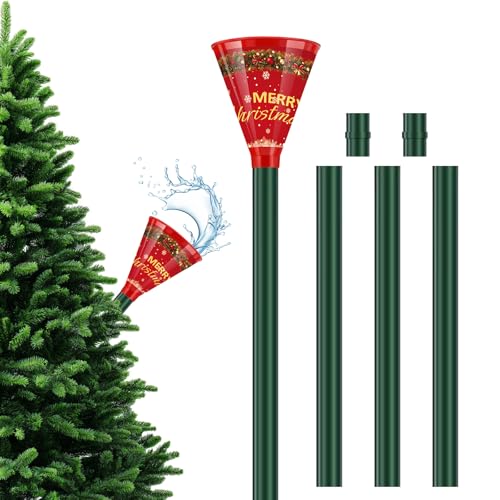
While the branches are still bare, clip a watering funnel to a back branch near the trunk, with its tube running down into the bowl. A cooler room helps.
A tree in a 65°F room drinks less and holds its needles longer than one at 72°F.
Use LED lights. They run cool. Turn the lights off when you go to bed or leave the house, and throw out any strand with cracked sockets or bare wire.
Watering
A fresh tree can drink up to a quart per inch of trunk in the first 24 hours. Check the level in the morning and in the evening for the first week. After that, once a day is usually enough.
Plain tap water is all it needs. Sugar, aspirin, bleach, soda and commercial tree preservatives don’t keep it fresher than water.
The one thing that matters is that the water never drops below the base of the trunk. If it does, even once, the cut can seal, and the tree may stop drinking.
Bending under a decorated tree with a pitcher is how water ends up on the floor. With the funnel in place, you pour from standing height, straight into the bowl.
Keeping It Going
Go by the water line.
Try this test: mark the level on the inside of the bowl with a crayon at bedtime. If it hasn’t dropped at all in 24 hours during the first two weeks, the cut has probably sealed.
In that case, a fresh cut is the only real fix, and it means taking the tree out of the stand, which few people want to do in mid-December.
Feel the needles once a week. If they’re brittle and drop when you brush past, the tree is dry. Dry trees catch fire easily, so take it down rather than pushing to New Year’s.
If you have a cat or a dog, cover the stand bowl. Pets drink tree water, which grows bacteria, and they chew low branches.
The ASPCA warns that fir oils can irritate a pet’s mouth and stomach, and that needles don’t digest. If you keep other holiday plants, check our page on whether poinsettias are poisonous to pets.
Living Trees in a Root Ball
A balled-and-burlapped or potted tree you plan to plant afterward needs a different plan. Keep it indoors no more than 5 to 7 days, in the coolest room you have.
Much longer and it starts to break dormancy, and new growth that starts in a warm house gets killed outdoors.
Move it to an unheated garage for 2 or 3 days on the way in and on the way out, so it doesn’t go straight from 20°F to 70°F and back.
Keep the root ball moist, not soggy. Dig the planting hole before the ground freezes: in October in Zones 3 and 4, and in November in Zones 5 and 6. Cover the pile of soil so it stays workable.
Shortcuts That Work (and One That Doesn’t)
Work: buying the tree in the first week of December rather than the weekend after Thanksgiving, if you want it fresh on Christmas Day. Getting a stand bigger than you think you need.
Keeping a pitcher of water next to the tree so topping up takes 10 seconds.
Doesn’t: any additive. Plain water works as well, and some homemade mixes, especially sugar, can grow mold and gum up the cut.
After the Holidays
Strip every hook, ornament and strand of tinsel. Slide a tree disposal bag over the top before you move it, and you’ll carry out the needles instead of vacuuming them for a month.
Many US cities pick up trees curbside for a few weeks in January and chip them into mulch. Check your city’s dates.
If you have a yard, cut the branches and lay them over perennial beds as winter cover, or chop them into a compost pile. Our guide to starting a compost pile explains how much woody material to mix in.
Don’t burn the tree in a fireplace. Dry needles flare up fast.
For something green that lasts past January, a potted rosemary Christmas tree or a Christmas cactus keeps going for years.
Your Short List
- Measure the trunk, then buy a stand that holds 1 quart per inch of it.
- Make a straight 1/2-inch fresh cut right before it goes in.
- Fill it at once, and check twice a day for the first week.
- Plain water only.
- 3 feet from any heat, LED lights, and off at night.
- Take it down when the needles turn brittle.
Christmas Tree Care Questions Worth Asking
What if the ground is frozen when it’s time to plant my living tree?
Hold it in an unheated garage, keep the root ball moist, and plant it in the pre-dug hole on the first thaw. Mulch it 3 to 4 inches deep afterward.
Can I use warm water for the first fill?
You can, and some growers suggest it, but it isn’t needed. A fresh cut does the work. Cold or warm, what matters is that the stand never goes dry.
How do I water a living tree’s root ball indoors?
Check it daily, and water when the top feels dry to the first knuckle. Never leave the root ball standing in water. A tray of ice cubes on top melts slowly and soaks in evenly.
Is it safe to put a Christmas tree near a window?
Yes, if the window doesn’t get much direct sun. A south window in sun warms the branches and dries the tree faster. North and east windows are fine.
Should I spray my tree with water or anti-transpirant?
Misting the needles doesn’t add much, and it’s a bad idea near lights. Anti-transpirant sprays slow moisture loss a little, but they don’t replace a full stand.

Hello there! I’m Elsa, and gardening is my passion. As an avid gardener, I created GardeningElsa.com to share my knowledge and experience with fellow enthusiasts. My website is a comprehensive resource for gardeners of all levels, offering expert advice on a wide range of topics, including plants, flowers, herbs, and vegetable gardening. Whether you’re a beginner looking to start your first garden or a seasoned pro seeking to expand your knowledge, GardeningElsa.com has something for everyone. Read more about me.