
Aloe vera wants the opposite of what most houseplants get: more sun and a lot less water.
Put it in your sunniest window, soak it only when the soil is dry all the way down, and pot it in a gritty mix in terracotta, and it’ll ask for almost nothing else.
What I’d tell a neighbor: if you’re not sure whether to water, don’t. A thirsty aloe tells you with thin, curled leaves and bounces back in a day, while a soggy one rots quietly from the roots up.
Before You Start
Check three things before you bring one home or repot the one you have.
First, the pot. It needs a drainage hole, no exceptions, and it should be only 1 to 2 inches wider than the root ball.
A clay pot is the easy choice because it breathes and dries out evenly. It’s also heavier, which matters with a top-heavy aloe.
Second, the soil. Regular potting soil holds too much water. A bagged succulent mix is a good start, and I’d still open it up with extra grit.
My pick for that grit is pumice, the light, porous volcanic rock sold in bags at garden centers. The recipe is in the repotting section below.
Third, the window. If you don’t have a south or west window with real sun, plan on a grow light from day one. Aloe in a dim room never looks right, no matter how carefully you water it.
Bringing It Home
Most store aloes come in a plastic nursery pot of peat-heavy soil. That’s fine for a few weeks. Don’t rush to repot unless the soil is soggy or roots are pushing out the bottom.
Do move it to a sunny spot gradually, though. A plant that lived in a greenhouse or under store lights can sunburn in a hot south window. Give it a few feet of distance for the first week, then move it closer.
Elsa’s note: give the pot a half spin every couple of weeks. Aloe leans toward the light, and a lopsided rosette tips over its pot sooner than you’d think.
The Sunniest Spot You’ve Got
Aloe needs at least 6 hours of bright light a day indoors. A south or west window is best, an east window is OK, and a north window just isn’t enough. It survives there for months, but slowly gets worse.
Low light shows in a particular way. The leaves flatten and splay outward instead of growing upright, the color goes pale green, and new leaves come in thin and stretched. The whole plant looks like it’s lying down.
If that’s your aloe, a grow light fixes it. Hang it close, a hand’s width to a foot above the leaves, and let a timer run it 12 to 14 hours a day.

A small clip-on fixture is plenty for one or two pots (aloe isn’t greedy, it just hates the dark).
Outdoors, aloe lives year-round in frost-free Zones 10 and 11, and in sheltered spots in Zone 9. Everywhere else, it can spend summer on a deck or patio.
Move it out over 1 to 2 weeks, starting in shade, and bring it back in before nights drop below 50°F. It takes 40°F for a night or two, but a frost turns the leaves to mush.
Our guide on moving indoor plants outside covers the hardening-off routine.
Soak, Then Wait
The method: water deeply, let it drain, then leave it alone until the soil is dry all the way to the bottom of the pot.
How long that takes depends on the pot, the light and the season. These are typical for a terracotta pot in a sunny window:

| Pot size | Spring and summer | Fall and winter |
|---|---|---|
| 4 inches | Every 10 to 14 days | Every 3 to 4 weeks |
| 6 to 8 inches | Every 2 to 3 weeks | Every 4 to 6 weeks |
| 10 inches and up | Every 3 weeks | Every 6 weeks or so |
Plastic pots, cooler rooms and dimmer windows stretch those gaps.
There are two quick checks I trust more than a finger in the soil.
Squeeze a lower leaf gently. Firm and plump means it’s fine. Thin, slightly soft and starting to curl inward at the edges means it’s thirsty.
The second check backs it up. Heft the pot right after watering so you learn what “wet” weighs, and again every week or so; when it’s nearly as light as dry soil and clay alone, it’s time.
When you water, pour until it runs out the bottom, then dump the saucer so the pot isn’t sitting in a puddle. A small splash every few days is the worst possible routine for aloe.
The top inch stays damp, roots stay wet, and the lower leaves start to go soft.
Elsa’s note: in winter, skip a watering if you’re on the fence. A dry aloe in a cool room loses nothing. A wet one in a cool room is how root rot starts.
When the Leaves Change Color
Aloe leaves are a good report card, once you know what each color means:
| What you see | What it usually means | What to do |
|---|---|---|
| Reddish or orange-brown blush, leaves still firm | Sun or cold stress pigment | Usually nothing. Give it a bit less direct sun if it bothers you |
| Dry, tan or white patches on the sun side | Sunburn | Pull it back a foot or two. Damaged spots stay |
| Pale yellow, soft or see-through leaves | Too much water | Let it dry fully, then water less often |
| Dark, mushy base or stem | Root or stem rot | Unpot and check the roots right away |
| Thin, curled, wrinkled leaves | Thirst | Water deeply. They plump up in 1 to 3 days |
| Gray, water-soaked leaves after a cold night | Cold damage | Cut off mushy leaves and move it in from the cold glass |
The red blush is the one people panic about, and usually it’s nothing. Plenty of aloes pinken a little in strong winter sun or on a cold windowsill and turn green again in spring.
Brown, dried tips are often old news: a past dry spell or a bit of sunburn. Snip the dead tip off at an angle so the leaf keeps a point; the cut end callouses over in a day. Or leave it.
The Gritty Mix and Repotting
Repot every 2 to 3 years, or when pups crowd the pot and the plant gets top-heavy. Spring and early summer are the best times.
For the mix, I like 2 parts succulent mix to 1 part pumice. Pumice doesn’t crush or float to the top the way perlite does, and its weight helps anchor the pot. Perlite or coarse sand will do if that’s what you have.

Let the soil dry out for a few days first, so the root ball slides out clean. Ease the plant out, shake off the old soil, and cut away any brown, mushy roots.
Set it in the new terracotta pot at the same depth it sat before (burying the lower leaves invites rot), fill in with the gritty mix and firm it gently. Then wait about a week before the first watering, so any broken roots can seal.
Fertilizer is barely part of the picture. Once in spring at half strength is plenty, and many aloes do fine with none. More feeding doesn’t make it grow faster. It just makes it floppy.
Pups and Sharing
A healthy aloe a few years old starts making pups, small plants that sprout from the base. Leave them on and you get a full, clumping pot. Take them off and you have free plants to share.
Wait until a pup is at least 2 to 3 inches tall with a few leaves of its own.
Unpot the mother plant, find where the pup joins, and gently pull or cut it free with some roots attached.
Let it sit out for a day or two so the cut dries, then pot it in dry gritty mix and wait a week before watering.
Using the Gel
If you want to use the gel on your skin, take a thick outer leaf from a plant that’s at least a few years old, cut close to the base.
Don’t take more than 3 or 4 leaves at once, and don’t cut from small plants.
Stand the cut leaf upright in a glass for about 15 minutes. The yellow sap that drains out is latex, which is bitter and irritating, so let it go.
Then slice the leaf open and scoop out the clear gel. It keeps in the fridge for about a week.
What Most People Get Wrong
The big one is watering on a schedule. “Every Sunday” works for a fern. For aloe, it means the soil is still damp from last week when you add more, and the roots never get a chance to breathe.
The second is the decorative pot with no hole. Those glazed ceramic pots and the ones with glued-on pebbles look great on a shelf, but water collects in the bottom with nowhere to go.
If you love the pot, keep the aloe in a plastic nursery pot inside it and lift it out to water.
Third, a pot that’s too big. A huge pot full of soil stays wet for weeks around a small root ball. Go up 1 to 2 inches at a time.
And finally, treating it like other houseplants. Aloe doesn’t need misting, a pebble tray or a humidifier.
It does best in the dry winter air that makes your ferns miserable. For other plants that enjoy a bright, dry spot, see our list of houseplants that like direct sun and our succulent care guide.
Pets and Kids
The ASPCA lists aloe vera as toxic to dogs, cats and horses, from compounds called saponins and anthraquinones. The signs it lists are vomiting (not in horses), lethargy and diarrhea.
It also notes the gel itself is considered edible. The trouble comes from the latex and leaf skin a pet chews through to get there.
Elsa’s note: if your cat chews anything green, keep aloe on a high shelf near a window or in a room the cat can’t reach, and pick from our list of cat-friendly houseplants for the floor.
Before You Head Out
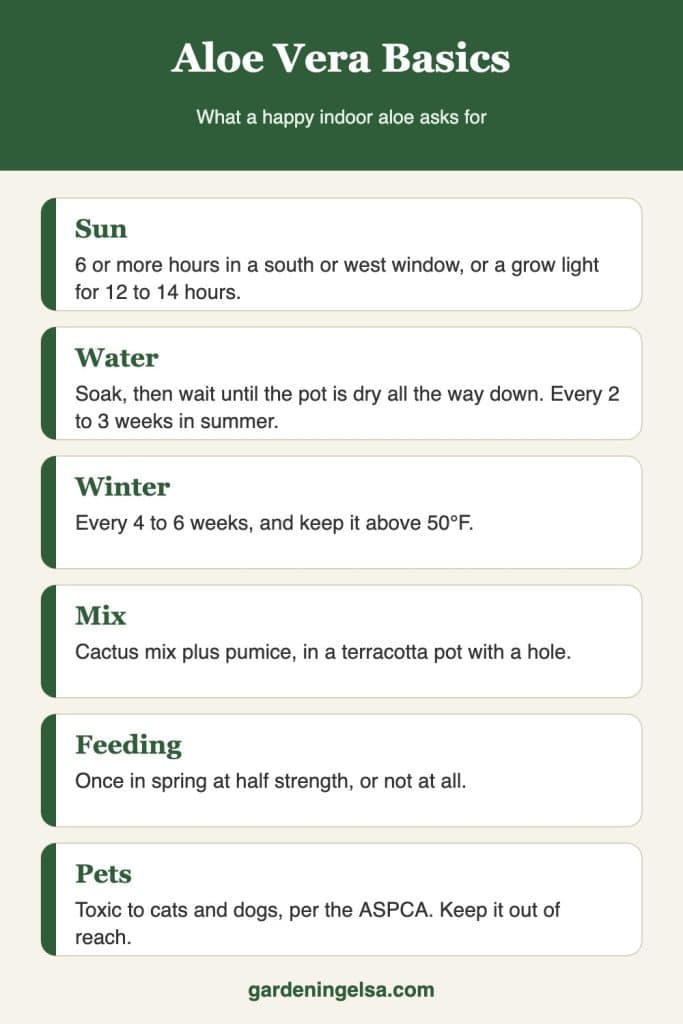
- Put it in your sunniest south or west window, or under a light for 12 to 14 hours.
- Water only when the pot is dry all the way down, then water deeply.
- Stretch the gaps to every 4 to 6 weeks in winter.
- Keep it in terracotta with a hole, in gritty mix.
- Don’t panic about a red blush.
- Keep it out of reach of pets.
More About Growing Aloe Vera
How fast does aloe vera grow indoors?
Slowly. Expect a few new leaves a year indoors, more in a sunny window in summer. A small 4-inch plant can take 3 to 4 years to reach full size, which is usually 1 to 2 feet tall.
Will my aloe flower indoors?
Occasionally, on older plants with lots of sun and a cool, dry winter. The flower stalk is tall and carries tubular yellow blooms. Many indoor plants never flower, and that’s not a sign anything is wrong.
What are the white fuzzy spots or brown bumps on my aloe?
White cotton tucked into the leaf bases is mealybugs. Brown, shell-like bumps that scrape off are scale. Dab them with rubbing alcohol on a cotton swab, rinse the plant, and repeat weekly for 3 to 4 weeks. Keep it away from other plants until it’s clean.
Is it okay to grow aloe in a bathroom?
Only if the bathroom has a bright, sunny window. Steam doesn’t help aloe, and most bathrooms are too dim. A sunny kitchen windowsill is a better spot.
Can I use tap water?
Yes. Aloe isn’t fussy about tap water the way some tropical plants are. If yours is very hard and leaves a white crust on the pot, flush the soil with a full watering every few months, or use rainwater.

Hello there! I’m Elsa, and gardening is my passion. As an avid gardener, I created GardeningElsa.com to share my knowledge and experience with fellow enthusiasts. My website is a comprehensive resource for gardeners of all levels, offering expert advice on a wide range of topics, including plants, flowers, herbs, and vegetable gardening. Whether you’re a beginner looking to start your first garden or a seasoned pro seeking to expand your knowledge, GardeningElsa.com has something for everyone. Read more about me.