
My first vertical garden was a disaster, and I still keep the photo on my phone as a reminder. I nailed a wooden pallet to the fence on the south side of my Zone 6 backyard, stuffed it with strawberries and lettuce, and stood back feeling pretty clever. Two weeks later the top row was crispy brown, the bottom row was soggy, and the whole thing was leaning like a drunk sailor. Nobody had told me that water only travels one direction.
That failure taught me more than any success. Vertical gardening isn’t just regular gardening turned sideways. Gravity changes the watering, the wall changes the temperature, and the height changes which plants you can actually reach to harvest. Once I started designing around those three facts, my 12-by-16-foot patio started producing more food than my old in-ground rows did.
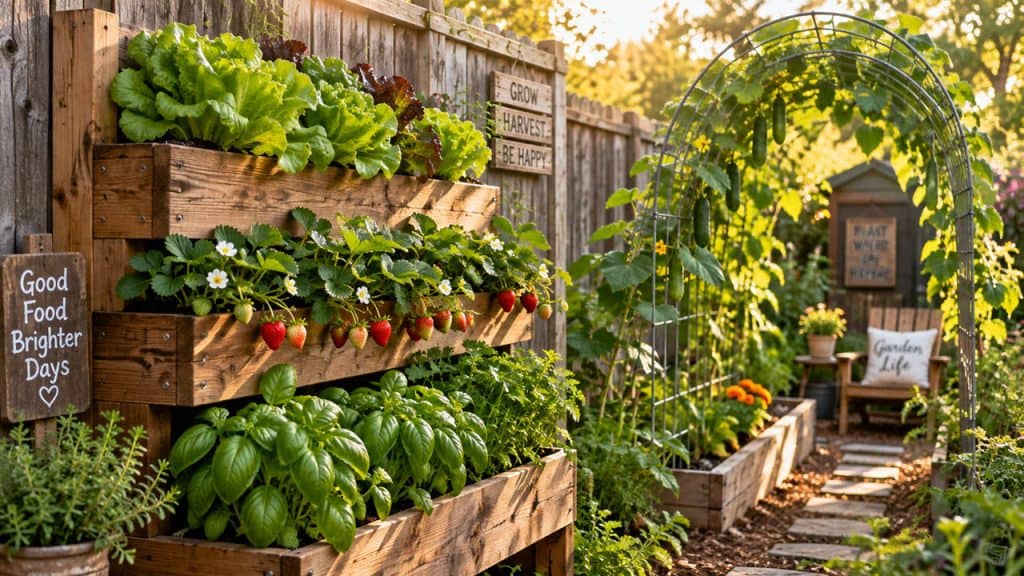
Below are the vertical garden ideas I’ve built, tested, and in a few cases torn down and rebuilt — with the real spacing, materials, and watering details that make each one hold up past July.
Why Vertical Gardening Works So Well in Small Spaces
Before the list, it helps to understand the mechanics. A vertical garden multiplies your growing area without adding a single square foot of footprint. A 4-foot-wide wall with five tiers gives you roughly 20 linear feet of planting space on a 4-square-foot footprint.
But there are trade-offs you need to plan around.
Water moves down, always. Every gravity-fed vertical system runs drier at the top and wetter at the bottom. You either fix this with drip irrigation timed in short bursts, or you plant thirsty crops low and drought-tolerant ones high.
Walls radiate heat. A south-facing brick or vinyl wall can run 10 to 15°F hotter than open air on an August afternoon. That’s a gift in April and a death sentence in July. North and east walls are far gentler on leafy greens.
Root volume gets tight. Most vertical pockets hold 1 to 2 quarts of soil. That’s fine for lettuce, basil, and strawberries. It’s not enough for a determinate tomato that wants 5 gallons.
Weight adds up fast. Wet potting mix weighs about 60 pounds per cubic foot. A loaded 4-by-6-foot living wall can easily hit 300 pounds. Anchor into studs or masonry, never just siding.
Pro Tip: I’ve found that the single best test for any vertical structure is the “shake test.” Before I plant a thing, I grab the frame and shake it hard for five seconds. If it wobbles, wind and wet soil will bring it down by midsummer. I’ve lost two trellises to skipping this step.
Vertical Garden Ideas for Growing Food
1. A-Frame Trellis Over a Raised Bed
This is my highest-producing structure, hands down. Two 6-foot wooden frames hinged at the top, straddling a 4-by-8-foot raised bed. Cucumbers climb one side, pole beans the other, and the shaded ground underneath grows lettuce and spinach all summer.
Space cucumber transplants 12 inches apart along the base. Beans go 4 to 6 inches apart. The shade tunnel underneath stays roughly 8°F cooler than open bed space, which buys you an extra month of greens before they bolt.
If cucumbers are your goal, it’s worth reading up on growing cucumbers in raised beds and how much sun cucumbers actually need before you build. Vertical cucumbers also stay cleaner and get far less cucumber stem disease, because the leaves dry fast and never touch wet soil.
2. Cattle Panel Arch
A 16-foot cattle panel bent into an arch between two beds is the prettiest thing in my garden and costs under $40. Sink four T-posts, bend the panel, zip-tie it down. It handles wind that flattens flimsier trellises.
The 6-inch grid squares are perfect for grabbing. I grow Delicata squash and small pie pumpkins on mine, letting the fruit hang inside the tunnel where slugs can’t reach it. Anything over 3 pounds needs a sling — an old T-shirt cut into strips, tied to the panel, cradling the fruit.
For techniques on training vining squash upward, growing squash in containers vertically covers the pruning side of it in detail.
3. Stacked Container Tower
Five 12-inch pots, each offset a quarter turn, stacked around a central 4-foot rebar stake. Simple, cheap, and movable. I keep one by the kitchen door planted entirely with herbs.
The key is drainage. Drill three extra half-inch holes in each pot before you fill it. Then use a mix that drains fast: two parts potting mix, one part perlite, one part compost. Straight bagged potting soil compacts in a tower and drowns your bottom pots.
Herbs are perfect for this. Thyme, oregano, and rosemary go on top where it’s driest. Parsley, cilantro, and mint go in the lower pots. If you’re new to it, the guide on starting an herb garden walks through which herbs actually pair well together in shared containers.
4. Gutter Garden for Shallow-Rooted Greens
Vinyl rain gutters mounted to a fence in horizontal rows, 12 to 14 inches apart vertically. Each run holds about 4 inches of soil depth — plenty for loose-leaf lettuce, arugula, spinach, and radishes.
Drill quarter-inch drainage holes every 8 inches along the bottom. Cap both ends, and give each run a slight 1-inch drop across its length so water moves rather than pools. Mount the top gutter no higher than 5 feet or you’ll never harvest it comfortably.
I plant these in succession: a new row seeded every 12 days from mid-March through May in Zone 6. That keeps salad on the table without a single bolted head. Many of these crops also handle partial shade well, which makes a north fence viable — the list of shade-tolerant vegetables is worth checking before you commit a shady wall.
5. Strawberry Wall Pockets
Felt wall planters with 12 to 15 individual pockets, mounted on a fence at 3 to 5 feet high. One everbearing strawberry plant per pocket, like ‘Albion’ or ‘Seascape’.
Vertical strawberries stay off the ground, which means dramatically less gray mold and almost no slug damage. The runners hang down and look great. In Zones 5 and colder, pull the whole panel into an unheated garage in December — the roots freeze solid in thin wall pockets otherwise.
Fruit set is the tricky part outdoors. If your blossoms open but nothing forms, the walkthrough on getting strawberry flowers to turn into fruit covers pollination and nutrient causes.
6. Tiered Ladder Planter
An old wooden A-frame ladder with boards laid across the rungs, holding a row of pots on each level. This is my favorite beginner project because there’s no construction and no drainage math.
Each step gets progressively less light as you go down, so plant accordingly. Top step: peppers, basil, cherry tomatoes. Middle: chard, kale. Bottom: lettuce, mint, parsley. A 6-foot ladder holds roughly 15 one-gallon pots.
7. Vertical Hydroponic Tower
If you want maximum food from minimum space, nothing beats a vertical hydroponic tower. Mine is a 5-foot PVC column with 20 net-cup ports and a small submersible pump circulating nutrient solution from a 5-gallon reservoir at the base.
Lettuce goes seed-to-harvest in about 30 days in one of these. That’s roughly twice the speed of my soil beds. The catch is the learning curve — you’re managing pH, nutrient strength, and pump reliability instead of just watering.
Start with the fundamentals in how to start hydroponic gardening, then pick your crops from the rundown of the best plants for hydroponic growing. Getting your starts right matters more than anything else — hydroponic seedlings that transplant strong will outrun weak ones for the entire season. And if you’re still deciding whether it’s worth the setup cost, the honest comparison of hydroponic versus soil growing lays out both sides.
8. Wall-Mounted Grow Bags
Heavy-duty fabric grow bags with grommets, hung directly on a fence rail. Three-gallon bags give you enough root volume for bush beans, determinate tomatoes, and dwarf peppers — plants that wall pockets can’t support.
Fabric bags air-prune the roots, meaning roots stop circling and branch instead. That produces a denser root ball and a tougher plant. The downside: fabric dries fast on a sunny wall. Expect to water daily from July through August in Zones 6 and warmer.
9. Living Fence of Espaliered Dwarf Fruit
Espalier means training a tree flat against a wall or wire frame. A three-tier horizontal cordon of dwarf apple on M27 rootstock takes up about 8 inches of depth and 8 feet of width.
Set your wires at 16, 32, and 48 inches. Train new growth along the wires each June while it’s still flexible. It takes three seasons to look like anything and five to fruit well — but a mature espalier is the single most beautiful thing you can do with a boring fence.
Container growers have an easier option. The guide on dwarf fruit trees perfect for containers covers varieties that stay small enough to line a wall in pots.
Pro Tip: In my experience, the biggest vertical gardening mistake is building too tall. Anything above 6 feet becomes a chore you’ll skip. I now cap every food-producing structure at eye level, and my harvest rate went up because I actually pick what’s there.
Vertical Garden Ideas for Beauty and Privacy
10. Hanging Basket Wall
A row of six to eight hanging baskets on a wall-mounted rail, staggered at two heights. Fast, cheap, and instantly full.
Use trailing petunias, calibrachoa, sweet potato vine, or bacopa for spillers. The trick is feeding. Baskets exhaust their nutrients in about six weeks, then go leggy and stop blooming. Liquid-feed at half strength every single watering after week five.
If your baskets already look stretched and bare, the diagnosis in why hanging baskets go leggy explains the pinching schedule that prevents it. Baskets in full sun also need careful variety selection — see which hanging plants survive high temps before you plant a west wall.
11. Pollinator Trellis Screen
A 6-by-8-foot lattice panel planted with scarlet runner beans, cypress vine, and native honeysuckle. It screens an ugly view and feeds hummingbirds at the same time.
Runner beans bloom from July to frost in Zones 4–8 and produce edible pods as a bonus. Cypress vine reseeds itself politely. I’ve counted four hummingbirds working my screen at once in late August.
For more nectar-heavy vertical options, the list of hanging plants that attract hummingbirds has good pairings for the lower tiers.
12. Indoor Living Wall
Vertical gardening doesn’t stop at the back door. A wall-mounted modular planter in a bright living room can hold 20 to 30 small houseplants in a single 3-by-4-foot panel.
Stick to plants with matching water needs — mixing a fern with a succulent in one shared irrigation panel guarantees one of them dies. Pothos, philodendron, peperomia, and spider plant all tolerate the same routine.
Light is usually the limiting factor. Most rooms need supplemental lighting for a wall this dense, and the breakdown of the best grow lights for indoor plants explains coverage and distance. If your wall is genuinely dim, build it from indoor plants that don’t need sun or the sturdier options in best indoor plants for dark rooms.
13. Air Plant Display Board
Tillandsia, or air plants, need no soil at all. Mount them on a piece of driftwood or a cork board with fishing line or a dab of waterproof adhesive.
They pull moisture from the air and from weekly soaking. Submerge the whole board’s plants in room-temperature water for 20 to 30 minutes once a week, then shake them dry and set them upside down for an hour so no water sits in the crown. That crown rot is the number one killer.
The step-by-step on attaching air plants to wood covers which adhesives are safe, and how long air plants can go without water is useful before you travel.
14. Pallet Planter (Done Right This Time)
Back to where I started. Pallets work — but only if you build them correctly.
Use a heat-treated pallet, stamped “HT,” never one stamped “MB” for methyl bromide. Staple landscape fabric across the back and bottom to hold soil. Then lay the pallet flat and let it root in for three full weeks before you stand it up. Roots need to knit the soil together, or half your mix dumps out the front.
Plant shallow-rooted things only: lettuce, herbs, strawberries, succulents. My original mistake was expecting deep-rooted crops to work in 3 inches of soil.
15. Green Roof or Shed Wall
If you have a shed, garage, or garden structure, the vertical surface is free real estate. A wire mesh cage 4 inches off the wall, filled with a lightweight sedum mat, creates a self-sufficient green panel that needs almost no watering once it’s established.
Sedum and sempervivum are the workhorses here. They handle 100°F wall heat, tolerate drought for weeks, and survive to Zone 4. If the idea appeals, the broader introduction to green roof gardening covers load calculations and drainage layers.
16. Balcony Rail Planters
For apartment gardeners, rail-mounted boxes are the highest-value square foot you own. A standard 24-inch rail box gives you room for six lettuce plants, three bush beans, or one dwarf tomato with two basil plants tucked in.
Check your railing’s weight rating and always use two-point mounting brackets, not just hooks. A gust that flips a full planter off a fourth-floor rail is genuinely dangerous.
Balconies have their own microclimate quirks. The guides on growing vegetables on a balcony and building a thriving balcony herb garden both address wind, reflected heat, and container depth in detail.
17. Window Box Stack
Three window boxes mounted on a wall at 18-inch vertical intervals. It’s the simplest vertical garden that exists, and it’s the one I recommend to nervous beginners.
Boxes at least 8 inches deep and 8 inches wide give you real root space. Fill with a mix of potting soil and compost, add a slow-release granular fertilizer at planting, and top-dress with liquid feed monthly. The blueprint in how to create a productive window box covers planting density crop by crop.
Watering and Feeding a Vertical Garden
This is where most vertical gardens fail, so it deserves its own section.
Water shorter and more often. Vertical containers drain fast and hold little reserve. I run drip lines for 4 minutes, twice a day, rather than 15 minutes once. Short pulses let the mix absorb water instead of sending it straight through.
Install drip from the top. A single quarter-inch drip line running along the top tier, with emitters every 6 inches, will feed lower levels through gravity in most pocket systems. Add a second line at the midpoint if your wall is over 4 feet.
Feed more than you think. Constant watering leaches nutrients out the bottom. I feed vertical containers a half-strength liquid fertilizer weekly during active growth, versus every three weeks for in-ground beds. The overview of liquid fertilizers for indoor plants applies just as well to outdoor container walls.
Use quality mix, not garden soil. Native soil compacts and turns to brick in a vertical pocket. You want a light, porous mix — the principles in making organic soil at home for plants will get you there cheaply.
Consider self-watering hardware. If you travel or forget, self-watering planters for busy urban gardeners are the single biggest reliability upgrade you can make to a vertical setup.
Mistakes to Avoid Before You Build
- Don’t mount directly against siding. Trapped moisture rots wood and voids siding warranties. Leave a 2-inch air gap using furring strips so the wall can breathe and dry.
- Match the wall to the season. South and west walls bake leafy greens by June in Zones 7 and warmer. Put heat-lovers like peppers and basil there, and move salad crops to north or east exposures.
- Plan the harvest reach. Anything higher than your shoulder or lower than your knee gets ignored. Keep productive crops between 18 inches and 5 feet off the ground.
- Overwinter thin containers. Roots in a 2-inch-deep pocket freeze at temperatures a raised bed shrugs off. In Zones 3–6, empty vertical planters in fall or move perennials into a sheltered spot.
- Watch for pests early. Dense vertical plantings trap humidity and invite aphids and spider mites. Scout weekly and treat fast — the natural methods in keeping bugs out of your vegetable garden work well in tight spaces.
- Anchor for wind, not for weight alone. A structure that holds 300 pounds sitting still can still tip in a 40 mph gust. Guy-wire freestanding towers or bolt them to something solid.
Frequently Asked Questions
What vegetables grow best in a vertical garden?
Shallow-rooted, fast crops perform best: lettuce, spinach, arugula, kale, radishes, bush beans, and strawberries. Vining crops like cucumbers, pole beans, and small squash work beautifully on trellises since they climb naturally. Skip carrots, potatoes, and other deep root crops in wall pockets.
How often do I need to water a vertical garden?
Most vertical systems need water once or twice daily in summer, compared to every two or three days for in-ground beds. Small soil volume plus wind exposure plus reflected wall heat dries containers quickly. A drip line on a timer is the most reliable fix.
Can a vertical garden damage my wall or fence?
Yes, if you mount it flat against the surface. Trapped moisture rots wood and can stain masonry. Always leave a 2-inch air gap with furring strips, and anchor into studs or masonry rather than siding alone.
Do vertical gardens work indoors?
They do, but light is almost always the limiting factor. A living wall packed with 20 or more plants needs supplemental grow lights unless it sits within 3 feet of a large south-facing window. Choose plants with matching water needs so a single irrigation schedule works for everything.
How much does it cost to build a vertical garden?
A gutter garden or stacked pot tower runs $30 to $60 in materials. A cattle panel arch costs around $40. A modular living wall system with irrigation typically runs $150 to $400 depending on size. Start cheap — build one small structure, learn how it waters, then scale up.
We covered 17 vertical garden ideas, from cattle panel arches and gutter gardens to hydroponic towers and indoor living walls. The best approach for most people is to start with one simple structure at a comfortable height, get the watering dialed in, and expand only after you’ve proven you can keep it alive through August. I hope you found this article helpful.
You May Also Like
- Small-space edible garden ideas for tight yards
- Small-space vegetable gardening basics
- Vegetables that grow well in containers
- How to build a small hydroponic system at home
- Gorgeous container plant combinations to copy

Hello there! I’m Elsa, and gardening is my passion. As an avid gardener, I created GardeningElsa.com to share my knowledge and experience with fellow enthusiasts. My website is a comprehensive resource for gardeners of all levels, offering expert advice on a wide range of topics, including plants, flowers, herbs, and vegetable gardening. Whether you’re a beginner looking to start your first garden or a seasoned pro seeking to expand your knowledge, GardeningElsa.com has something for everyone. Read more about me.
