
My north-side vegetable bed used to be my biggest embarrassment. It gets maybe three and a half hours of direct sun in June, and for two summers straight I stubbornly planted tomatoes there. I got tall, floppy plants and about nine golf-ball fruits total. Then a neighbor in my old Zone 6 neighborhood walked past, looked at the bed, and said, “That’s a lettuce spot, honey.” She was right.
The next spring I ripped out the tomato cages and planted arugula, bok choy, Swiss chard, and a wide row of spinach. By mid-May I was cutting salad twice a week from the same soil that had humiliated me for two years. Shade tolerant vegetables aren’t a consolation prize — they’re just a different crop list, and in hot summers they actually outperform the same crops grown in blazing sun.
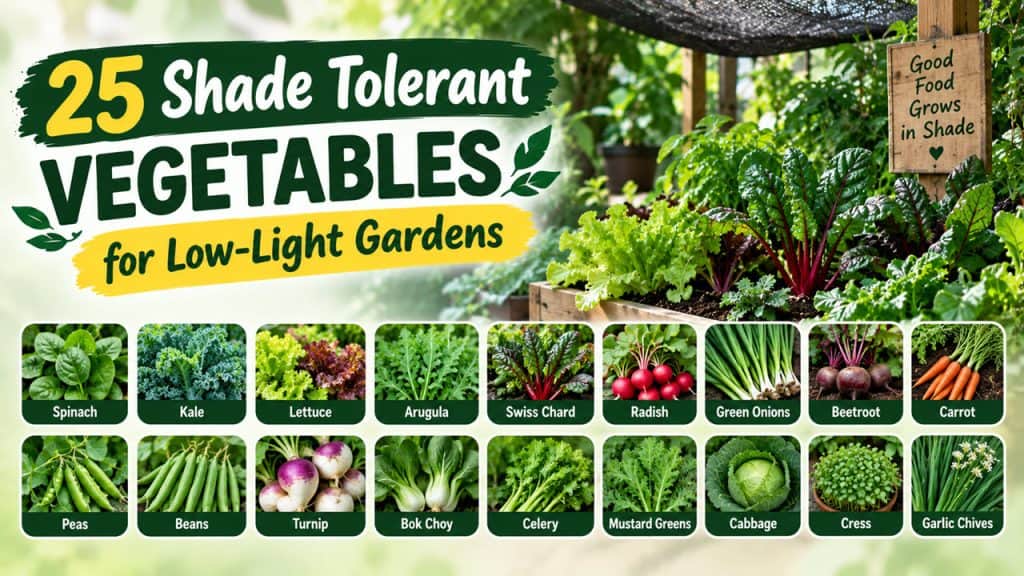
Below you’ll find the 25 shade tolerant vegetables I keep planting in low-light beds, grouped by how much shade they’ll genuinely take, with spacing, timing, and the honest limits of each one.
First, Know What Kind of Shade You Actually Have
“Shade” is a lazy word. Before you pick a single seed packet, go outside and count hours of direct sun on a clear day in late May or June, when the tree canopy is full. Check at 9 a.m., noon, 3 p.m., and 6 p.m.
Here’s how I sort my own beds:
- Light shade (4–6 hours direct sun): Almost anything leafy thrives. You can even squeeze in bush beans and small-rooted crops.
- Partial shade (3–4 hours direct sun): Leafy greens, brassicas, and some root crops. This is the sweet spot for most of this list.
- Dappled shade (filtered light all day through open branches): Surprisingly productive. Greens do well here because the light is steady, not blasting.
- Deep shade (under 2 hours, north wall, dense evergreens): Skip vegetables. Grow ferns, hostas, or use containers you can rotate out.
There’s a second factor most guides skip: reflected light. A bed against a white garage wall or light fence gets far more usable light than the sun-hour count suggests. My side bed only logs three direct hours, but the pale siding bounces light all afternoon, and my chard there is noticeably stockier than the chard under my maple.
Also, shade changes with the calendar. That bed under a deciduous maple gets nearly full sun in late March and again in late October. I plant it hard in early spring and again in fall, and let it coast through July.
Pro Tip: I’ve found that most shade-garden failures aren’t about light at all — they’re about roots. Trees drink everything. If your shade comes from a tree, build a raised bed at least 10 inches deep on top of landscape fabric, or you’ll be feeding the maple, not the spinach. I learned this after two seasons of stunted kale that no amount of fertilizer could fix.
The Best Shade Tolerant Vegetables: Leafy Greens
Leaves are the whole point here. A plant growing a leaf only has to photosynthesize enough to build that leaf. A plant growing a fruit has to build the leaf and fuel a sugar factory. That’s the entire reason greens dominate any shade tolerant vegetables list.
1. Loose-Leaf Lettuce
The undisputed champion. Varieties like ‘Black Seeded Simpson’, ‘Red Sails’, and ‘Salad Bowl’ produce full heads of cut-and-come-again leaves on as little as 3 hours of sun. Shade is actually an advantage — lettuce bolts (sends up a flower stalk and turns bitter) when soil hits about 75°F. My shaded rows stay sweet three weeks longer than my sunny ones.
Sow every 14 days, thin to 6 inches apart, and harvest outer leaves rather than pulling whole plants.
2. Butterhead and Romaine Lettuce
Slower and needing a bit more light than loose-leaf — call it 4 hours minimum. ‘Buttercrunch’ and ‘Parris Island Cos’ both head up fine in partial shade, just expect them to take 65 days instead of 55. They’re also excellent candidates for water culture if you’d rather grow indoors; check the rundown of the best plants for hydroponic systems before you commit shelf space.
3. Spinach
Spinach genuinely prefers shade in anything warmer than Zone 6. It bolts fast in heat and long days. I plant ‘Bloomsdale Long Standing’ in my dappled bed in early March and get harvests through mid-June. Sow ½ inch deep, thin to 4 inches, and keep the soil evenly moist.
4. Arugula
Ready in 21 days from seed. In full sun, arugula gets punishingly hot and peppery. In shade, the leaves stay tender and mild. Broadcast seed thickly in a 12-inch-wide band and cut with scissors an inch above the crown. It regrows two or three times.
5. Swiss Chard
My favorite shade crop, full stop. ‘Fordhook Giant’ and ‘Bright Lights’ will produce all season on 3–4 hours of sun. Chard is a beet without the root, so it puts everything into leaves. Space 8 to 10 inches apart, harvest outer stalks, and it’ll keep going until a hard freeze. Hardy through Zone 5 with mulch.
6. Kale
‘Lacinato’ (dinosaur kale) and ‘Red Russian’ both handle partial shade well. Leaves come in smaller and thinner than in full sun, which honestly makes them better for salads. Space 12 inches. In Zones 5–8, fall-planted kale survives winter under a row cover and gives you a huge March harvest.
7. Mustard Greens
Fast, tough, and shade-friendly. ‘Southern Giant Curled’ matures in 45 days. Shade keeps the heat in the leaves manageable. Watch for flea beetles — tiny black jumping insects that pepper leaves with holes. Floating row cover from day one is the cleanest fix.
8. Tatsoi
A spoon-shaped Asian green that forms a flat rosette. It’s one of the most cold-hardy greens I grow, shrugging off 15°F under a low tunnel. Needs only 3 hours of sun. Space 6 inches.
9. Mizuna
Feathery, mild, and almost impossible to kill. Mizuna regrows after cutting faster than any green in my beds. It also tolerates the uneven moisture common under trees better than lettuce does.
10. Bok Choy
Baby bok choy at 6-inch spacing is a perfect low-light crop, ready in 45 days. Full-size varieties need closer to 5 hours. Shade helps here too, because bok choy bolts the moment it gets warm and stressed. If you garden in tight rows, the guide to bok choy in square foot gardening covers spacing in detail.
11. Sorrel
A perennial lemony green, hardy in Zones 3–7. Plant it once in a shady corner and harvest for five or six years. It’s the crop I recommend to anyone who wants food from a spot they can’t easily till.
12. Corn Salad (Mâche)
Grows in near-freezing weather and low light. Sow in September, harvest through winter in Zones 6 and warmer. Nutty, soft, and expensive at the store.
13. Endive and Escarole
Both take partial shade and are less bitter when grown out of direct sun. Space 10 inches. They’re slow — about 85 days — so plan for one crop, not succession.
>> Vegetable Seeds for Planting
Root Crops That Tolerate Low Light
Roots need more energy than leaves, so results here get more variable. Expect smaller roots and longer days to maturity. The trick is choosing fast, small varieties and loosening your garden soil deeply so roots don’t fight compaction on top of low light.
14. Radishes
30 days in full sun, 40 to 45 in partial shade. ‘French Breakfast’ and ‘Cherry Belle’ both work. If you only get 3 hours, you may get more top than root — pick a variety bred for greens too, or just eat the tops sautéed. Sow ½ inch deep and thin ruthlessly to 2 inches.
15. Beets
Grow beets in shade primarily for the greens, with the roots as a bonus. ‘Bull’s Blood’ and ‘Detroit Dark Red’ will size up to golf-ball or slightly larger on 4 hours. Thin to 3 inches. Beet “seeds” are actually clusters, so expect several sprouts per seed.
16. Turnips
‘Hakurei’ salad turnips are the standout — sweet, white, and ready in 40 days. They handle partial shade better than beets and give you two crops in one plant since turnip greens are excellent cooked.
17. Carrots
The trickiest of the group. Carrots need 4 to 5 hours minimum, and even then choose short varieties like ‘Danvers Half Long’, ‘Napoli’, or the round ‘Paris Market’. Long ‘Imperator’ types will fork and stall. Sow shallow, keep the top inch damp for the full 14 to 21 day germination window, and thin to 2 inches. My tips on growing carrots in a square foot garden apply directly to shaded beds.
18. Green Onions and Scallions
Bunching onions like ‘Evergreen Hardy White’ do fine in 3–4 hours. You’re harvesting stems, not storage bulbs, so the energy demand is low. Plant 1 inch apart in a clump and cut as needed.
19. Garlic (Grown for Scapes and Greens)
Bulbs will be small in shade — think crabapple, not softball. But garlic greens in spring and hardneck scapes in June are legitimately worth the bed space. Plant cloves in October, 6 inches apart, 2 inches deep. For full spacing math, see growing garlic in square foot gardening.
20. Horseradish
Nearly indestructible perennial for Zones 3–9. It genuinely doesn’t care about shade. Plant it where you’re willing to let it stay forever, because any root fragment left behind resprouts.
Brassicas and Legumes for Partial Shade
21. Broccoli
Needs 4 to 5 hours and a lot of patience. Heads come in smaller, but shade keeps plants from bolting in a May heat wave, and side shoots keep coming for weeks after the main cut. Space 18 inches apart and feed with a nitrogen-rich amendment at transplant. The square foot gardening broccoli guide covers timing by zone.
22. Cabbage
Same story as broccoli — heads size down, but they still form. Choose small varieties like ‘Gonzales’ or ‘Tiara’ rather than 8-pound storage cabbages. Space 12 to 15 inches. If you’re growing in pots on a shaded patio, growing cabbage in containers walks through pot size and watering.
23. Brussels Sprouts
Marginal, but it works in light shade with a long season. Plant in June for a November harvest in Zones 5–7. Sprouts will be looser than store-bought. Details on spacing live in my post on growing Brussels sprouts in square foot gardening.
24. Peas
Both snap and shelling peas produce well on 4 hours of sun, and shade extends their season by keeping soil cool. ‘Sugar Ann’ stays under 2 feet and needs no trellis. ‘Super Sugar Snap’ climbs to 6 feet and needs netting. Sow as soon as soil hits 45°F. See growing peas in a square foot garden for trellis layouts.
25. Bush Beans
The one warm-season crop I’ll defend in partial shade. ‘Provider’ and ‘Contender’ set pods on 4 to 5 hours. Yields drop maybe 30 percent versus full sun, but you’ll still fill a colander. Direct sow after soil reaches 60°F, space 4 inches, and don’t bother with pole varieties — they need more light to justify the height.
Herbs Worth Tucking In
Not vegetables exactly, but they earn their space. Mint, parsley, cilantro, chives, and lemon balm all handle 3–4 hours easily. Cilantro in particular bolts in a week of full-sun heat, so shade genuinely doubles your harvest window.
Basil is the exception — it sulks below 5 hours and gets leggy, and leggy basil is prone to problems like black spots on the leaves. If a shaded patio is all you have, my walkthrough on building a thriving balcony herb garden covers the container side of it.
How to Make a Shady Bed Actually Produce
Picking the right shade tolerant vegetables is half the job. The other half is compensating everywhere else.
Build the soil harder than you would in sun. Shaded beds stay cooler and wetter, and cold soil slows nutrient uptake. I work 2 to 3 inches of finished compost into the top 6 inches every spring. My notes on preparing soil for a vegetable garden go deeper, and if you want the science of what makes soil work, the soil secrets guide is worth an afternoon.
Water less than you think. This is the mistake I see constantly. Shaded soil dries maybe half as fast as sunny soil. I stick a finger 2 inches down before every watering. Overwatered shade beds get root rot and slugs, not bigger plants.
Space wider, not tighter. Plants in low light stretch toward whatever they can get. Giving each one 25 to 50 percent more room than the packet says improves airflow and cuts down on powdery mildew, which loves damp shade.
Mulch, but keep it thin. One inch of shredded leaves is plenty. Three inches in a shady bed holds too much moisture and becomes slug housing. My guide to mulching a vegetable garden breaks down materials.
Fight slugs from day one. Shade plus moisture equals slugs, guaranteed. I go out at dusk with a flashlight for the first two weeks after seedlings emerge. Beer traps and a ring of crushed eggshell help. For the broader pest picture, see keeping bugs out of the vegetable garden naturally.
Use reflection deliberately. A 4-foot panel of white-painted plywood on the north side of a bed measurably brightens it. It’s ugly, and it works.
Consider growing up. Shifting crops onto a fence or wall gets them above ground-level shade. The vertical garden ideas post has structures I’ve built myself.
Have a backup. When a bed is truly too dark, I move greens indoors under lights. Starting hydroponic seedlings is how I keep lettuce coming in January, and if you’re weighing methods, hydroponic versus soil growing lays out the honest tradeoffs. Getting the lighting right matters most — the best grow lights for indoor plants covers wattage and distance.
Mistakes I See Every Season
- Counting sun hours in April. Tree canopy isn’t leafed out yet. That bed looks bright in spring and turns into a cave by June. Always measure in full leaf.
- Planting fruiting crops out of stubbornness. Tomatoes, peppers, eggplant, squash, melons, and cucumbers need 6-plus hours. No amount of fertilizer fixes missing light. If you want cucumbers, read how much sun cucumbers need first and site them properly.
- Over-fertilizing to “make up” for shade. Excess nitrogen in low light produces soft, floppy, pest-magnet growth. Feed lightly and consistently instead.
- Ignoring tree root competition. A mature maple pulls hundreds of gallons a week. Raised beds or large containers are the only reliable answer.
- Skipping the fall window. In Zones 5–8, August through November is prime shade-gardening time. Cool temperatures plus shorter days suit every crop on this list.
- Crowding for yield. Tight spacing works in full sun. In shade, it produces pale, mildew-prone plants that yield less overall.
Frequently Asked Questions
What is the minimum sunlight vegetables need to grow?
Leafy greens like lettuce, arugula, and spinach will produce on about 3 hours of direct sun, or bright dappled light all day. Root crops need 4 to 5 hours. Fruiting vegetables need 6 or more, with no real workaround.
Can I grow tomatoes in a shady garden?
Realistically, no. Tomatoes need 6 to 8 hours of direct sun to ripen fruit. With 4 hours you’ll get tall vines and a handful of small, late tomatoes. Use that bed for greens and grow tomatoes in a container you can move to the sunniest spot you have.
Do shade tolerant vegetables taste different?
Often better. Lettuce, spinach, arugula, and cilantro all turn bitter and bolt when heat-stressed. Grown in partial shade, they stay sweeter and tender for weeks longer. The tradeoff is smaller size and slower growth.
How much longer do vegetables take to mature in shade?
Plan on 20 to 40 percent longer than the seed packet says. A 45-day lettuce becomes roughly 55 to 60 days. Add that to your calendar when planning fall crops so you’re not racing the first frost.
Will shade tolerant vegetables grow in containers on a shaded porch?
Yes, and containers are often better than in-ground shade beds because you dodge tree root competition. Use pots at least 8 inches deep for greens and 12 inches for root crops. Check moisture more often — pots dry faster than beds, even in shade.
We covered 25 shade tolerant vegetables, how to read the light you actually have, and the soil, spacing, and pest adjustments that make a low-light bed productive. The short version: grow leaves first, roots second, and skip fruit entirely — then lean hard on spring and fall when the light is best. I hope you found this article helpful.
You may also like:
- Easiest vegetables to grow in raised beds
- Small space vegetable gardening ideas
- Best vegetables for container growing
- How to grow vegetables on a balcony
- Companion planting for square foot gardens

Hello there! I’m Elsa, and gardening is my passion. As an avid gardener, I created GardeningElsa.com to share my knowledge and experience with fellow enthusiasts. My website is a comprehensive resource for gardeners of all levels, offering expert advice on a wide range of topics, including plants, flowers, herbs, and vegetable gardening. Whether you’re a beginner looking to start your first garden or a seasoned pro seeking to expand your knowledge, GardeningElsa.com has something for everyone. Read more about me.
