
Pothos grows in almost any room, but it only looks full and bright in a good one.
Give it bright, indirect light, water when the top half of the soil has dried, feed it lightly in summer, and trim the long vines a couple of times a year, and it’ll keep putting out new leaves for decades.
What I’d tell a neighbor: most sad pothos plants are getting too much water and too little light. Water less often than you think, and move it closer to a window before you buy anything to fix it.
Before You Start
You don’t need much. A pothos wants a pot with a drainage hole and a loose, fast-draining potting mix.
I like to stir in a few handfuls of perlite, about 3 parts mix to 1 part perlite, so water runs through instead of pooling around the roots.
For a trailing look, a hanging planter or a high shelf lets the vines drop. Pick one with a drainage hole or a removable inner pot, because a closed basket holds water like a bucket (a very pretty bucket, but still).
When you buy one, slide the plant out of its nursery pot if the store allows it. White or tan roots are good.
Brown, mushy roots or a sour smell mean root rot has already started, and the plant needs trimming and fresh potting mix right away.

It also helps to know what you’ve got. True pothos (Epipremnum) has thick, slightly waxy leaves and a groove running down the top of each leaf stalk.
Heartleaf philodendron looks similar but has thinner, softer leaves and round stalks, and its new leaves unfurl from a thin sheath that browns and drops off. Pothos leaves have no sheath.
Satin “pothos” belongs to a separate genus, Scindapsus, with matte leaves and silver spots. All three take similar care.
Finding Its Spot
Light is the difference between a pothos that fills out and one that grows a few long, bare strings. “Low light tolerant” means it survives in a dim corner. It doesn’t mean it grows well there.
If you want numbers, a free light-meter app on your phone gets you close enough. Lay the phone where the leaves are, screen facing the window, at midday.
| Reading | Lux (approx.) | What happens |
|---|---|---|
| Under 75 foot-candles | Under 800 | Barely grows. Leaves get small. |
| 75 to 200 foot-candles | 800 to 2,000 | Survives and grows slowly. Variegation fades. |
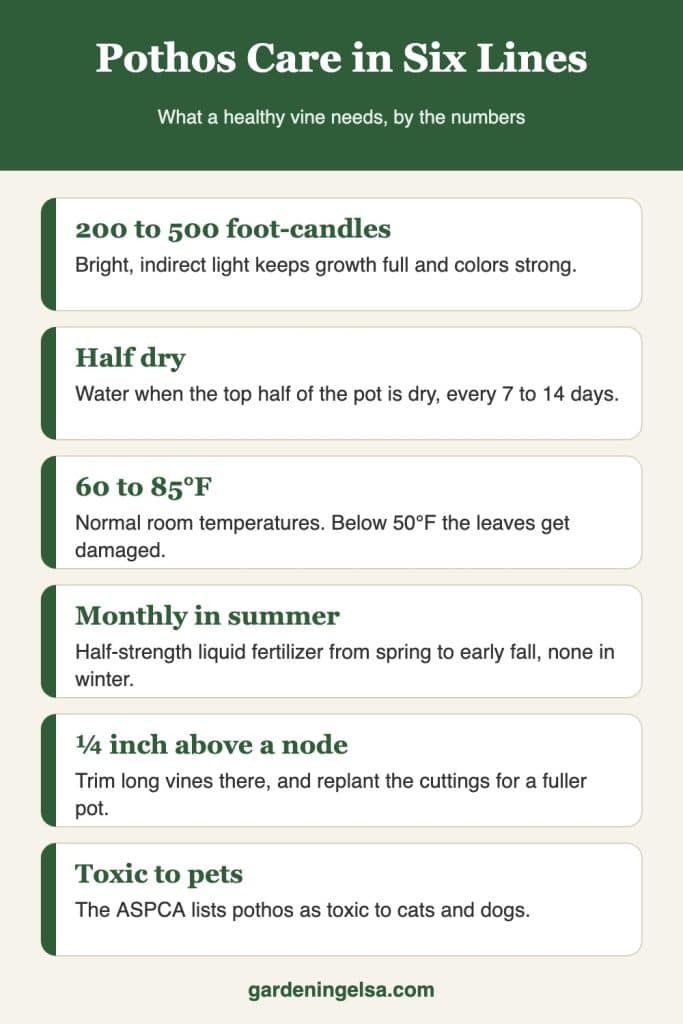
| 200 to 500 foot-candles | 2,000 to 5,400 | Full, steady growth and strong color. The target. |
| 1,000+ foot-candles of direct sun | 10,000+ | Leaves bleach or scorch, especially in a south or west window. |
In practice that means 3 to 6 feet from an east window, or set back 5 to 8 feet from a south or west one, or behind a sheer curtain. A north window works if the plant sits right beside it.
Variety changes the rule. Golden and Jade pothos handle the least light. Marble Queen, N’Joy, Pearls and Jade, and Manjula carry lots of white or cream, so they need brighter spots and grow more slowly. Neon turns dull green in low light.
Elsa’s note: a variegated pothos that keeps putting out solid green leaves is telling you it needs more light. Move it closer and the next leaves usually come back marked.
The Watering Rhythm
Water when the top half of the pot is dry. In a 6-inch pot in summer, that’s usually every 7 to 10 days.
In winter it stretches to 10 to 14 days or longer. When you do water, pour until it runs from the bottom, then empty the saucer.
The finger test only checks the top inch. For the whole pot, push a wooden chopstick or skewer down to the bottom, wait 10 seconds and pull it out. Dark, damp soil stuck to it means wait. Clean and dry means water.
You can also go by weight. Lift the pot right after watering, then lift it every few days. A dry pot feels surprisingly light, and after a couple of weeks you’ll know it without thinking.
A thirsty pothos tells you. The leaves go soft and droop, then perk back up within a few hours of a good drink. That’s fine now and then. It’s much easier on the plant than soggy soil.
Room temperatures between 60 and 85°F suit it. Keep it away from cold windows and doors in winter, since leaves get damaged below 50°F.
Ordinary household humidity is fine, though it puts out bigger leaves in a humid bathroom or beside a humidifier.
See our guide to humidity for houseplants if your air is very dry, and our tips on winter houseplant care for the cold months.
Feeding and Repotting
Pothos isn’t hungry. Feed it once a month from spring to early fall with a liquid indoor plant food mixed at half the label strength, and stop completely from October to March.

Too much fertilizer shows up as brown, crispy leaf tips and a white crust on the soil.
For more on timing, see how often to fertilize indoor plants.
Repot when roots circle the bottom or poke out of the drainage holes, usually every 1 to 2 years. Go up only 1 to 2 inches in pot width.
A pot that’s much bigger holds extra wet soil the roots can’t reach, which is a common route to rot. Spring and summer are the best times, while it’s growing fast.
Our guide to the best soil for indoor plants covers mixes in more detail.
Trimming for a Fuller Plant
Left alone, pothos vines grow long and leaves cluster at the tips, with bare stem near the pot. Trimming fixes that.
Cut each long vine with clean pruning shears or sharp scissors about ¼ inch above a node, the little bump where a leaf meets the stem.
New growth sprouts from just below the cut, usually as one new vine, sometimes two. I’d trim in spring and again in midsummer.
Elsa’s note: if you want bigger leaves, give it something to climb. A pothos growing up a moss pole or board makes larger leaves than one hanging down, because climbing is what it does in the wild.

Don’t throw the cuttings away. Put pieces with 2 or 3 nodes in a jar of water, and roots usually show within 1 to 3 weeks.
Once they’re an inch or two long, plant them back into the same pot around the base. That’s the easiest way to turn a stringy pothos into a full one.
When It Sulks
Yellow leaves are the question everyone asks. Check the pattern first, because it points to the cause.
| What you see | Most often | What to do |
|---|---|---|
| One old leaf near the base yellows, now and then | Normal aging | Nothing. Snip it off. |
| Several leaves yellow at once, soil still wet | Overwatering | Let it dry well. Check roots for brown mush. |
| Yellow with crispy brown edges, soil bone dry | Underwatering | Water thoroughly and shorten the interval. |
| Pale, washed-out leaves in a sunny window | Too much light | Move it back from the glass. |
| Small new leaves, long gaps on the stem | Too little light | Move it closer to a window. |
| Brown tips plus white crust on the soil | Fertilizer buildup | Flush the pot with water and feed less. |
Pests are uncommon but do show up. Mealybugs look like bits of white cotton in the leaf joints.
Spider mites leave fine webbing and speckled leaves. Wipe mealybugs off with a cotton swab dipped in rubbing alcohol, and spray the plant with insecticidal soap every 7 days until they’re gone.
Small black flies around the soil are fungus gnats. Our guide to getting rid of fungus gnats has the fix.
What Most People Get Wrong
The biggest mistake is watering on a schedule. “Once a week” works in July and kills plants in January, when the same pot can stay wet for two weeks. Check the soil instead.
The second is the oversized pot. People move a small pothos into a big, handsome planter and the roots sit in cold, wet soil they can’t use. Step up gradually.
Then there’s the dark corner. A pothos placed 12 feet from a window will hang on for a year or two, slowly getting thinner, and people blame their watering. It’s the light.
And pet owners often assume a common plant must be safe. It isn’t.
The ASPCA lists pothos as toxic to cats and dogs. It contains insoluble calcium oxalate crystals, and chewing causes mouth pain, drooling, vomiting and trouble swallowing.
Hang it out of reach, or pick something from our list of cat-friendly indoor plants.
Elsa’s note: the same goes for small children. The reaction is painful rather than dangerous in most cases, but it’s no fun for anyone.
Before You Head Out
- Put it where it can see the sky from its spot, within a few feet of a window.
- Water when the chopstick comes out dry, then empty the saucer.
- Feed monthly at half strength in spring and summer only.
- Trim long vines above a node and plant the cuttings back in.
- Keep it out of reach of cats and dogs.
If pothos turned out easy for you, a spider plant is a good next hanging plant. My spider plant care tutorial covers bright, soft light, fixing brown leaf tips and what to do with the babies it sends out.
More About Growing Pothos
Can pothos live outside in summer?
Yes, in shade. Move it out once nights stay above 55°F and keep it out of direct sun, which scorches it fast. In Zones 10 to 12 it can stay outside all year, where it climbs trees. In Florida it’s considered invasive, so keep it in a pot there.
How fast does pothos grow?
In bright, indirect light during spring and summer, a healthy vine can add up to a foot a month. In low light or winter, it might add a few inches. Indoors, vines easily reach 10 feet if you never trim them.
Why are my pothos leaves curling?
Curling usually means thirst, especially if the leaves also feel soft. Water and check again in a few hours. If the soil is moist and leaves still curl, look underneath for pests, or move the plant away from a heater vent or hot window.
Does pothos clean the air?
Not in any way you’d notice in a normal room. You’d need a jungle of plants to match what an open window or a basic air filter does in an hour. Grow it because you like it.
Should I mist my pothos?
It does no harm, but it doesn’t do much either. The water evaporates within minutes. If you want to help the leaves, wipe them with a damp cloth every month or two so dust doesn’t block the light.

Hello there! I’m Elsa, and gardening is my passion. As an avid gardener, I created GardeningElsa.com to share my knowledge and experience with fellow enthusiasts. My website is a comprehensive resource for gardeners of all levels, offering expert advice on a wide range of topics, including plants, flowers, herbs, and vegetable gardening. Whether you’re a beginner looking to start your first garden or a seasoned pro seeking to expand your knowledge, GardeningElsa.com has something for everyone. Read more about me.