
The most common humidity mistake is misting. The fix is a humidifier you aim at the plants and a cheap gauge that tells you when to run it.
Get it wrong and calatheas, ferns and prayer plants crisp at the edges all winter, no matter how often you spray.
Do this instead: measure the air at leaf height first. If it reads under 40% and you grow thin-leaved tropicals, run a humidifier 3 to 6 feet from them until it reads 45 to 50%. Skip the spray bottle.
Guessing Instead of Measuring
People skip this step because dry air feels obvious. Your lips crack, the doorknob shocks you. But “dry” could mean 35% or 15%, and those need different fixes.
A digital hygrometer costs less than one fern. Set it among the plants, at leaf height, away from the humidifier’s plume. Read it in the morning and again at night for three days before you change anything.
Relative humidity is how much moisture the air holds compared with the most it could hold at that temperature. The same air reads lower once the furnace warms it.
Heated homes often drop to 15 to 25% from December to February, and lower in the Mountain West and the upper Midwest. Bathrooms and kitchens run higher than the rooms around them.
If you already bought a humidifier without measuring, you’re fine. Just add the gauge now so you know when to turn it off.

Treating Every Plant Like a Fern
Not every plant cares. That’s the part most humidity advice leaves out.
| Plant | Comfortable range | Shows dry air as |
|---|---|---|
| Calathea, maranta, prayer plant | 45 to 55% | Crispy edges, curled leaves |
| Maidenhair and Boston ferns | 45 to 55% | Brown, shedding fronds |
| Alocasia, anthurium | 45 to 55% | Brown tips on new leaves |
| Monstera, philodendron | 40 to 50% | New leaves stick as they unfurl |
| Pothos, snake plant, ZZ | 30 to 40% is fine | Rarely shows it |
| Cacti, succulents, aloe | Room air | Never. Extra humidity hurts them |
A pothos at 30% is fine. A calathea at 30% is not.
Read the hygrometer next to the fussy plants, not across the room, because a sunny corner by a radiator runs drier.

Our calathea care guide covers the rest of what that plant fusses about, and the fern care basics apply to most indoor ferns.
Where a plant’s ideal runs past 50%, the house limit wins. Use a cloche or a glass case for anything that truly needs more, and leave the cacti in the driest room in the house.
You’ve done it if your succulents share a shelf with the humidifier and their lower leaves have gone soft.
Misting or a Pebble Tray and Calling It Done
Misting feels like care. You see the droplets. The leaves look glossy.
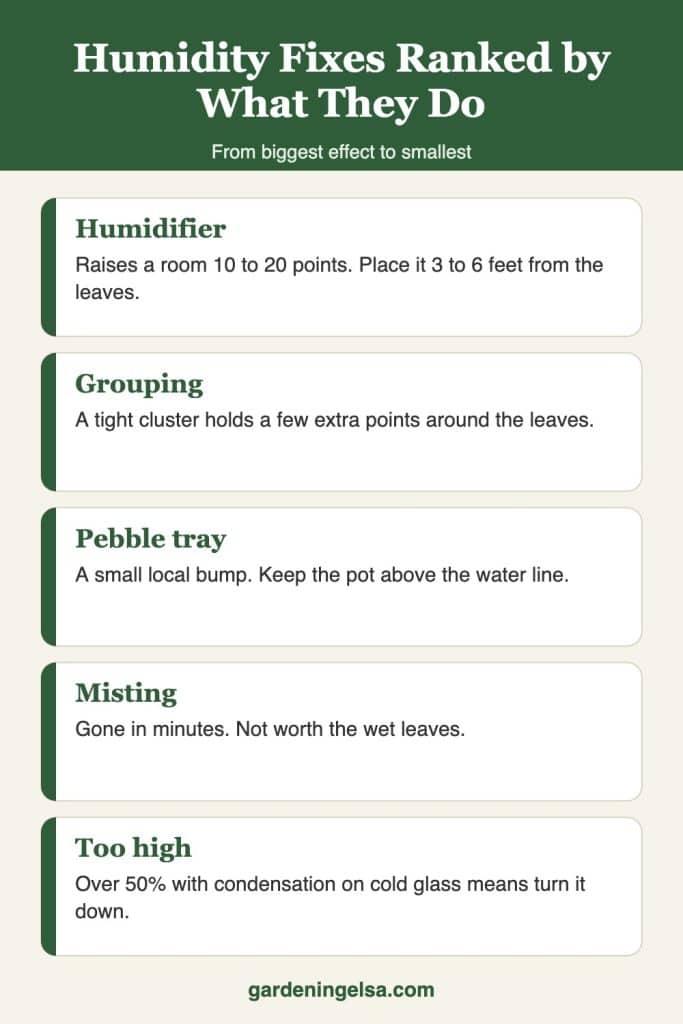
Then they dry. In a heated room at 25%, a misted leaf is dry in 10 to 15 minutes, and the air around it returns to where it was. To make a real difference you would have to mist every quarter hour, all day.
Worse, water that sits in leaf joints and on velvety leaves at night invites leaf spot. Calatheas and African violets mark easily.
A humidity tray is a shallow tray filled with pebbles and water, with the pot sitting on top. Evaporation adds a little moisture right around the plant.

In an open room, a tray adds a point or two at the leaves. It helps a single small plant. It won’t rescue a calathea in a 20% room.
If you use one, keep the water below the top of the pebbles. A pot base sitting in water wicks it up, and the bottom inch of soil stays soggy. Refill every few days and rinse the pebbles monthly, because they grow algae.
You’ve done it if the leaves still crisp despite daily misting, or the bottom inch of soil in a tray pot stays soggy.
The exception: misting is fine for air plants, which take up water through their leaves, and for a cutting under a clear bag or cloche, where the moisture has nowhere to go.
Buying a Humidifier and Parking It Wrong
A humidifier is the only fix that moves the number much. A small room unit can lift a closed bedroom 10 to 20 points in a few hours. Placement is where people go wrong.
Too close, under 2 feet, and the cool mist settles on the leaves and the furniture. Too far, across a big open room, and the plants never see it.
Put it 3 to 6 feet away, raised off the floor if you can, with the plume aimed into the room rather than straight at the foliage.
Five or six leafy plants pushed close together hold a few extra points between them, so group the fussy ones within the humidifier’s reach.
Use distilled water in ultrasonic models. Tap water leaves a fine white mineral dust on leaves, screens and shelves.
The EPA advises distilled or demineralized water for ultrasonic and impeller units. It also says to empty the tank, wipe it dry and refill it daily, and to clean portable units every third day so mold and bacteria don’t grow.
Set it to stop at 50%. Many units have a built-in humidistat; if yours doesn’t, plug it into a timer for mornings and evenings.
You’ve done it if there’s white dust on nearby shelves, or the leaves right under the plume stay wet.
Pushing Humidity Too High
Yes, you can overdo it. In winter, warm moist air meets cold window glass and condenses. Run a room at 60% in January and you’ll see water running down the panes by morning, then black mold on the sills and peeling paint.
The EPA says to keep indoor humidity below 60%, ideally 30 to 50%, and not to run a humidifier past 50%. For plants and the house, 45 to 50% is the sweet spot.
If the windows fog at dawn, or the hygrometer reads above 55%, turn the humidifier down 5 points.
A dry-air plant kept damp also suffers. Succulents in a humid room rot from the base. Keep them in another room from the humidifier.
Blaming Humidity for Every Brown Tip
Brown tips are the classic dry-air sign. They are also the classic sign of other problems, and people miss those.
If the soil stays wet for 10 days, think roots, not air. If a white crust lines the pot rim, it’s fertilizer salt.
Dracaenas and spider plants brown at the tips from fluoride and chlorine in tap water. Spider mites, which love dry air, leave fine speckling and webbing under the leaves. Our guide to spider mites on indoor plants shows how to check.
Once the cause is sorted, cut the brown off at a slant so the tip keeps its point, leaving a hair of brown so you don’t open green tissue.
You’ve done it if a humidifier has run for a month at 45% and new tips still brown.
If You Already Did It
If your plants spent a winter at 20%, don’t expect the damaged leaves to recover. Brown edges stay brown.
In a closed room, the hygrometer should reach 45 to 50% within a day. New leaves that open after that point, usually within 3 to 6 weeks in winter light, should come out clean. Calatheas often stop curling within a week.
If new leaves still brown at 50%, look at water, light and the other usual causes of a struggling houseplant. For the rest of the cold-season routine, see our winter houseplant care numbers.
What I’d Actually Do
I’d buy the gauge first and let it decide. If your room sits above 40% and you grow pothos and snake plants, you need nothing. If it reads 25% and you love ferns, a humidifier is the only answer that works.
- Put the hygrometer at leaf height and read it for three days.
- Group the fussy plants into one room or one corner.
- Run a humidifier 3 to 6 feet away, set to stop at 50%.
- Fill it with distilled water and clean it every third day.
- Turn it down if the windows fog at dawn.
Houseplant Humidity Questions, Answered Plainly
How do I know my hygrometer is accurate?
Do the salt test. Put a capful of table salt with a few drops of water, enough to make damp slush, in a zip-top bag with the gauge, without touching it. Seal it and leave it 8 to 12 hours at room temperature. The air inside settles at 75%. If yours reads 70%, add 5 points to every reading.
Is a bathroom a good place for humidity-loving plants?
Only if it has a window. A bathroom gets a big humidity spike after a shower, then dries back down. That helps ferns, but no amount of steam makes up for a windowless room.
Do terrariums or cloches solve the problem?
For small plants, yes. A closed glass case holds 70% or more with no equipment. Use it for small ferns, nerve plants and baby calatheas, and open the lid for an hour a week if the glass stays fogged.
Warm mist or cool mist for plants?
Cool mist is safer around pets and children and uses less power. Warm mist units boil the water, so they don’t throw mineral dust, but the steam outlet can burn. Plants don’t care which.
Do houseplants need a humidifier in summer?
Usually not. Indoor air in most of the US runs 40 to 60% in summer. The exceptions are the dry Southwest and rooms where the air conditioner runs hard all day, which can pull humidity into the 30s.

Hello there! I’m Elsa, and gardening is my passion. As an avid gardener, I created GardeningElsa.com to share my knowledge and experience with fellow enthusiasts. My website is a comprehensive resource for gardeners of all levels, offering expert advice on a wide range of topics, including plants, flowers, herbs, and vegetable gardening. Whether you’re a beginner looking to start your first garden or a seasoned pro seeking to expand your knowledge, GardeningElsa.com has something for everyone. Read more about me.