
Yes, but only where summers are long and hot.
You can plant eggplant seeds directly in the ground if your soil stays at 75°F or warmer and you have about four to five frost-free months ahead; most US gardeners get a better harvest by starting seeds indoors or buying transplants.
That’s because eggplant is the most cold-sensitive crop in the nightshade family. Seeds sit and rot in cool soil, and slow outdoor seedlings can run out of summer before the fruit sizes up.
Below, you’ll be able to check whether your region fits, pick your sowing date, and choose the method that gets fruit on your plate.
The Short Answer: Direct-Sow Only in a Long, Hot Season
Direct sowing works when three things line up: warm soil, warm nights, and a long season.
If you garden in the Deep South, along the Gulf Coast, in South Florida, or in the low desert of Arizona and California, planting eggplant seeds outdoors is a fair bet.
Everywhere else, I’d start indoors. Here’s how I’d sort it:
- Direct sow: Soil at 4 inches holds 75°F or more, nights stay above 60°F, and you have 140+ days before first fall frost.
- Start indoors: You have warm summers but a frost season, like most of the Midwest, Northeast, Mid-Atlantic, and Pacific Northwest.
- Buy transplants: You’re short on time, space, or grow lights, or your season is under 120 days.
Eggplant seeds are cheap, so testing a short row outdoors costs little. Just plan a backup if the soil runs cool.
Why Does Direct Sowing Often Fail?
Outdoor sowing fails for three linked reasons: seeds need heat most springs can’t provide, the plant needs a long run to fruit, and tiny seedlings make easy meals for flea beetles. Each problem makes the others worse.
Cold Soil Delays Germination
Eggplant seeds sprout best at 75°F to 85°F. At that range, you’ll see seedlings in about 7 to 14 days.
Drop the soil to 65°F and emergence stretches past two to three weeks. Below 60°F, most seeds won’t sprout at all, and many rot in the damp ground.
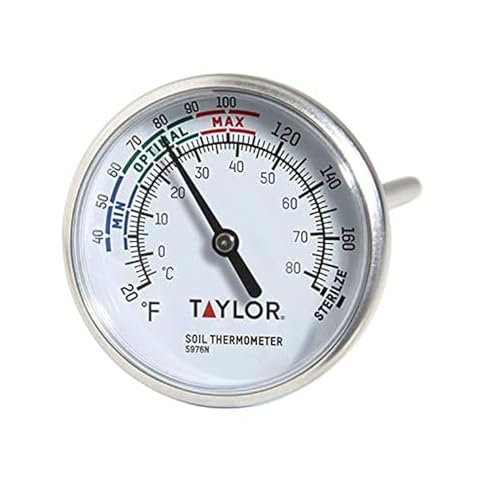
Air temperature fools a lot of gardeners. A sunny 80°F afternoon in May can sit on top of 58°F soil, so I always go by a soil thermometer pushed 4 inches deep and read in the early morning.
Eggplants Need Time to Reach Harvest
Most eggplant varieties need 60 to 80 days from transplant to first fruit. Add the 8 to 10 weeks a seedling needs to reach transplant size, and you’re looking at roughly 4 to 5 months from seed.

In New York, soil may not hit 75°F until mid-June. A seed sown then wouldn’t be ready to pick until October, right when frost shows up.
Cold also stalls growth that’s already started. Eggplant stops growing when nights fall below about 55°F, and it doesn’t make up that lost time later.
Flea Beetles Can Damage Small Seedlings
Flea beetles are tiny dark beetles that chew round “shot holes” in leaves. A big, healthy plant shrugs them off. A seedling with two leaves can lose most of its leaf area in a few days.
Slow, cold-stressed eggplant seedlings stay small longer, which keeps them in the danger zone. That’s a big reason transplants, which go out already 6 to 8 inches tall, survive better.
Where Can Outdoor Sowing Work?
Outdoor sowing pays off mainly in USDA zones 9 through 11 and the hottest parts of zone 8. In those areas, the soil warms early and frost-free time runs long enough for seed-to-harvest.
Long, Warm Seasons in the Deep South and Gulf Coast
South Texas, coastal Louisiana, southern Mississippi and Alabama, and the Florida Panhandle can direct sow once soil reaches 75°F, usually from mid-April into May.
The long summer gives plants time to catch up. Many Gulf Coast gardeners also get a second flush of fruit in fall as temperatures ease.
One catch: very hot spells above 95°F make blossoms drop. Plants sown in spring will set fruit, pause in midsummer, then pick up again in September.
Spring and Fall Windows in the Low Desert and South Florida
The low desert around Phoenix, Tucson, and the Imperial Valley has two windows. Sow in early spring (March) so plants fruit before peak heat, or in late summer (July to August) for a fall crop.
South Florida flips the usual calendar. Summer is too wet and buggy for many growers, so fall and winter sowing (August through February) works best.
In both places, afternoon shade cloth in the hottest weeks helps flowers set fruit.
When Should You Sow in Your Region?
Your sow date comes from soil temperature first, then frost dates, then season length. Use the checks below together, and let the thermometer make the final call.
Compare Soil Temperature, Frost Dates, and Growing-Season Length
I’d run through this checklist before you sow anything:
- Soil temperature: For direct sowing, 75°F at 4 inches for three mornings in a row. For transplants, at least 60°F, with 65°F to 70°F better.
- Night lows: Above 55°F for transplants and 60°F for direct-sown seedlings.
- Last frost: Transplant 2 to 3 weeks after your average last frost date.
- Season length: Count days from your sow date to your first fall frost. You need about 140 days for direct sowing a standard variety.
Eggplant grows best when daytime temperatures hold between 70°F and 85°F. For more on reading those signals, see my guide on the best time to plant eggplant.
Regional Timing for Direct Sowing and Transplanting
These dates are starting points. Shift them a week or two for your own microclimate.
| US region (typical zones) | Start seeds indoors | Set out transplants | Direct sow outdoors? |
|---|---|---|---|
| Northeast, upper Midwest (3 to 5) | Mid-March to early April | Late May to mid-June | No |
| Mid-Atlantic, Ohio Valley (6) | Early to mid-March | Mid to late May | No |
| Upper South, Oklahoma (7) | Late February to early March | Late April to mid-May | Rarely |
| Southeast, north Texas (8) | Early to mid-February | April | Late April to May, in warm years |
| Gulf Coast, south Texas (9) | Mid-January | Mid to late March | Mid-April to May |
| South Florida, low desert (10 to 11) | Varies by season | Feb to March, Aug to Sept | Yes, spring and late summer |
| Pacific Northwest (7 to 8, cool summers) | Early to mid-March | Early to mid-June | No |
How Do You Sow Eggplant Seeds Outdoors?
To sow outdoors, warm the bed first, plant shallow, keep it moist, and thin hard. Each step protects slow seedlings during their weakest weeks.
Prepare a Sunny Bed with Warm, Well-Drained Soil
Pick a spot with at least 6 to 8 hours of direct sun. Eggplant wants rich, loose soil with a pH of 6.0 to 7.0.
Work 2 to 3 inches of compost into the top 8 inches. Heavy clay stays cold and wet, so a raised bed is the better choice if your ground drains slowly.
I’d lay black plastic mulch over the bed one to two weeks before sowing. It raises soil temperature a few degrees and smothers weeds. Cut small X-shaped slits where each seed group goes.
Skip any spot where tomatoes, peppers, potatoes, or eggplant grew in the past 3 to 4 years. That rotation lowers the risk of Verticillium wilt.
Sow at the Right Depth and Keep the Seedbed Moist
Plant eggplant seeds about 1/4 inch deep. Deeper than 1/2 inch slows emergence.
Drop 3 or 4 seeds in each planting spot, cover lightly, and press the soil so seeds touch it. Some gardeners soak seeds in warm water for a few hours first to soften the coat.
Keep the top inch evenly moist, like a wrung-out sponge, until sprouts appear. A light sprinkle once or twice a day works in hot weather. A strip of shade cloth or row cover over the bed holds moisture and keeps beetles off.
Thin Seedlings and Leave Room for Mature Plants
When seedlings reach 2 to 3 inches tall, keep the strongest one in each spot. Snip the others at soil level with scissors so you don’t disturb the keeper’s roots.
Final spacing should be 18 to 24 inches between plants, with rows 30 to 36 inches apart. Dwarf types can go 12 to 18 inches apart. My page on how far apart to plant eggplant breaks this down by variety.
If you garden in a grid, you can also grow eggplant in a square foot garden by giving each plant its own square.
How Do You Start Seeds Indoors Instead?
Indoor starting gives eggplant the 8 to 10 weeks of steady heat it needs, so plants go outside big enough to fruit fast. It’s the method I’d recommend for most US gardeners.
Count Back from Your Outdoor Transplant Date
Anchor your timing to the transplant date and work back from there.

- Find your average last frost date.
- Add 2 to 3 weeks. That’s your transplant target.
- Count back 8 to 10 weeks. That’s your sow date.
For example, a last frost of April 20 gives a transplant date near May 10, so seeds go in around