
Yes, you can eat lemongrass. The tender, pale lower stalk of lemongrass is edible once you peel off the tough outer layers and slice or mince it finely, while the green leaves and woody tops are best used for tea and infusions, then strained out.
The whole plant is safe for people in food amounts.
What separates the parts is texture: the lower 4 to 6 inches of the stalk turns soft and fragrant when cooked, and the upper grass stays stringy no matter how long it simmers.
Once you know where that line falls, you’ll waste almost nothing.
The Short Answer: Eat the Tender Stalk, Infuse the Leaves
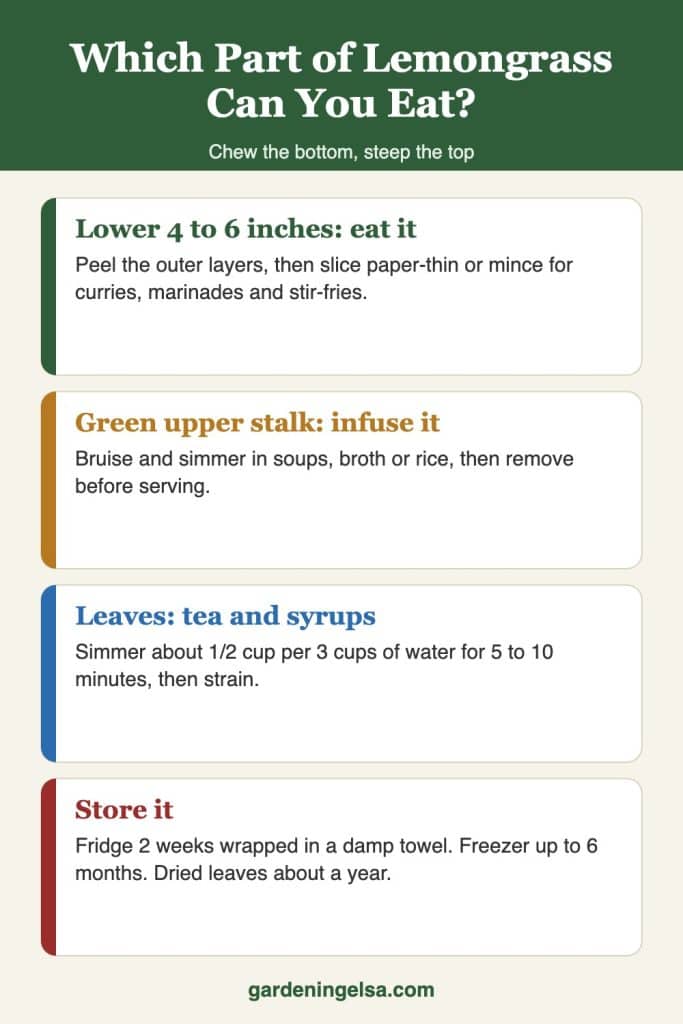
The rule I follow with lemongrass is simple to remember: chew the bottom, steep the top. If you are stocking up, a pair of bypass pruners is the first thing I would pick up.
The pale, fleshy base is the part you mince into curry pastes, marinades, and stir-fries. It holds the most concentrated lemony flavor, with a light hint of ginger and none of the sourness of lemon juice.
The green upper stalk and leaves carry the same aroma but feel like chewing on twine. I bruise them and drop them into soups, broths, and teas, then pull them out before serving, the same way you’d treat a bay leaf.
Which Parts of Lemongrass Can You Eat?
Every part of culinary lemongrass is non-toxic, but only the inner base softens enough to eat. The outer sheaths, upper stalk, and leaf blades are flavor-only parts.
The Tender White Base and Inner Stalk
The edible part of a lemongrass stalk sits in the bottom third, just above the root end. Peel back the dry outer layers and you’ll find a pale yellow to white core that feels firm and slightly moist, a bit like a peeled garlic clove.
This is the part of Cymbopogon citratus, West Indian lemongrass, that cooks in Thailand and Vietnam slice into rings or pound into paste. A slight pink or purple tint near the base is normal on many stalks.
Even this tender core is fibrous. You’ll want to slice it paper-thin across the grain or mince it fine, and cook it for at least 5 minutes so it softens.
The Tough Outer Layers and Green Leaves
The papery outer sheaths and the green upper stalk are too woody to chew. They won’t hurt you, but big fibers get stuck in your teeth and feel unpleasant to swallow.
The long, flat leaf blades on homegrown plants are even tougher, with sharp edges that can give you a paper cut. Save all of these for infusions.

A stalk top has a milder flavor than the base, so I use about twice as many tops when a recipe calls for one whole stalk.
How Do You Prepare a Lemongrass Stalk?
Prepping lemongrass takes about two minutes per stalk: pick a firm one, trim both ends, peel, then bruise or mince depending on whether you’ll eat it.

Choose a Firm Stalk and Remove the Tough Layers
Look for fresh lemongrass that feels heavy and firm, with a pale green color and a slightly bulbous base. Skip stalks that feel hollow, bend easily, or look brown and crumbly at the bottom.
If you cook with it often, a couple of live lemongrass plants keep you in fresh stalks all summer.
Then prep it like this:
- Cut off the hard root end, about ¼ to ½ inch.
- Peel away one or two dry outer layers with your fingers.
- Pinch your way down the stalk from the top until it feels solid. Cut there.
- Set the green top aside for broth or tea.
Don’t expect a whole stalk to smell strongly at the store. The scent comes out once you cut or crush it.
Bruise for Infusing or Mince for Eating
Bruising releases the oils without breaking the stalk apart. Whack it a few times with the back of a knife, a rolling pin, or a heavy can, or bend it back and forth.
Cut it into 2- to 4-inch pieces so they’re easy to fish out.
For eating, slice the tender core into thin rings, starting at the base and stopping once it turns green and woody. For a finer texture, pound it first, pull the fibers apart, then chop.
A food processor or mortar and pestle turns the slices into soft, yellow-green flakes that disappear into a dish.
How Do You Cook with Lemongrass?
Lemongrass works two ways in a recipe: as removable pieces that flavor liquid, or as minced stalk and lemongrass paste that stays in the food.
Add Bruised Pieces to Soups and Curries, Then Remove Them
Bruised pieces belong in anything that simmers. Thai tom yum and tom kha soups, coconut curries, Vietnamese pho-style broths, and even a pot of rice all take on that bright citrus aroma.
Add the pieces at the start so they have 15 to 20 minutes to give up their flavor. Pull them out before serving, or warn your guests they’re there. A muslin bag or tea ball makes cleanup easy in rice and small batches.
Use Finely Minced Stalk or Paste in Marinades and Stir-Fries
Minced stalk is the part you eat, so it goes where it’ll cook into the food. Mix 1 to 2 tablespoons with garlic, shallot, fish sauce, and a little sugar for a Vietnamese-style marinade on chicken, pork, or tofu.
Pound it with chiles and ginger for Thai curry paste.
In stir-fries, add minced lemongrass with the garlic and cook it a minute or two before the other ingredients. Store-bought lemongrass paste works in a pinch, but check the label, since many contain added salt and sugar. Taste before seasoning.
If you can’t find fresh stalks, 1 teaspoon of ground lemongrass or 1 tablespoon of dried equals about one fresh stalk.
What Can You Do with Lemongrass Leaves?
The leaves are your flavoring material for any liquid you’ll strain. If you grow lemongrass, you’ll have far more leaves than stalks, so it pays to use them.
Infuse Broth, Syrup, and Cooking Liquid
Here’s where I put leaves and trimmed tops to work:
- Broth and stock: Add a handful while chicken or vegetable stock simmers.
- Simple syrup: Simmer 1 cup sugar, 1 cup water, and ½ cup chopped leaves for 10 minutes, then strain. Use it in lemonade, iced tea, or cocktails. It keeps about 2 weeks in the fridge.
- Rice and grains: Lay a few leaves in the pot while rice cooks.
- Flavored oil: Warm chopped leaves gently in a neutral oil, strain, and refrigerate. Use it within a week.
- Grilling skewers: Firm stalk tops work as skewers for meatballs and shrimp.
Tie Leaves into Bundles for Easy Removal
Long leaves are awkward in a pot, so I fold them into a tight bundle and tie a knot with one of the leaves. You can also wrap them with kitchen twine.
A bundle lets you lift every piece out in one grab. It’s the cleanest way to flavor a big pot of soup or a slow cooker curry without anyone chewing a stray strand.
How Do You Make Lemongrass Tea?
Lemongrass tea is the easiest use for both leaves and stalks, and it takes about 15 minutes.
Wash and Cut the Leaves or Stalk
Rinse leaves or stalks well, especially homegrown ones, since soil collects at the base. Wear gloves when handling a big pile of fresh leaves to protect your hands from the sharp edges.
Cut everything into 1-inch pieces. Bruise stalk pieces with the flat of your knife; leaves don’t need it. You’ll want about ½ cup packed for 3 cups of water, or about 2 stalks.
Steep, Strain, and Adjust the Strength
- Bring 3 cups of water to a boil in a saucepan.
- Add the lemongrass, cover, and simmer 5 to 10 minutes.
- Strain through a fine-mesh sieve.
- Taste and adjust.
For a stronger cup, simmer up to 15 minutes or add more lemongrass. If it tastes grassy, cut back on leaves and use more stalk.
Honey, a slice of ginger, or a squeeze of lime all pair well. For iced tea, chill it an hour and pour over ice.
How Should You Store Fresh Lemongrass?
Whole lemongrass stalks last about 2 weeks in the fridge and up to 6 months in the freezer, and dried leaves keep for months in a jar.
Refrigerate or Freeze Stalks
Wrap whole stalks in a slightly damp paper towel and tuck them into a loose plastic bag in your crisper drawer. They’ll stay fresh 10 days to 2 weeks. Chopped or minced lemongrass only lasts 2 to 3 days in the fridge.
The freezer is my favorite option. Freeze whole stalks, sliced rings, or minced lemongrass in an airtight freezer bag. Freezing also softens the fibers, so frozen stalks are easier to chop, and you can drop frozen pieces straight into soup.
Dry Leaves for Later Infusions
Hang bundles of leaves in a warm, dry, airy spot out of direct sun, or spread them on a screen. They’re ready when they snap, in about 1 to 2 weeks. A dehydrator at 95 to 115°F works faster.
Cut the dried leaves into 2- to 3-inch pieces and store them in an airtight glass jar away from light. Use them within about a year for the best flavor.
What Should You Know About Nutrition and Safety?
Lemongrass in normal food and tea amounts is low in calories and safe for most adults. Concentrated forms and pets need more caution.
Food Amounts, Allergies, and Pregnancy
A tablespoon of fresh lemongrass adds very few calories, plus small amounts of iron, calcium, and vitamin C. Since you eat it in small quantities, think of it as a flavor herb, not a nutrition source.
Some people react to lemongrass with skin irritation or allergy symptoms. If lemongrass oil or the fresh grass irritates your skin, I’d skip eating it too.
Pregnancy is a gray area. There’s limited research, and some health sources advise pregnant women to avoid medicinal amounts. A little in a curry is a different thing from daily strong tea, so check with your doctor if you’re pregnant or take regular medications.
Why Essential Oil and Pets Need Different Precautions
Lemongrass essential oil is a concentrate, not a food. Never drink it or add it to recipes in place of fresh lemongrass, and dilute it before it touches your skin.
Pets are another story. The ASPCA lists lemon grass as toxic to cats, dogs, and horses, mainly causing vomiting and diarrhea. Read more about is lemongrass safe for pets if you have animals that nibble on grass.
How Do You Harvest Homegrown Lemongrass for Cooking?
Homegrown stalks are ready when they’re at least ½ inch thick at the base, usually 3 to 4 months after planting.
Cut Mature Stalks with a Sharp Knife or Pruning Shears
Pick the thickest stalks from the outside of the clump. Cut each one at soil level with a sharp knife or pruning shears, or twist and pull it free so you get some of the tender white base.
Take leaves anytime for tea by snipping them with sharp scissors. Wear gloves and long sleeves, since the blades are sharp. My full guide shows how to harvest lemongrass through the season.
Keep the Plant Growing After a Harvest
Never take more than about a third of the clump at once. The remaining stalks keep feeding the roots and sending up new shoots.
After a big harvest, water deeply and feed the plant. Cutting back overgrown leaves keeps it tidy, too; here’s how to trim lemongrass without hurting it. In cold regions, harvest everything you want before the first frost.
Should You Buy Lemongrass or Grow Your Own?
Buying makes sense for occasional cooks, while growing gives you endless leaves for tea and fresh stalks all summer. Many people do both by rooting a store stalk.
Identify Culinary Lemongrass and Choose Fresh Stalks
The cooking type is West Indian lemongrass, Cymbopogon citratus. East Indian lemongrass (C. flexuosus) is also edible. Citronella grass looks similar but is grown for scent, so buy live lemongrass plants labeled by botanical name.
Asian markets have the freshest stalks and the best turnover. Many also sell frozen packs of 6 to 8 stalks.
Regrow a Grocery Store Stalk
Choose a stalk with the base intact. Trim the top to about 6 inches, peel one outer layer, and stand it in 1 to 2 inches of water in a sunny window. Change the water every day or two.
Roots show up in 1 to 3 weeks. Once they’re about an inch long and new leaves appear, pot it up. My step-by-step guide shows how to regrow lemongrass from store-bought stalks.
Care for Live Plants in US Growing Conditions
Lemongrass is a tropical perennial grass, hardy only in USDA zones 10 to 11, or zone 9 with protection. Parts of Florida, south Texas, and Southern California can grow it in the ground year-round.
Everywhere else, from the Northeast to the Pacific Northwest, I’d grow lemongrass in pots. Plant outside once nights stay above 60°F, and bring pots indoors before nights drop below 50°F.
Give it 6 or more hours of direct sun; see how much sun lemongrass needs for details. Feed every 2 to 3 weeks in summer with a nitrogen-rich or balanced fertilizer, and keep the soil evenly moist but well drained.
My lemongrass care guide covers watering and winter care.
Frequently Asked Questions
Can you eat raw lemongrass?
Yes, the tender inner core is edible raw if you