
For most American homes, I’d pick the cat palm if your room gets moderate light and you want a fuller plant that stays around 3 to 6 feet tall.
I’d pick the areca palm if you have a bright window and want a taller, feathery palm that can reach 6 to 8 feet indoors. Both are true palms, both are non-toxic to cats and dogs, and both hate soggy roots.
The big differences come down to light, size, and thirst. Areca palms need more light and get bigger. Cat palms handle shadier spots but dry out and brown faster when you miss a watering.
At-a-Glance Comparison Table
The areca palm (Dypsis lutescens) is the taller, brighter-light plant. The cat palm (Chamaedorea cataractarum) is the shorter, shade-tolerant, water-loving plant. Here’s how they line up. If you are stocking up, a soil moisture meter is the first thing I would pick up.
| Feature | Areca Palm | Cat Palm |
|---|---|---|
| Indoor height | 6 to 8 feet | About 3 to 6 feet |
| Light | Bright indirect | Medium to bright indirect |
| Water | Water when top 1 to 2 inches dry | Keep evenly moist |
| Frond color | Light, yellow-green | Deep green |
| Stems | Yellow-gold canes | Very short, nearly stemless clumps |
| Pet safety (ASPCA) | Non-toxic | Non-toxic |
Which Differences Matter Most Indoors?
Light and height decide most of the choice. An areca in a dim corner slowly thins out, drops lower fronds, and stops pushing new spears. Once a cane gives up, it doesn’t fill back in.
A cat palm copes with less light, but it wants steadier moisture. If you travel often or forget to water, its frond tips crisp quickly.
Height comes next. An areca can touch an 8-foot ceiling in a few years. A cat palm stays wide and bushy, which suits apartments and smaller rooms.
How Can You Tell These Palms Apart?
You can tell them apart by color and stems: arecas have pale green, finely cut fronds on golden canes, while cat palms have darker, wider leaflets that sprout from a low clump near the soil.
Both are feather-leaf palms, so the shape alone can fool you at first glance.
Compare Frond Color and Shape
Areca fronds are light green to yellow-green. They arch outward like a fountain, and each frond carries many narrow leaflets, roughly half an inch wide. The effect is airy and soft.
Cat palm fronds are a richer, darker green. The leaflets are wider, about an inch, and there are fewer per frond. The plant looks dense and lush.
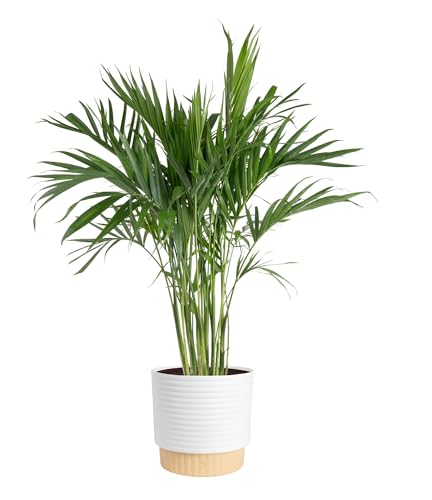
Garden centers sometimes sell other Chamaedorea palms next to these. The parlor palm (Chamaedorea elegans) is smaller with single stems, and the bamboo palm has tall, smooth green canes.
If you want to sort through other palm varieties, my guide to types of indoor palms covers the common ones.
One more naming trap: arecas are also sold as butterfly palm and golden cane palm, and some tags even call them bamboo palm. Check the botanical name on the label.

Check the Stems and Growth Habit
Look at the base of the plant. Areca palms grow as a clump of several upright, cane-like stems. The canes are yellow-orange to gold and show ring marks like bamboo.
Cat palms barely form visible trunks. Fronds rise from a tight crown right at the soil line, so the plant spreads out more than up. Older cat palms keep sending up new shoots, which makes them look fuller each year.

How Much Light Does Each Palm Need?
The areca needs bright indirect light to stay full, while the cat palm stays healthy in medium indirect light and also does well in brighter filtered sunlight. Neither palm wants hours of hot direct sun through glass.
Where to Place an Areca Palm
Put an areca 2 to 4 feet back from an east, south, or west window, or right at a window filtered by a sheer curtain. A few hours of gentle morning sun is fine.
Hot afternoon sun from about 1 to 4 p.m. in summer bleaches and scorches the fronds. If you see tan patches on the side facing the glass, pull the plant back a couple of feet.
In a dim room, growth slows, fronds get sparse and floppy, and the soil stays wet longer. That last part leads to root rot.
If your only spot is darker, read my notes on areca palm in low light before you buy. A full-spectrum LED grow light on a timer for 8 to 10 hours a day helps through northern winters.
Where to Place a Cat Palm
A cat palm fits spots a few feet back from a window, or near a north-facing window. It also thrives in bright indirect light, and grows faster and fuller there.
“Low light” still means a room with a window. A windowless bathroom or deep hallway won’t keep it alive for long.
Keep it out of direct afternoon sun, especially in the Southwest and Southeast, where sun through a south or west window is intense. Rotate the pot a quarter turn every week or two so the clump grows evenly.
How Should You Water and Pot Each Palm?
Water an areca when the top 1 to 2 inches of soil feel dry, but keep a cat palm a little more evenly moist, watering as soon as the top inch dries.
Both need well-draining soil and a pot with holes, because standing water rots palm roots.
Check Soil Moisture Instead of Following a Schedule
Push your finger 1 to 2 inches into the soil near the pot’s edge. For an areca, water when that layer is dry and the soil below is just barely damp. For a cat palm, water when the top inch dries.
Water deeply until it runs out the bottom, then empty the saucer within 15 minutes. As a starting point, many arecas need water every 5 to 7 days in spring and summer and every 10 to 14 days in winter.
Your room’s light and heat will shift those numbers.
Cat palms drink a bit more and complain fast when they dry out. Crispy brown tips across many fronds point to missed waterings.
Both palms are sensitive to fluoride, chlorine, and salts in tap water. If tips keep browning, switch to filtered, distilled, or rainwater, and flush the pot with plenty of water every few months.
Soggy soil is the most common killer, so if your areca’s lower fronds yellow in wet soil, cut back.
Choose a Pot and Mix That Drain Freely
Use a peat- or coir-based potting mix lightened with perlite and a little fine bark. A simple recipe is 2 parts potting mix, 1 part perlite, and 1 part orchid bark.
Skip heavy, dense potting soil and decorative pots without holes. If you love a cachepot, set a plastic nursery pot inside it and tip out any water that collects.
Both palms like a snug pot. Too much extra soil holds water the roots can’t use. My guide to pot size for an areca palm walks through sizing up the right way.
How Big Do They Get Indoors?
The areca grows taller, reaching 6 to 8 feet indoors with a 3 to 5 foot spread, while the cat palm usually stays around 3 to 6 feet tall and nearly as wide.
Outdoors in USDA zones 10 and 11, an areca can reach 15 to 30 feet.
Allow Room for Height and Spreading Fronds
Arecas grow about 6 to 10 inches a year in good light. A 4-foot nursery plant can hit the ceiling within a few years, so measure before you buy.
You can’t shorten a palm by cutting the top. Each cane grows from a single tip, and cutting it kills that cane.
Cat palms spread outward. Give them a circle about 3 to 4 feet across so fronds don’t rub on walls or furniture, which tears leaflets and browns edges.
Plan for Slow Growth and Occasional Repotting
Repot either palm every 2 to 3 years in spring, or when roots circle the pot or poke out the drainage holes. Go only 1 to 2 inches wider than the old pot.
Set the plant at the same soil depth it sat before. Burying canes or the crown deeper invites rot.
Palm roots are fragile, so ease the root ball out gently and loosen only the outer roots. Wait about a month before fertilizing a freshly repotted plant.
Feed both palms about once a month in spring and summer with a palm fertilizer or a balanced liquid fertilizer at half strength. Stop feeding in fall and winter.
What Humidity and Temperatures Keep Them Healthy?
Both palms like humidity of 40 to 60% or higher and temperatures between 65 and 85°F. Keep them above 50°F, because chilling damage shows up below about 45 to 50°F.

Handle Dry Indoor Air
Winter heating in the Northeast and Midwest can drop indoor humidity below 30%. That dry air browns frond tips and invites spider mites.
A small room humidifier works far better than misting, which only raises humidity for a few minutes. Grouping plants together and using a pebble tray also help a little.
Keep both palms away from heat vents, radiators, and wood stoves. Hot, dry air blowing on the fronds crisps every tip facing it within weeks. Cold drafts from doors and single-pane windows cause yellow or spotted fronds too.
Move Outdoor Plants Inside Before Cold Nights
Either palm enjoys summer outside in shade on a porch or patio. Start it in full shade for a week before giving it any brighter filtered light.
Bring it back indoors before night temperatures drop below 50°F. In much of the Northeast, Midwest, and Pacific Northwest, that’s often by mid-September or early October.
Before moving it in, hose off the fronds and check leaf undersides for pests. Expect a few yellow fronds as it adjusts to lower indoor light.
Are Both Palms Safe for Cats and Dogs?
Yes, both are safe choices for homes with pets. The ASPCA lists the areca palm (as golden cane palm) as non-toxic to cats, dogs, and horses, and Chamaedorea palms like the cat palm are also listed as non-toxic.
Understand What Non-Toxic Means
Non-toxic means the plant doesn’t contain poisons that seriously harm pets. A cat that chews a lot of fronds can still vomit or get an upset stomach from the plant fiber.
Cats love batting and chewing feathery fronds, and the cat palm earned its name partly from that reputation. If yours treats it like a salad bar, move it up on a plant stand.
The ASPCA list doesn’t cover rabbits, so I’d keep any palm away from a rabbit. You can read more about areca palms and pets.
Avoid Confusing True Palms with Sago Palm
The sago palm (Cycas revoluta) is a cycad and belongs to a different plant group from true palms. The ASPCA lists it as highly toxic to cats and dogs, and every part of it is poisonous, especially the seeds.
Sago palms have stiff, dark, shiny fronds on a thick, shaggy trunk. If a plant tag just says “palm,” check the botanical name before bringing it home to pets.