
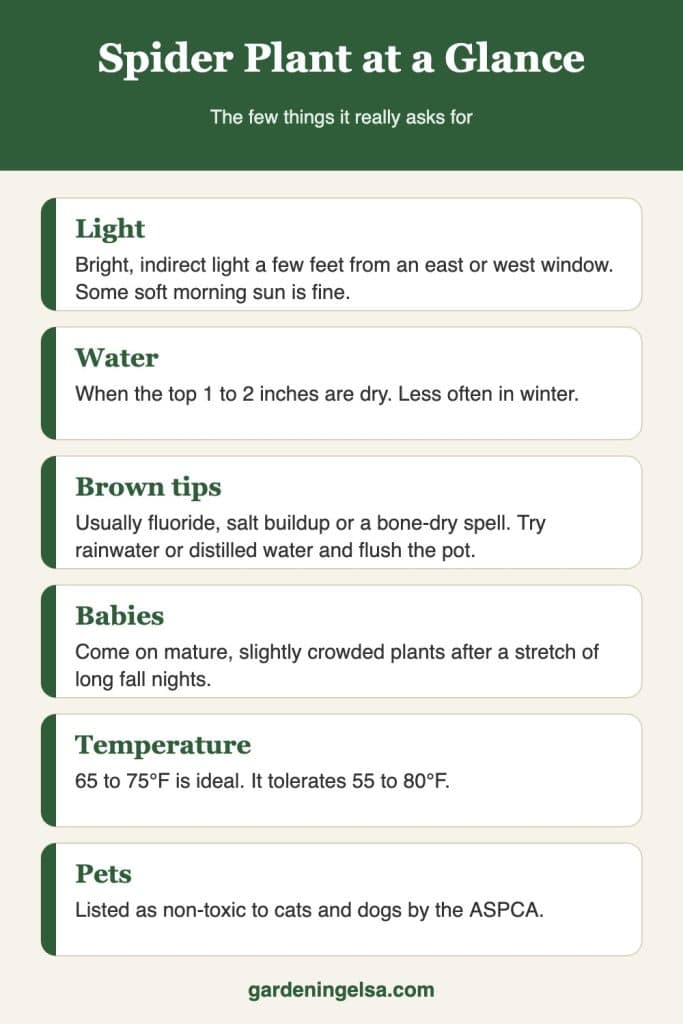
Give a spider plant bright, indirect light, water it when the top inch or two of soil is dry, and switch to rainwater or distilled water if the tips keep browning. That’s most of it.
A happy one will hang its little babies over the pot edge within a year or two.
What I’d tell a neighbor: brown tips are cosmetic, so don’t panic and don’t overwater to fix them. Trim them, change the water you use, and judge the plant by its new leaves, not its old ones.
Before You Start
Pick the pot first, because it decides how easy watering is. A spider plant looks best hanging, where the babies can dangle freely, so a hanging planter with a drainage hole is the natural choice.
Skip any pot without a hole, no matter how pretty it is.
For soil, any good bagged indoor potting mix works. You don’t need anything special. I’d avoid mixes that list “moisture control” crystals, which hold water longer than this plant wants.
Then check your water. If you’re on city water and every spider plant you’ve owned has had brown tips, that’s a clue. Set out a bucket for rain, or plan on a gallon jug of distilled water from the grocery store. It’s cheap insurance.
The First Month at Home
Store plants usually come in a crowded plastic pot, and that’s fine. Leave it alone for the first few weeks. Repotting right away just adds stress to a plant that’s already adjusting to new light and drier air.
Expect a few older leaves to yellow or brown in that first month. It’s normal. The plant is dropping leaves it grew under greenhouse conditions. Cut those off at the base with clean pruning snips once they’re fully yellow.

Elsa’s note: if you can’t tell which variety you have, look at the stripe.
A white center stripe with green edges is ‘Vittatum’, white edges with a green center is ‘Variegatum’, and the one with leaves that curl like ribbons is ‘Bonnie’. They all take the same care.
A Spot With Bright, Soft Light
The best spot is 3 to 5 feet from an east or west window, or right in an east window where it gets a couple of hours of gentle morning sun. A south window works if a sheer curtain softens the afternoon glare.
Too much hot sun shows up fast. You’ll see pale, washed-out leaves and dry tan patches on the side facing the glass.
Too little light is slower. Variegated types lose some of their white stripe, the leaves get floppy, and the plant stops making babies. A spider plant will live in a dim room for years. It just won’t look like much.
A room at 65 to 75°F suits it best, and it puts up with 55 to 80°F. Don’t let leaves touch cold window glass in January.
Outdoors, it’s a year-round groundcover only in frost-free parts of Zones 9 to 11. Everywhere else, it can summer on a shaded porch and come back in before nights drop below 50°F. Our guide to moving houseplants outdoors for summer covers the shift.
Watering Without the Drama
Water when the top 1 to 2 inches of soil feel dry. In a bright room in summer, that’s often once a week. In winter, with less light, it might be every 10 to 14 days.
Spider plants have thick, white, tuber-like roots that store water. That’s why they bounce back from a missed week. It’s also why they rot if the soil stays soggy, because those fleshy roots go mushy fast.
If you can’t trust your finger, a moisture meter takes the guesswork out. Push it to the middle of the root ball and water when it reads in the dry end of the scale. It’s especially handy for hanging pots you can’t easily lift.

When you water, soak the pot until water runs out the bottom. Then let it drain fully before you hang it back up (and before it drips on the rug).
The Brown Tip Problem, Honestly
Almost every spider plant gets some brown tips. The question is whether they’re spreading on new leaves. A few crispy tips on old leaves don’t mean anything.
The common causes, roughly in order:
- Fluoride and salts in the water. Spider plants are sensitive to fluoride, which is added to many US city water supplies. Salts from tap water and fertilizer also build up in the soil and burn the leaf tips first. Letting tap water sit out for a day lets chlorine escape, but not chloramine, which many cities now use instead, and never fluoride. Perlite and some phosphate fertilizers carry a little fluoride too.
- Letting it go bone dry. One really dry spell can brown the tips of every leaf at once.
- Too much fertilizer. Extra feed means extra salts. Look for a white crust on the soil surface or the pot rim.
- Very dry winter air. Heated rooms in January can pull moisture from the tips faster than the roots replace it. This one shows up from December to February and stops once the heat goes off.
The fix is mostly about water. Switch to rainwater or distilled water for a couple of months.
Once a season, flush the pot by running a slow stream of water through it for a minute or two, so salts wash out the drainage hole. Then watch the new leaves.
If they come in with clean tips, you found it.
Brown tips never turn green again, so trim them. A pair of pruning snips with a fine point makes cleaner cuts than kitchen scissors.
Follow the leaf’s natural shape and cut at a slight angle, leaving a tiny sliver of brown so you don’t wound green tissue.
Elsa’s note: if the tips are dark brown and the leaves are also yellowing and limp, that’s a different story. Check the roots for rot before you blame the water.
Feeding and Repotting
Feed once a month from spring through summer with a balanced liquid fertilizer at half the label rate. Stop in fall and winter.
A spider plant that gets no fertilizer at all usually does fine, and an overfed one gets brown tips and, oddly, fewer babies.
Repot when you see roots circling the surface or the tuber-like roots pushing the plant up out of the pot. They can crack a thin plastic pot. That’s usually every 1 to 2 years.
Go up only 1 to 2 inches in pot width. Fresh potting mix, same depth as before, and water it in well.

If the clump is too big, divide it instead. Slide it out, pull or cut it into 2 or 3 sections that each have roots and a good fan of leaves, and pot them separately. Spring is the best time for both jobs.
Getting Babies, and What to Do With Them
The babies (growers call them plantlets or spiderettes) grow at the ends of long, thin flowering stems. First you’ll see tiny white flowers, then little rosettes of leaves form along the stem.
To get them, you need a mature plant, usually at least a year old, that’s a bit crowded in its pot.
Spider plants also start those flowering stems after a stretch of long nights, roughly 3 weeks of 12 hours or more of darkness, which is why many plants send out runners in fall and winter.
A plant under a lamp that’s on until midnight may never get the signal.
When a baby has small root nubs on its underside, it’s ready. There are two easy ways to root it.
The no-fail way is to pin it, still attached, onto a small pot of moist soil set beside the mother plant. A bent paper clip holds it down. In 2 to 3 weeks it has roots and you can snip the stem.
The faster way is to cut it off and stand it in a glass of water so only the base is wet. Roots grow in 1 to 2 weeks. Pot it once they’re about an inch long, before they get used to living in water.
What Most People Get Wrong
The biggest one is overwatering a plant with brown tips. The tips look dry, so it feels like the plant is thirsty. Most of the time it isn’t. More water just leads to soggy roots and a second, bigger problem.
Another is repotting too often. People see the plant filling its pot and move it to a huge one. The plant spends a year growing roots into all that new soil, and you get no babies while it does.
And a lot of people cut off every runner because the plant looks messy. That’s your call, but if you want a full, cascading look, leave a few babies on.
They’re what make a spider plant look like a spider plant. For more plants that look good hanging, see our list of the best plants for hanging baskets.
Pets, Pests and Little Problems
The ASPCA lists spider plants as non-toxic to cats and dogs, which makes them one of the easier choices for a home with pets.
Cats do love to chew the dangling leaves, though, and eating plant material can still cause a little vomiting. Hang it out of reach.
Our list of cat-friendly indoor plants has more options.
Pests are rare indoors. Spider mites show up in hot, dry rooms as fine webbing and stippled leaves.
Rinse the plant in the shower and raise the humidity a bit; our guide to humidity for houseplants explains the easy ways. Mealybugs and scale hide where the leaves meet the crown.
Dab them off with a cotton swab dipped in rubbing alcohol. Fungus gnats mean the soil is staying too wet.
Elsa’s note: skip water from a home water softener. It swaps calcium for sodium, and sodium browns the tips just like fluoride does. An outdoor spigot is often plumbed before the softener, so fill your can there, or use rainwater.
Before You Head Out
- Hang it 3 to 5 feet from an east or west window.
- Water when the top inch or two is dry, then let it drain.
- Use rainwater or distilled water if new leaves brown at the tips.
- Flush the pot once a season and go light on fertilizer.
- Let it get a little crowded if you want babies.
- Root babies by pinning them onto soil while they’re still attached.
More About Growing Spider Plants
Should I mist my spider plant?
You don’t need to. Average home humidity suits it, and misting only raises it for a few minutes. If the tips crisp up every January, set the pot on a tray of wet pebbles or run a small humidifier nearby while the heat is on.
Do I cut the flower stem off once the babies root?
No rush. One stem can keep flowering and making babies for months. Cut it off at the base once it turns yellow and dry.
Can I grow a spider plant in just water?
It can survive in water for a while, but it does better in soil long term. Water-grown plants tend to get weak, and roots that grew in water need a few weeks to adjust once you pot them.
Do spider plants clean the air?
Not enough to notice in a real home. The old claim came from small sealed-chamber tests. You’d need a jungle of plants per room to match what an open window or a basic air purifier does.
How long do spider plants live?
Decades. Divide the clump and refresh the soil every few years, and keep rooting babies, and it never really ages out.

Hello there! I’m Elsa, and gardening is my passion. As an avid gardener, I created GardeningElsa.com to share my knowledge and experience with fellow enthusiasts. My website is a comprehensive resource for gardeners of all levels, offering expert advice on a wide range of topics, including plants, flowers, herbs, and vegetable gardening. Whether you’re a beginner looking to start your first garden or a seasoned pro seeking to expand your knowledge, GardeningElsa.com has something for everyone. Read more about me.