
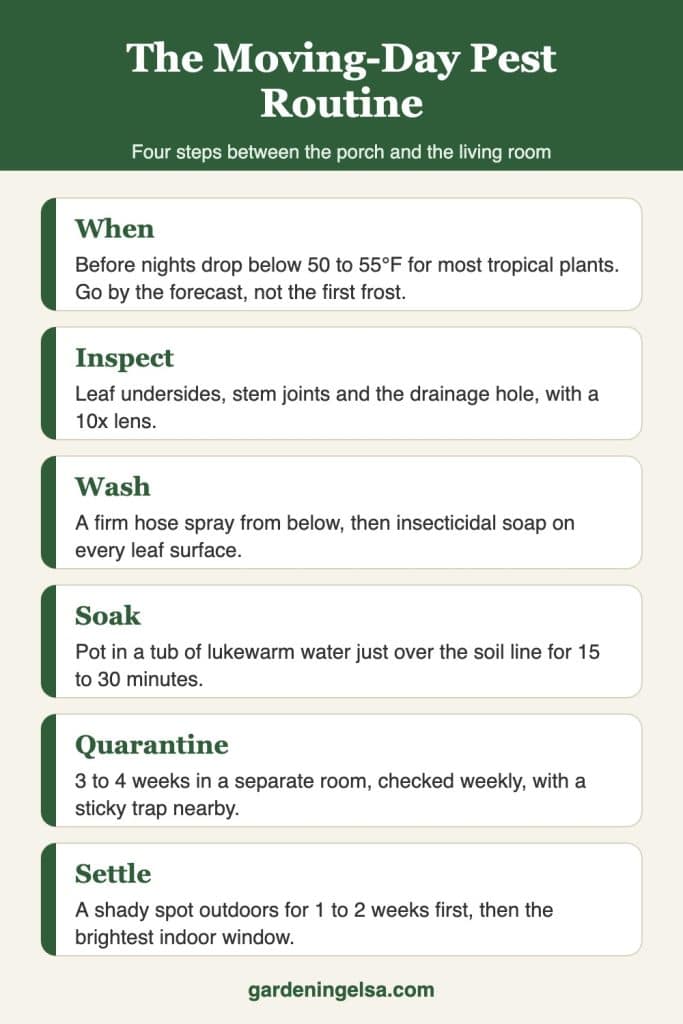
Start here: bring tropical plants in before nights drop below 50 to 55°F, and put every one through four steps on the way: inspect, wash, soak the pot, then quarantine it for 3 weeks.
That routine stops most of the aphids, mites, mealybugs and soil bugs that would otherwise move in with them.
This suits anyone who summered houseplants, tropicals or tender herbs outside and wants them back in without an infestation by January.
The bugs are a bigger risk than the cold. The warm, dry air of a heated house is exactly what spider mites and mealybugs like best.
What You’ll Need
- A garden hose with an adjustable spray nozzle.
- A ready-to-use soap spray made for insects.
- A 10x hand lens or jeweler’s loupe.
- A tub, bucket or clean trash can wider than your biggest pot.
- A sheet of white paper and 2 yellow sticky traps.
- Fresh potting mix, a few quarts, for topping up.
- A spare room, or at least a table well away from your other houseplants.
If you buy one thing, make it the insecticidal soap. It kills soft-bodied pests on contact and leaves no lasting residue indoors.
When to Move Them
Most tropical houseplants start to suffer once nights fall below 50°F, and the touchiest ones prefer to come in before 55°F. Don’t wait for the first frost. A run of cool nights is the trigger.
Check the extended forecast. When lows start reaching the low 50s, begin. In Zones 4 and 5 that’s usually early to mid-September. In Zones 8 and 9 it may be late October or November.
Not everything has to come in on the same day. Rosemary and bay handle nights in the 40s, so they can wait.
Our guide to growing rosemary by zone has its own timing. Geraniums are different again: you can keep them growing or store them dormant, as covered in overwintering geraniums.
Hardy perennials and shrubs in pots need a different plan, covered in how to overwinter potted plants.
One to Two Weeks in the Shade First
Outdoor shade is far brighter than a living room. Plants moved straight from a sunny deck to a dim corner often shed a pile of leaves within a few weeks. Weeping figs and tropical hibiscus are famous for it.
So start the light change outside, with 1 to 2 weeks in full shade on the porch or under a tree. Run the four steps below during that time.
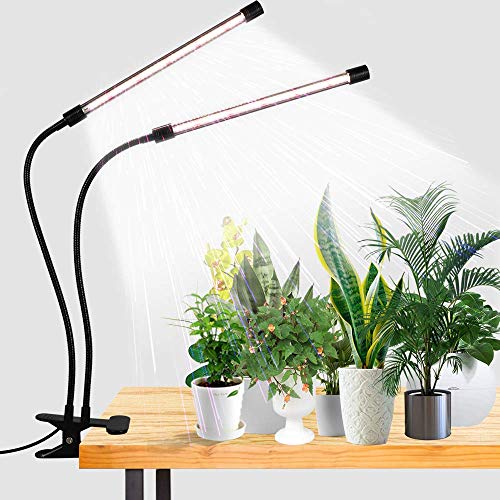
Indoors, give them the sunniest window you have. Where windows fall short, a grow light on a timer for 12 to 14 hours a day keeps them from stretching.
Expect some yellow leaves anyway. Plants can take a month or two to adjust, and that’s not disease. Once they’re in, stop feeding, water less and let the top inch dry first. Our guide to winter houseplant care covers the rest of the season.
Step 1: Look Before You Lift
Check every plant outside, before it crosses the threshold. Turn leaves over, because most pests live underneath. Then check the leaf joints and new growth.
A good hand lens makes this much faster. At 10x, spider mites look like moving specks of pepper, and mealybug egg sacs look like tufts of cotton.

What you’re looking for:
| You see | It’s usually |
|---|---|
| Fine webbing, stippled pale leaves | Spider mites |
| White cottony tufts in leaf joints | Mealybugs |
| Hard brown or tan bumps on stems | Scale |
| Clusters of soft green or black insects on tips | Aphids |
| Tiny white moth-like flies that rise when shaken | Whiteflies |
| Sticky, shiny leaves or black sooty film | Honeydew from any sap-sucker |
Then hold the white paper under a branch and tap the stem sharply. Specks that crawl are mites.
Finally, tip the pot and look at the drainage hole. Slugs, earwigs, pill bugs and ants all shelter there.
Step 2: Wash Every Leaf
Set the plant on its side on the lawn or a tarp and spray it with the hose. Aim from below so the water hits leaf undersides. Use a firm stream, but not one that tears leaves. This alone knocks off most aphids and mites.
Let the foliage dry for an hour. Then spray the insecticidal soap on every surface until it drips, undersides included.
For a big plant, decant it into a continuous-mist spray bottle that works at any angle, even upside down. Reaching the undersides gets far easier, and soap kills only the pests it touches, so coverage matters more than the amount.

Spray in shade, below 90°F, and test one leaf on fuzzy or thin-leaved plants first, waiting a day or two for any scorch. Soap only works while it’s wet and doesn’t kill eggs, so repeat every 4 to 7 days for 2 or 3 rounds.
Step 3: Soak the Pot
This is the step most people skip, and it’s the one that catches the bugs you can’t see.
Fill the tub with lukewarm, room-temperature water. Lower the pot in until the water sits about an inch above the soil line.
Leave it for 15 to 30 minutes. Ants, earwigs, pill bugs and slugs crawl or float up to escape, and you can pick them off.
Let it drain for at least an hour before it comes inside.
Skip the soak for succulents and cacti. Slide the root ball out of the pot instead and look at it, then put it back.
For every plant, scrape off the top inch of soil and replace it with fresh mix. Fungus gnat eggs and larvae live mostly in that top layer. If gnats show up anyway, see how to get rid of fungus gnats.
Step 4: Keep Them Apart for 3 to 4 Weeks
Even a clean-looking plant can carry eggs, and most pest problems show up within about a month. Put newcomers in a separate room, away from your year-round houseplants, for 3 to 4 weeks.
Stick a couple of yellow sticky traps in the pots or on stakes nearby. They catch adult fungus gnats and whiteflies, and a trap that fills up fast tells you which plant still has a problem.
Check each plant weekly with the lens. If mites show up, see how to get rid of spider mites before they spread.
Shortcuts That Work (and One That Doesn’t)
Works: take cuttings of coleus, begonias, impatiens and sweet potato vine instead of hauling the whole plant in. A jar of rooted stems takes little space and carries far fewer pests.
Shortcut: if a plant is cheap and badly infested, compost it. One coleus isn’t worth a winter of mites on your fiddle-leaf fig.
Doesn’t work: spraying with a squirt of kitchen dish soap in water. Dish detergents aren’t insecticidal soap. They strip leaf coatings and can burn foliage, and the strength is a guess every time.
Your Short List for Moving Day
- Lows in the low 50s on the forecast: start.
- Inspect undersides and the drainage hole.
- Hose, dry, then soap. Repeat the soap every 4 to 7 days.
- Soak the pot 15 to 30 minutes and refresh the top inch.
- Quarantine 3 to 4 weeks with a sticky trap.
Bringing Plants Indoors Questions Worth Asking
Can I just spray neem oil on everything instead?
Neem works on many of the same pests, but it smells strongly indoors and can’t go on in sun or heat. I’d keep soap for moving day and save neem for a specific problem later.
Should I repot plants before bringing them in?
Only if roots are circling out of the drainage hole. Repotting adds stress right when the plant is adjusting to lower light. Spring is better for anything that can wait.
When can the plants go back outside?
When nights hold above 50°F in spring, usually 2 to 4 weeks after your last frost date. Reverse the process: 1 to 2 weeks in full shade first, then morning sun, so leaves grown indoors don’t scorch.
My pot is too big for a tub. What then?
Water the soil slowly with a hose until it runs out the bottom for several minutes, which flushes out many soil insects, then scrape and replace the top inch. Or slip the plant, pot and all, into a larger cache pot indoors so any stragglers stay contained.
Is it too late if we already had a frost?
A light frost to 32°F may scar leaves on tropical plants, but the plant often lives. Bring it in now, skip the soak if the night is cold, trim damaged leaves after a week, and do the full routine at a sink or tub inside.

Hello there! I’m Elsa, and gardening is my passion. As an avid gardener, I created GardeningElsa.com to share my knowledge and experience with fellow enthusiasts. My website is a comprehensive resource for gardeners of all levels, offering expert advice on a wide range of topics, including plants, flowers, herbs, and vegetable gardening. Whether you’re a beginner looking to start your first garden or a seasoned pro seeking to expand your knowledge, GardeningElsa.com has something for everyone. Read more about me.