
Monstera deliciosa is a climbing vine that makes its largest, most deeply split leaves only when it has strong light, some age and something to climb.
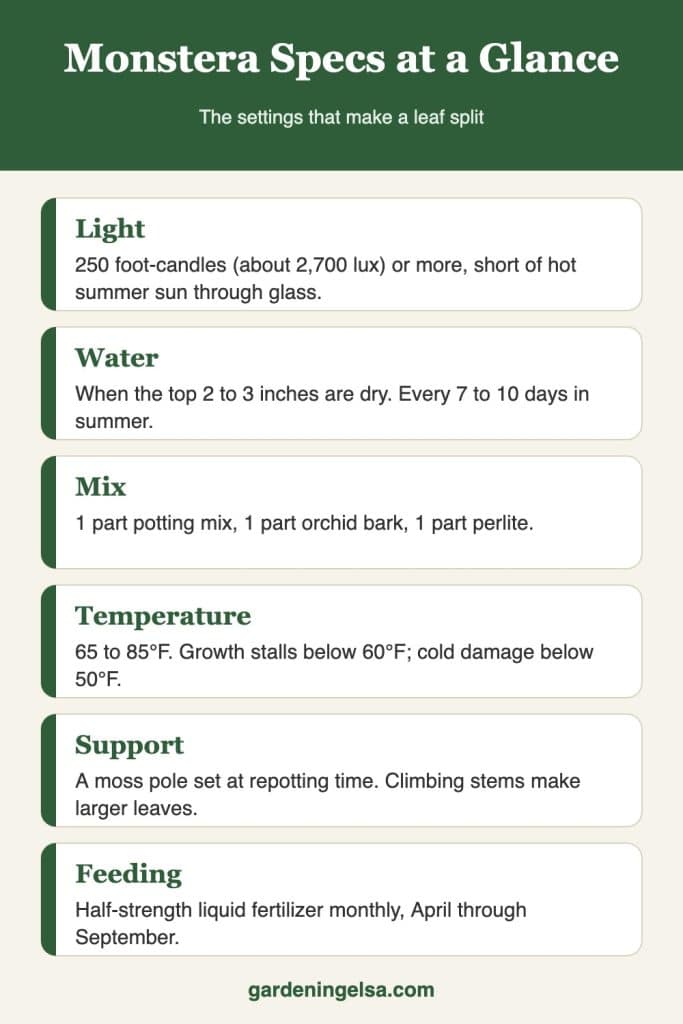
Give it bright, indirect light, water when the top 2 to 3 inches of soil are dry, pot it in a chunky mix, and stand it against a pole.
The rule: light comes first. Water, mix and feeding follow from how much light the plant gets.
Monstera by the Numbers
| Setting | Target | What changes it |
|---|---|---|
| Light for split leaves | 250 fc or more | Not hot summer sun through glass |
| Distance from a window | Within 3 feet of east, 3 to 6 feet from south | Closer in winter, farther in summer sun |
| Watering | Top 2 to 3 inches dry | Small pots dry faster |
| Summer interval | Every 7 to 10 days | Every 14 to 21 days in winter |
| Temperature | 65 to 85°F | Damage below 50°F |
| Humidity | 40 to 50% | Below 30%, new leaves may tear |
| Pot size step | 2 inches wider | Every 1 to 2 years, in spring |
| Feeding | Monthly, half strength | None from October to March |
| Indoor height | 6 to 8 feet | Less without a pole |
The potting mix matters more with monstera than with most houseplants. A bagged indoor potting mix on its own holds too much water for thick aerial-style roots.
Opened up with bark and perlite, it drains fast and dries evenly, which is what the watering numbers above assume.
Light Decides the Splits
The holes and splits, called fenestrations, appear as the plant matures. Young plants make solid, heart-shaped leaves.
Most start splitting once they are 2 to 3 years old, and only if the light is strong enough. In dim corners, mature plants keep producing small, solid leaves.
Measure instead of guessing. A free phone light-meter app reads in lux; divide by 10.76 to get foot-candles. Take the reading at the top leaf at midday.
Under about 100 fc (1,000 lux), the plant survives but leans and stretches. Between 150 and 250 fc it grows steadily with few splits.
From about 250 fc (2,700 lux) up, new leaves come in larger and more fully split. The ceiling is hot summer sun through south or west glass, which leaves pale, scorched patches within days.
Rough midday estimates on a clear day, taken at leaf height behind clean glass:
| Window | Right at the glass | 3 feet back | 6 feet back |
|---|---|---|---|
| South | Direct sun, too hot in summer | 250 to 500 fc | 150 to 300 fc |
| East | 1 to 3 hours of morning sun | 150 to 300 fc | 75 to 150 fc |
| West | Hot afternoon sun | 150 to 300 fc | 75 to 150 fc |
| North | 100 to 200 fc | 50 to 100 fc | Under 50 fc |
Treat these as starting points. Trees, porches, screens and the season all change them, and readings can vary 3 to 5 times between a sunny and an overcast day.
Take your own reading; the table only tells you where to start. I’d pick an east window first, because its morning sun is gentle enough that you rarely have to move the plant.
A south window works from October to March. In summer, pull the plant back 4 to 6 feet or filter the light with a sheer curtain.
How a Leaf Gets Its Splits
A leaf’s shape is fixed before it unrolls. An existing solid leaf will never gain holes, no matter how much you improve the light.
Only the leaves that form after the change show it, and you usually see the difference within 2 to 4 new leaves.
Three things push a stem toward split leaves: age, light and climbing.
A young plant in a 6-inch nursery pot typically makes solid or barely notched leaves 4 to 8 inches wide.
As the stem thickens and climbs, each new leaf comes in larger, first with a few notches at the edge, then with splits and a row of holes near the midrib.
A stem lying across the soil or flopping over the pot rim tends to stay in the juvenile stage. Tied to a moss pole or stake, the same stem grows upward and the leaves scale up. Set the pole early for this reason.

Field note: measure at the top leaf, not the pot rim. On a 4-foot plant near a window, the two readings can differ by half.
Watering by Depth, Not Days
Monstera roots rot in soil that stays wet. Water only when the top 2 to 3 inches are dry, then water until it runs from the drainage holes, and tip out whatever collects in the saucer.
Expect roughly 1 cup for a 6-inch pot and 3 cups for a 10-inch pot before water runs out.
For pots deeper than 10 inches, a finger only reads the surface. A moisture meter pushed two-thirds of the way down tells you what the roots are sitting in. Water when it reads 3 or lower on a 1-to-10 scale.

Intervals follow light and season. In summer, at 75°F in good light, most pots need water every 7 to 10 days. From November to February, every 14 to 21 days is typical. Cooler rooms and larger pots stretch that further.
Signs of too much water: lower leaves yellowing from the edges inward, and soil that smells sour. Signs of too little: leaves that droop and curl inward at the sides, then recover within a few hours of a thorough drink.
The Mix: Chunky and Fast-Draining
In the wild, monstera roots climb trees and grip bark. In a pot, they want air around them as much as water. A dense, peat-heavy mix packs down within a year and keeps the root zone wet.
A reliable recipe is 1 part potting mix, 1 part orchid bark and 1 part perlite, by volume. The bark holds open pockets of air; the perlite keeps the mix from compacting.

For a 10-inch pot, mix about 2 quarts of each. More on mixes in our guide to the best soil for indoor plants.
Use a pot with a drainage hole. A decorative cachepot is fine as an outer sleeve if you lift the plant out to water.
Repotting and Setting the Pole
Repot every 1 to 2 years in spring, or when roots circle the pot bottom or push out of the holes. Move up only 2 inches in width. A pot much larger than the root ball stays wet in the center.
- Water the day before, so the root ball slides out in one piece.
- Ease the plant out and loosen circling roots with your fingers.
- Put 2 to 3 inches of fresh mix in the new pot.
- Push the pole to the bottom of the pot, behind the plant, before you add more mix.
- Set the plant against the pole at the same depth as before.
- Fill around the roots, firm gently, and water until it drains.
- Tie the main stem to the pole loosely with soft plant ties, every 8 to 12 inches.
Setting the pole at this stage avoids pushing it through roots later.
Climbing: Why a Pole Means Bigger Leaves
Monstera is a climber. When a stem has something to climb, it tends to produce larger leaves with more fenestration than a stem sprawling across the floor. Without support, mature plants lean, flop and widen to 6 feet or more.
A moss pole works best because the aerial roots grow into it. Keep the moss damp by misting it or pouring water down it once or twice a week, and tuck the aerial roots toward it as they grow.
Plain stakes or coir poles also hold the plant upright, with less root grip.
Aerial roots that miss the pole can be guided into the pot, trimmed, or left alone. Cutting them does not harm the plant.
Temperature, Humidity and Feeding
Room temperatures of 65 to 85°F suit monstera. Growth slows below 60°F, and leaves can show cold damage below 50°F. Keep it 3 feet from heat vents and away from drafty doors.
In Zones 10 to 12, which covers South Florida, Hawaii and frost-free parts of Southern California, monstera grows outdoors in shade all year. Elsewhere it can spend summer on a shaded porch once nights stay above 55°F.
Bring it back in before they drop below 50°F, and check it for pests on the way.
Average home humidity of 40 to 50% is enough. Under 30%, which is common in heated homes in January, new leaves sometimes stick and tear as they unroll. A humidifier helps more than misting; see our page on humidity for houseplants for targets.
Feed with a balanced liquid fertilizer at half the label rate once a month from April to September. Stop in fall. Our schedule for fertilizing indoor plants explains the reasoning.
Drooping, Leaning and Pests
A monstera that droops all over usually needs water. A plant that leans and falls over has outgrown its support, or is reaching for a window. Stake it, turn it, or move it closer to the light.
Check under the leaves and along the stems each time you water. Four pests show up indoors:
- Spider mites: pale stippling on the leaf tops and silk on the undersides, worst in dry winter air.
- Mealybugs: white cottony clusters in leaf joints and on the sheaths.
- Scale: brown, shell-like bumps on stems that scrape off with a fingernail.
- Thrips: silvery streaks on leaves and tiny dark specks.
Rinse the plant in the shower first, then wipe or spray with insecticidal soap every 5 to 7 days for 3 weeks. Isolate the plant until it’s clean.
Tolerances
Monstera forgives some mistakes and not others.
It tolerates a missed watering and a week of 30% humidity. A month without fertilizer or a few hours of morning sun won’t hurt either. It also handles being rootbound for a season longer than ideal. Growth slows; the plant does not decline.
It does not tolerate soil that stays wet for two weeks, a pot without drainage, temperatures under 50°F, or hot afternoon sun pressed against glass. These cause rot, cold damage or scorch that the plant cannot reverse on existing leaves.
A few yellow lower leaves per year are normal as the plant grows. Yellowing on new leaves is not.
Pruning and Size Control
Cut long or bare stems back to 1/4 inch above a node, the bump where a leaf and aerial root emerge. New growth comes from the node below the cut. Wipe the blades with rubbing alcohol first.
Indoors, a well-grown plant reaches 6 to 8 feet. If yours outgrows the room, cut the top stem above a node, and the plant branches below.
Propagating From a Stem Cutting
Every new monstera starts from a node. A leaf without a piece of stem and a node will root but never grow a new leaf.
Cut a section about 6 inches long with 1 or 2 nodes, ideally with a short aerial root, making the cut just below the lowest node.
Stand it in a jar of water so the node is covered, or wrap the node in damp sphagnum moss. Change the water weekly.
Roots usually appear in 2 to 4 weeks at 70 to 80°F. Pot the cutting in the same chunky mix once the roots reach 3 to 4 inches.
Monstera or Split-Leaf Philodendron
Stores sell two different plants as “split-leaf philodendron.” Monstera deliciosa has leaves with splits from the edge and holes inside the blade, and it climbs.
Thaumatophyllum bipinnatifidum, sold as Philodendron selloum, has deeply ruffled, lobed edges with no holes, and it forms a trunk. Our page on pruning a split-leaf philodendron covers that plant. Monstera adansonii is a third look-alike: a smaller vine with holes but smooth, unsplit edges.
Pets
The ASPCA lists Monstera deliciosa, under the name cutleaf philodendron, as toxic to cats and dogs because of insoluble calcium oxalates.
The signs it lists are oral irritation, intense burning and irritation of the mouth, tongue and lips, excessive drooling, vomiting, and difficulty swallowing. Keep it out of reach of pets that chew, and call your vet if a pet shows those signs.
The Checklist for a Healthy Monstera
- Light reading at the top leaf: 250 fc or more.
- Water only when the top 2 to 3 inches are dry.
- Mix of potting mix, bark and perlite in equal parts.
- Pot with a drainage hole, 2 inches wider at each repot.
- Moss pole set in the pot, stem tied loosely.
- Half-strength feeding monthly, April to September.
- Keep it above 60°F and 3 feet from vents.
Technical Questions About Monstera Care
How long does a new monstera leaf take to unfurl?
About 1 to 3 weeks from the first visible roll to a flat leaf, faster in warm, bright summer conditions. Don’t pull a stuck leaf open. Raise the humidity and it usually releases.
Why are my monstera’s leaf edges brown and crispy?
Usually dry air under 30%, watering that swings between bone dry and soaked, or fertilizer salts building up. Flush the pot with plain water until it runs clear for a minute, check the humidity, and water on the 2 to 3 inch rule.