
My first air plant came home from a Brooklyn street fair in a tiny seashell, and the seller told me it would “live on air.” It was crispy and brown within two months, and that little failure taught me more about Tillandsia than any plant tag ever has. These days I soak my air plants once a week for 20 to 30 minutes in a bowl, and they live near an east-facing window.
In this guide, I’ll walk you through air plant care from start to finish: light, soaking and drying, the right water, feeding, glued and mounted displays, terrariums, growth and blooms, pups, pets, bugs, and what to do when something goes wrong.
Quick answer: Give an air plant bright indirect light, a 20 to 30 minute soak once a week, and a full upside-down dry within about 4 hours. Keep it in moving air, away from copper and closed jars, and feed it lightly once a month in spring and summer.
What Are Air Plants, and Why Don’t They Need Soil?
Air plants are Tillandsia, a genus of roughly 650 species that grow on trees, rocks, and even power lines without ever touching dirt. They belong to the bromeliad family, the same group as pineapples, and they’re native to the southern US, Mexico, Central and South America, and the Caribbean.
You’ve probably seen one in the wild already. Spanish moss (T. usneoides) and ball moss (T. recurvata) are air plants that drape oaks across the Southeast and Texas. The small ones sold for homes are mostly tidy species like T. ionantha.
How Trichomes and Anchoring Roots Work
Air plants are epiphytes, which means they perch on other plants for support, much like the tree-dwelling orchids I write about in my orchid care notes. They take nothing from the branch they sit on.
Their leaves do all the feeding. Tiny scales called trichomes cover the leaf surface and soak up water and nutrients whenever rain, fog, or dew lands on them. That silvery fuzz on many plants is trichomes, so leave it alone.
The roots have one job: holding on. Indoors, you can let them grip a piece of wood or trim them off for a neater look.
Soil is bad news for a tillandsia. Packing the base in damp potting mix keeps it wet for days, and a wet base rots fast.
Xeric vs. Mesic Air Plant Varieties
Most air plant varieties fall into two loose groups, and knowing which one you have shapes every other care choice.
| Type | Look | Examples | Light | Water |
|---|---|---|---|---|
| Xeric | Silvery, fuzzy, thick leaves | T. xerographica, T. tectorum, T. harrisii | More light, some sun | Less; quick dunks |
| Mesic | Greener, smoother leaves | T. bulbosa, T. brachycaulos, T. cyanea | Softer, indirect | More; regular soaks |
Xeric types come from drier, sunnier places and handle drought better. Mesic types come from shadier, damper forests and dry out faster indoors.
T. ionantha, the small spiky plant sold almost everywhere, sits in the middle. The standard weekly soak suits it well.
Light: Bright, Indirect, and Never Baking
Air plants need bright, indirect light for most of the day, or a few hours of gentle morning sun. Think of the filtered light a branch gets under a tree canopy: bright, but broken up.
Light also decides how much water a plant uses. A plant in strong light dries faster and drinks more, while one in a dim room stays wet longer and is more likely to rot. I compare window exposures and sun tolerance by type in my post on whether air plants need sun.
Choosing a Window Without Scorching the Leaves
An east-facing window is my first pick because morning sun is gentle, and mine live near one for exactly that reason. A north window works for mesic types if it’s bright and unobstructed.
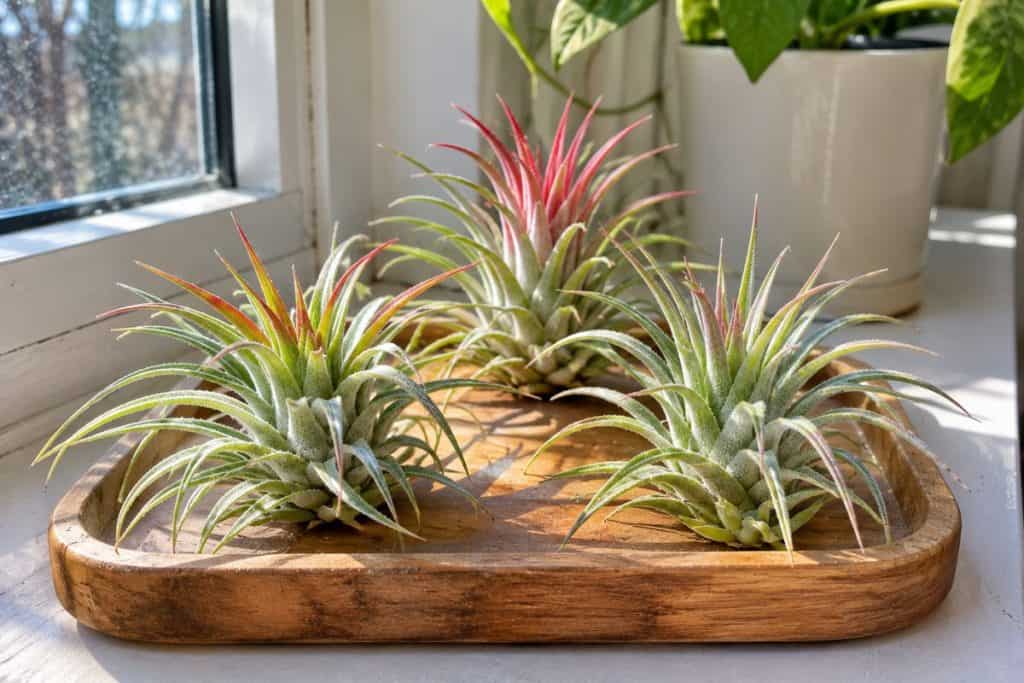
South and west windows are fine if you set plants a few feet back or behind a sheer curtain. Hot afternoon sun through glass heats the leaves fast and leaves pale, crispy patches.
- Too much sun: bleached or tan spots, crispy tips, leaves rolling tight
- Too little light: faded color, slow or stretched growth, plants that stay damp for hours after watering
- Just right: firm leaves, steady color, and sometimes a pink or red blush on the tips
In a dim room, air plants decline slowly over months. They won’t survive long in true low light, even if they look