
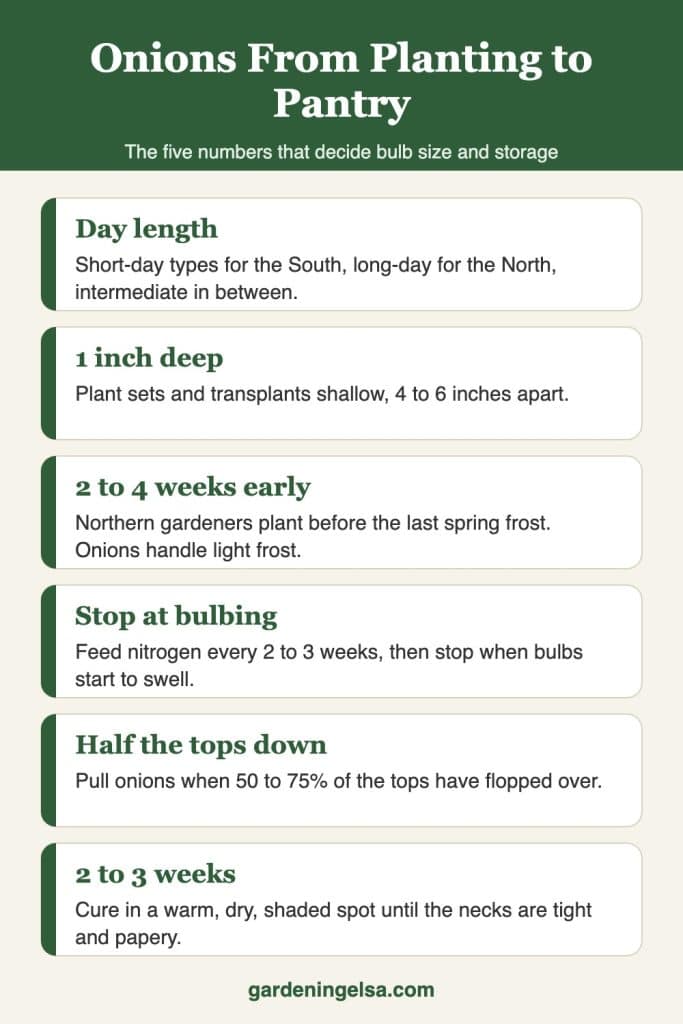
Start here: buy the onion type that matches your day length (short-day in the South, long-day in the North), plant small sets or transplants 1 inch deep and 4 to 6 inches apart, and get them in early.
Feed them until the bulbs start to swell, pull them when half the tops fall over, and cure them for 2 to 3 weeks before storing.
That’s the whole recipe for bulb onions. If you just want green onions, any type and any timing will do.
What You’ll Need
- Onion sets or transplant bundles: about 80 per 25-foot row
- Seed and a tray, if you’re starting from seed
- A soil test, or at least a pH reading
- A high-nitrogen fertilizer for side-dressing
- About 1 inch of water a week
- A shady, airy spot for curing in summer
Most first-time growers do best with onion sets, the small dry bulbs sold by the pound in spring. Choose firm sets under ¾ inch across, about the size of a dime.
Bigger sets look like a head start, but they’re more likely to bolt and send up a flower stalk instead of making a bulb.
Transplants come as bundles of 50 to 70 pencil-thin plants. They’re the usual choice in the South, where most short-day varieties are sold this way, and they make bigger bulbs than onion sets.

Seed is cheapest and has the widest choice of varieties.
Start it indoors in a seed starting tray 8 to 10 weeks before your planting date, sow it ¼ inch deep, and give the seedlings a haircut with scissors back to 4 to 5 inches whenever they flop over.
They get sturdier each time.
Match the Onion to Your Latitude
Bulbing starts when daylight reaches a set length, whatever the plant’s size or age. Plant the wrong type and you’ll get green tops all summer and a bulb no bigger than a golf ball.
| Where you garden | Type to buy | When to plant | Harvest |
|---|---|---|---|
| Deep South, Gulf Coast, Southern California (below about 35° N, Zones 8 to 10) | Short-day (10 to 12 hours) | October to February, as transplants | April to June |
| Middle states, from about 35° to 38° N (Zones 6 to 7) | Intermediate (12 to 14 hours) | Fall in warmer areas, February to March elsewhere | June to July |
| North and Mountain West, above about 37° N (Zones 3 to 6) | Long-day (14 to 16 hours) | 2 to 4 weeks before your last spring frost | July to September |
The bands overlap. If you’re near the line, as in much of Virginia, Tennessee or Kansas, intermediate types are the safest bet. ‘Candy’ is a widely sold intermediate that does well across most of the middle.
Short-day varieties include ‘Texas Grano’ and ‘Granex’. Long-day storage types include ‘Yellow Sweet Spanish’, ‘Copra’ and ‘Patterson’.
Planting
Onions want full sun, at least 6 hours, and loose soil that drains. A pH of 6.0 to 7.0 suits them.
If you’ve never checked your beds, a soil test kit shows the pH and gives a rough read on nitrogen, which matters more for onions than for most crops.

Work 2 inches of compost into the top 6 inches. Onion roots are short and shallow, and they struggle in heavy clay that cracks when dry. Our guide on how to prepare soil for a vegetable garden covers fixing clay.
Set sets pointed end up, 1 inch deep, so the tips sit just under the surface. Space them 4 inches apart for medium bulbs and 6 inches for large ones, in rows 12 to 18 inches apart.
Transplants go in at the same depth, with the roots pushed straight down.
Shortcut: plant sets 2 inches apart and pull every other one as a green onion in late spring. The ones left behind fill the gap.
The Leaf Count Decides Bulb Size
Each green leaf on an onion matches a ring inside the bulb. Every leaf the plant grows before bulbing starts is one more layer later. Once the day length triggers bulbing, the plant stops making new leaves and pours everything into the bulb.
The aim is to grow as many big leaves as you can before that date. Each leaf is one ring, and bigger leaves make bigger rings.
A well-grown onion has about 13 leaves by harvest, and a plant that starts bulbing with only a handful stays small however well you water it afterward.
In practice: Southern transplants by mid-January, Northern sets as soon as the soil crumbles in March or April.
Watering and Feeding
Give onions about 1 inch of water a week from rain or the hose, and more in sandy soil. Their roots sit in the top 6 inches, so they dry out faster than deeper crops.
Uneven watering during bulbing causes split and double bulbs. Our guide on watering a vegetable garden has more on timing.
Feed nitrogen early and often. Mix some fertilizer into the bed at planting, then side-dress every 2 to 3 weeks with a high-nitrogen onion fertilizer, scattered 2 to 3 inches from the plants and watered in.

Stop feeding as soon as the bulbs begin to swell and push the soil aside. Late nitrogen keeps the necks thick and green, and thick-necked onions rot in storage. For general rates, see how to fertilize a vegetable garden.
Weed by hand or with a shallow hoe. Onions have thin leaves that shade nothing, so weeds take over fast. A thin layer of straw helps, kept pulled back from the bulbs.
Don’t pile soil over the swelling bulbs. Unlike potatoes, onions bulb on the surface, and the top third of a ripening bulb should sit above ground.
Harvesting With the Pinch Test
When the bulbs reach full size, the necks soften and the tops fall over by themselves. Wait until 50 to 75% of the tops in the row are down. Stop watering, and pull the onions about a week later on a dry morning.
Before you pull, pinch the neck just above the bulb. A ripe onion’s neck feels soft and limp, with no firm green core. A stiff neck means it’s still growing. Give it another week.
Don’t bend the tops over yourself to speed things up. Onions knocked down early often store poorly.
Curing and Storing
Lay the onions in a single layer, tops on, somewhere warm, dry, shaded and airy, such as a covered porch, garage with the door open, or a shed. Keep them out of direct sun, which scalds the skins.
At 75 to 80°F, curing takes 2 to 3 weeks.
Pinch the necks again to check. A cured neck is dry, papery and tight. It doesn’t slide or feel moist when you roll it between your fingers. The outer skins rustle.
Trim the tops to 1 inch and the roots to ¼ inch. Store in mesh bags or old pantyhose at 35 to 40°F with low humidity, such as a cool basement or unheated room.
Keep them away from potatoes, which give off moisture that makes onions sprout and rot.
| Onion type | How long it stores |
|---|---|
| Short-day sweet (Granex, Grano) | 1 to 2 months |
| Intermediate (‘Candy’) | 2 to 4 months |
| Long-day pungent storage types | 6 months or more |
Sweet onions hold so much water that they don’t keep. Eat them first, and save the sharp ones for winter.
Fixing Common Problems
Bolting. A flower stalk shooting up from the center means the plant has given up on bulbing.
It’s usually caused by a cold snap of 45 to 50°F lasting 2 to 3 weeks or more, once stems are pencil-thick (about ⅜ inch), or by oversized sets. Snap off the stalk and use those onions first.
They won’t store.
Thrips. Silvery streaks on the leaves, worst in hot, dry weather. A hard spray of water aimed into the neck every few days knocks them back. If that fails, use insecticidal soap.
Onion maggots. Wilting, yellow plants that pull out easily, with small white larvae in the bulb. They’re worst in the North and in cool, wet springs.
Rotate beds yearly, cover new plantings with row cover until early summer, skip fresh manure, which draws the egg-laying flies, and don’t plant onions where onions, garlic or leeks grew last year.
Small bulbs. Almost always the wrong day-length type, late planting, or too little nitrogen early on.
Shortcuts That Work (and One That Doesn’t)
Fall-planted onions work in the South and in mild parts of Zone 7. Transplants set out in late fall grow leaves all winter and bulb in spring, well before summer heat.
Bunching onions and scallions skip the day-length question entirely. Sow them every 3 weeks from early spring for a steady supply. They also grow well in a 10-inch pot.
Garlic is grown the same way but planted in fall in every zone. See our guide on how to plant garlic in fall. Onions also fit neatly in small beds, as in this plan for square foot gardening with onions.
What doesn’t work: planting the root end of a grocery-store onion for a new bulb. It regrows green leaves you can snip, but it rarely makes a usable bulb.
Your Short List
- Buy the right day-length type for your latitude.
- Plant dime-sized sets or transplants 1 inch deep, 4 to 6 inches apart, as early as your zone allows.
- Water 1 inch a week and feed nitrogen every 2 to 3 weeks.
- Stop feeding when bulbs swell. Never bury the bulbs.
- Pull when half the tops fall and the neck is soft.
- Cure 2 to 3 weeks in shade, store at 35 to 40°F.
Onion Questions Worth Asking
Can I grow onions in containers?
Yes, though the bulbs come out smaller. Use a pot at least 10 inches deep and wide enough to space onions 3 to 4 inches apart. Container soil dries fast, so check it daily in warm weather and water when the top inch is dry.
Can I snip the green tops while the bulb grows?
A leaf here and there from a few plants is fine. Every leaf feeds a ring of the bulb, though, so cutting a lot shrinks the harvest. If you want greens all season, grow a separate row of bunching onions for cutting.
Why are my onion bulbs rotting soon after harvest?
Most early rot starts at the neck when onions are stored before they’re fully cured, or after late watering or feeding. Cut one open: a soft gray area spreading down from the neck is neck rot. Cure longer next year, and stop water when the tops fall.
Why are my onions so strong?
Pungency comes from sulfur compounds, and dry spells concentrate them. Soil rich in sulfur adds more. Steady watering through bulbing and sweet short-day or intermediate varieties give milder onions.
Can I save seed from my onions?
Onions are biennial, so they flower in their second year. You’d need to store good bulbs over winter and replant them in spring. Different varieties cross easily, so grow only one variety for seed if you want it true to type.

Hello there! I’m Elsa, and gardening is my passion. As an avid gardener, I created GardeningElsa.com to share my knowledge and experience with fellow enthusiasts. My website is a comprehensive resource for gardeners of all levels, offering expert advice on a wide range of topics, including plants, flowers, herbs, and vegetable gardening. Whether you’re a beginner looking to start your first garden or a seasoned pro seeking to expand your knowledge, GardeningElsa.com has something for everyone. Read more about me.