
My top pick among tall indoor plants for low light is the dracaena, especially the corn plant and its dark-green cultivar ‘Janet Craig,’ because it forms a real tree shape and keeps its leaves in a dim corner where most floor plants drop theirs.
If your corner is narrow, a tall snake plant is my second choice, and if you have pets, I’d go with a kentia or parlor palm.
Low light still means some light, though. A north window or a spot deep in a room can carry a big plant for years, but only if you pick a species built for the shade, water less, and accept slower growth.
What Counts as Low Light for a Tall Houseplant?
Low light is a north window or a spot far back in a room where you can read comfortably during the day but no sunbeams ever land.
Many big plants sold as “easy” need much more than that, so it helps to know your corner before you buy.
How Much Indirect Light Does a Dim Corner Receive?
Light drops fast as you move away from glass. A plant right beside an east window gets bright indirect light, but the same plant 8 to 10 feet back sits in low indirect light.
Here’s how I’d sort your spot:
- Direct sun: a sunny south or west window where rays hit the leaves.
- Bright indirect: near a window but out of the sun’s rays.
- Low light: a north window, or deep in a room away from any window.
A quick test helps. At midday, hold your hand a foot above where the pot will sit.
A crisp shadow means bright light, a soft fuzzy shadow means medium, and a faint or missing shadow means low light. If you can’t see a shadow at all, plan on a grow light.
Which Popular Floor Plants Need a Brighter Spot?
Some of the most popular large indoor plants show up on low-light lists but struggle in a dim corner. These need bright indirect sunlight to look good:
- Monstera (monstera deliciosa)
- Bird of paradise
- Fiddle leaf fig and weeping fig
- Money tree
- Schefflera (umbrella tree)
- Ponytail palm, which wants some direct sun
In low light, these plants stretch, drop lower leaves, and stay lopsided. If you love one of them, give it a window and save the dark corner for the plants below. My list of indoor plants that don’t need sun covers smaller shade picks too.
Dracaena: My Pick for a Tall, Tree-Like Shape
Dracaena gives you a woody trunk and a crown of leaves, which is the indoor-tree look most people want. The solid green types handle dim rooms best, while striped and colored types need brighter light to keep their color.

Corn Plant, ‘Janet Craig,’ and ‘Lisa’: Which Handles Dimmer Rooms?
The corn plant (Dracaena fragrans) is a slow grower that usually stays around 4 to 5 feet tall indoors. ‘Massangeana,’ or mass cane, has a yellow-green stripe down each leaf and a thick trunk.
Dracaena janet craig has solid, glossy, dark green leaves, and growers have long called it a workhorse for low light.
It reaches 3 to 6 feet. ‘Lisa’ is a close cousin with narrower, darker leaves on tall canes, and I like it for a slim corner.
My ranking for a dim spot:
- ‘Janet Craig’ or ‘Lisa’ (darkest leaves, most shade-tolerant)
- Plain corn plant or mass cane
- Striped types like ‘Lemon Lime’ or ‘Warneckii,’ which fade in low light
Let the top inch or two of soil dry before watering. Dracaenas are sensitive to fluoride, so brown leaf tips often point to tap water; switching to filtered water or rainwater helps.
Where Does the Dragon Tree Fit?
The dragon tree (dracaena marginata) has thin, spiky leaves on bare, slender canes, so it looks airy and fits tight spaces. It can be pruned to about 6 feet indoors.
It prefers bright indirect light, though. Plain green marginata tolerates a medium spot, but ‘Tricolor’ and ‘Colorama’ lose their pink tones in dim light. I’d put a dragon tree a few feet from a window and keep ‘Janet Craig’ for the true dark corner.
All dracaenas are toxic to cats and dogs.
Snake Plant: Upright Height for a Narrow Corner
The snake plant adds height without taking up floor space, which makes it my choice for the strip between a sofa and a wall. Its stiff leaves rise straight from the pot, and it puts up with dim light and missed waterings.

Which Snake Plant Varieties Look Tallest?
Most snake plants stay under 3 feet indoors, so pick the variety carefully if you want height.
- Standard green (Dracaena trifasciata): dark banded leaves, the best for low light.
- ‘Laurentii’: yellow edges; tall, but the pale edges want more light.
- ‘Bantel’s Sensation’: narrow leaves with white stripes, slim and graphic.
- ‘Moonshine’: silvery, broad leaves that dull in deep shade.
- ‘Hahnii’: a short rosette for shelves, never a floor plant.
For a floor plant, buy a mature clump that’s already 3 to 4 feet tall. Set it in a heavy, wide pot so it doesn’t tip.
How Do You Keep Its Roots Healthy in Low Light?
Root rot is the main way snake plants die in dim corners. Less light means the plant drinks slowly, so wet soil sits around the roots for weeks.
- Use a fast-draining cactus mix and a pot with a drainage hole.
- Let the mix dry almost all the way through before watering.
- In winter, that might mean once a month or less.
- Empty any water that collects in a decorative outer pot.
Check the soil with your finger and lift the pot to feel its weight. A light pot is a dry pot. The ASPCA lists snake plant as toxic to cats and dogs because of saponins.
ZZ Plant: Glossy Foliage with Little Fuss
The zz plant handles dark rooms better than almost anything else, and its waxy leaves look polished even when ignored. It stores water in thick underground rhizomes, so it forgives a forgetful waterer.
Will a Standard or Raven ZZ Plant Fill Your Space?
According to Clemson HGIC, the standard ZZ grows 3 to 4 feet tall and 2 to 4 feet wide. That makes it a medium floor plant, best on its own or on a low stand.
‘Raven’ tops out around 2.5 feet, with new leaves that turn nearly black. ‘Chameleon’ can reach 4 feet. Skip ‘Zenzi,’ a dwarf that tops out near 12 inches.
| ZZ type | Mature height | Best use |
|---|---|---|
| Standard green | 3 to 4 ft | Floor plant |
| ‘Chameleon’ | Up to 4 ft | Floor plant |
| ‘Raven’ | Up to 2.5 ft | Stand or low floor spot |
| ‘Zenzi’ | 10 to 12 in | Shelf or desk |
Why Is Buying a Mature Plant Often the Better Choice?
ZZ plants grow very slowly, and bright indirect light speeds them up. In a dim corner, a small plant could take years to gain a foot.
That’s why I’d pay more for a large plant from the start. Look for thick stems, no soft spots at the base, and black specks on stems, which are normal.
Keep it above 60°F, water only when the mix is fully dry, and feed just once or twice a season. ZZ plants aren’t on the ASPCA list, but they contain calcium oxalate, so keep them away from pets.
Kentia Palm: A Larger Palm for Softer Light
The kentia palm is the best large palm for a dim room. It handles low light better than almost any palm sold as a houseplant, it’s non-toxic to cats and dogs, and its arching fronds feel calm and classic.
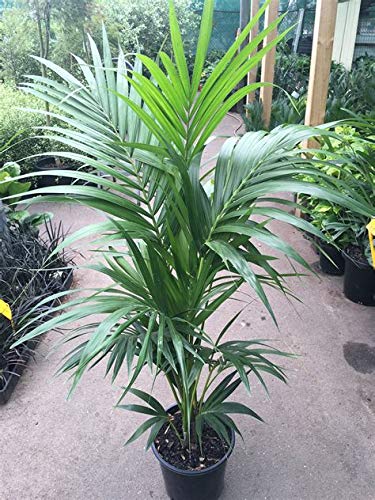
How Much Room Does a Kentia Palm Need?
Kentias grow 6 to 10 feet indoors over many years, and the fronds spread 5 to 6 feet wide. Give it a wide corner away from doorways where people would brush past.
It grows slowly, sometimes one new frond in several months in low light. Buy it at the size you want.
A 5-foot palm in a 12- to 14-inch pot is a common starting point, and it likes being slightly pot-bound, so repot only every 3 to 4 years.
What Keeps Its Fronds Looking Healthy?
Brown tips are the most common kentia complaint, and dry winter air is the usual cause. Aim for 40% to 60% humidity with a small humidifier, especially in the Northeast and Midwest where heated homes get very dry.
- Water when the top inch is dry; every 7 to 10 days in summer and 14 to 21 days in winter.
- Never let it stand in water.
- Keep it above 60°F and at least 3 feet from drafts.
- Feed lightly with a palm fertilizer two or three times a year.
Pale, stretched new fronds mean the spot is too dark. Move the pot a few feet closer to a window.
Parlor Palm: A Slower-Growing, Pet-Safe Option
The parlor palm (Chamaedorea elegans) is a forest-floor palm that keeps its looks for a long time in shade, and the ASPCA lists it as non-toxic to cats and dogs. It’s smaller than a kentia and costs much less.
How Tall Can a Parlor Palm Get Indoors?
Expect 2 to 6 feet indoors, with most plants staying around 3 to 4 feet. Nurseries plant several seedlings in one pot, which is why it looks bushy.
To make it read as a floor plant, buy one in a 10-inch or larger pot and set it on a sturdy stand 12 to 18 inches high.
Never cut the top off a stem; palms have one growing point and won’t regrow from a cut.
Keep the soil lightly moist but never soggy. Parlor palms are less drought-tolerant than snake plants, and dry soil brings brown tips.
When Would a Bamboo Palm Make More Sense?
Choose the bamboo palm (Chamaedorea seifrizii) if you want more height. It forms tr