
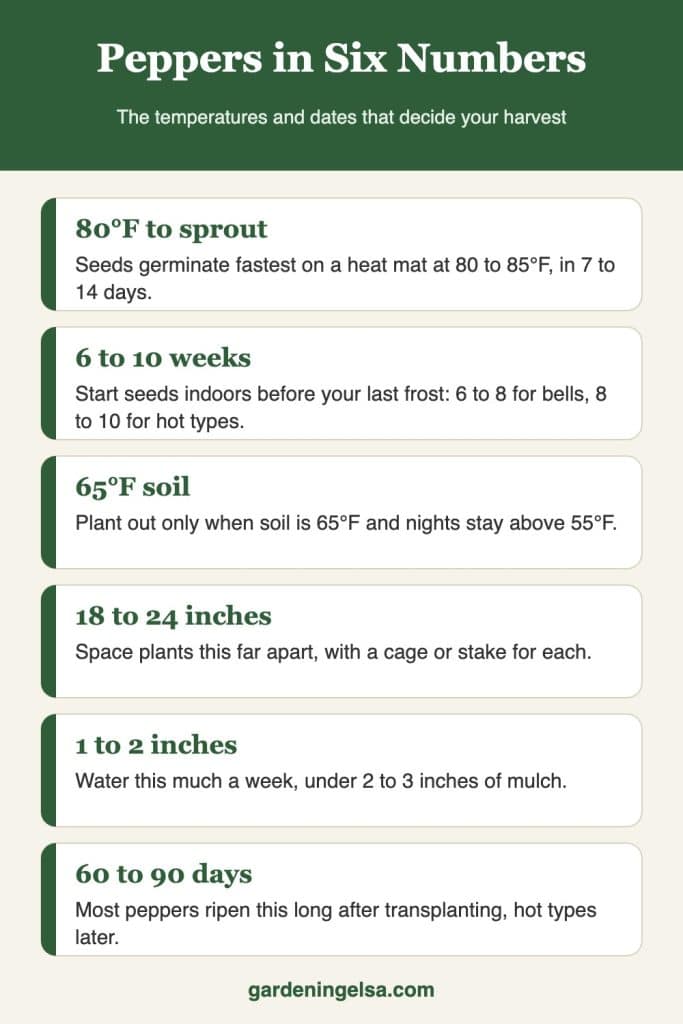
Start here: sow pepper seeds indoors 8 to 10 weeks before your last frost (6 to 8 for bell peppers), keep them at 80°F until they sprout, and don’t plant them outside until the soil reads 65°F.
After that it’s full sun, steady water, a cage for support and a light hand with fertilizer.
This works for every pepper, from mild bells to habaneros. Hot peppers just take longer at every step.
What You’ll Need
- Seeds or transplants: 2 or 3 varieties is plenty for a first year
- A seed tray with a clear lid, plus seed-starting mix
- A heat mat (seeds sprout much faster than in a cool room)
- A light for indoor seedlings
- A soil thermometer
- One cage or stake per plant
- Straw or shredded leaves for mulch
- A balanced organic vegetable fertilizer
The one item worth buying even for a few plants is a heat mat. Pepper seeds want 80°F soil, and most houses in March sit around 65°F, where they come up slowly and unevenly or not at all.
Sow into a seed starting tray with a domed lid, which holds humidity until the sprouts appear. After that, the lid comes off.
Transplants from a garden center skip the first 8 weeks. They’re the better choice if you only want four or five plants, or if you’ve missed the window for seed. Buy short, sturdy plants with dark green leaves and no flowers yet.
Sowing
Fill cells with damp seed-starting mix, drop 2 seeds per cell, and cover them ¼ inch deep. Set the tray on a heat mat.
At 80 to 85°F, sweet peppers usually sprout in 7 to 10 days. Hot ones, especially habaneros and other Capsicum chinense types, can take 2 to 3 weeks.
At a cool 65°F windowsill, some never come up at all.
As soon as the green loops break the surface, the seedlings need strong light. A windowsill in March isn’t enough, and they’ll stretch thin and pale within days.
Hang a grow light above them and run it 14 to 16 hours a day: 2 to 4 inches above the tops for fluorescent tubes, or 6 to 12 inches for an LED panel (check its label).

Raise it as they grow.
When the first true leaves appear (the jagged ones, not the two smooth seed leaves), snip the weaker seedling in each cell at soil level. Pulling it disturbs the roots of the one you keep.
Water from below, by setting the tray in an inch of water for 10 minutes, then letting it drain. Feed with a quarter-strength liquid fertilizer once a week after the true leaves come in. Move plants up to 4-inch pots at about 4 weeks.
Shortcut: once seedlings are up, turn the heat mat off. They grow sturdier at 70°F than at 85°F.
When to Plant by Zone
Peppers stop growing below about 55°F and can be stunted for weeks by one cold night. The dates below assume an average last frost for each zone.
Check your own date with a local frost-date lookup, because elevation and nearness to water shift it by weeks.
| USDA zone | Typical last frost | Start seeds indoors | Plant outside |
|---|---|---|---|
| 3 to 4 | Late May to early June | Mid to late March | Mid June |
| 5 | Mid May | Early to mid March | Early June |
| 6 | Early May | Late Feb to early March | Mid to late May |
| 7 | Mid April | Mid February | Early May |
| 8 | Late March | Late January | Mid April |
| 9 to 10 | February or none | December to January | March, or a fall crop in August |
In Zones 9 and 10, summer heat over 95°F stops fruit set. Many gardeners there get two crops, one in spring and a second planted in late summer for fall.
Choosing Varieties for Your Season
Match the pepper to your summer, not just your taste.
Short seasons (Zones 3 to 5) favor fast types. Shishito, banana peppers, jalapeños and early bells like ‘Ace’ or ‘King of the North’ ripen before September cold sets in.
Habaneros and other late hot peppers rarely color up there without a head start in a greenhouse or a big pot you can move against a south wall.
Long, hot seasons (Zones 8 to 10) suit almost anything. Heat-tolerant types do best through midsummer. Jalapeños, cayenne, Thai peppers and most habaneros keep setting fruit in heat that makes bells drop their flowers.
Everywhere else, grow one bell, one mild type and one hot type the first year.
Hardening Off and Transplanting
Seedlings raised indoors have never felt wind or real sun. Put them outside in shade for an hour on the first day, then add an hour or two each day and move them into more sun.
After 7 to 10 days they can stay out all day and all night.
Now test the ground. Push a soil thermometer 4 inches down at about 8 in the morning, when soil is coldest.

When it reads 65°F three mornings in a row, and the forecast shows nights above 55°F, plant. This is usually 2 to 3 weeks after your last frost date, not on it.
Set each plant at the same depth it grew in the pot, or an inch deeper. Peppers root from buried stem far less than tomatoes do, so there’s little point burying them deep. Water each one in with a quart of water.
| Temperature | What happens |
|---|---|
| Soil under 60°F | Roots barely grow. Plants sit still and yellow. |
| Nights under 55°F | Growth stalls, and open flowers drop. |
| Days 70 to 85°F | Best growth and fruit set. |
| Days over 90°F (or over 85°F with high humidity) | Flowers drop without setting fruit. |
| Nights over 75°F | Pollen fails. Expect a gap in fruit until it cools. |
Spacing, Sun and Support
Give peppers the sunniest spot you have, with at least 6 hours of direct sun and 8 if you can. Space small hot types and compact bells 18 inches apart.
Full-size bells and big plants like poblano or habanero need 24 inches. Rows can sit 24 to 30 inches apart.
A loaded pepper plant is top-heavy and the branches are brittle. A single summer storm can split one down the middle.
Put a support in at planting time, while the roots are small. Small tomato cages fit peppers perfectly, or use a 3-foot stake and soft ties.

Peppers grow well in containers too. Use a pot of at least 5 gallons for a bell and 3 gallons for a compact hot type. Our list of vegetables for containers has more ideas for a small patio.
Soil should be loose and well-drained with a pH of 6.2 to 6.8. Work 2 inches of compost into the bed before planting. If your soil is heavy, see these steps to prepare soil for a vegetable garden.
Watering and Feeding
Water deeply and evenly, about 1 to 2 inches a week, more in July heat and for containers. Uneven watering is the main cause of blossom end rot, the sunken black patch on the bottom of the fruit.
The soil usually has plenty of calcium. The plant just can’t move it into the fruit when the soil swings between dry and wet.
Once the soil has warmed, spread 2 to 3 inches of straw or shredded leaves around the plants. Mulch evens out moisture and keeps soil from splashing onto the leaves.
More on that in our guide to mulching a vegetable garden, and on timing in how to water a vegetable garden.
For feeding, mix a balanced organic vegetable fertilizer into the soil at planting, following the label rate. Feed again when the first fruits are about the size of a quarter, and then every 3 to 4 weeks.
Go easy on nitrogen. A pepper plant fed like a lawn grows huge and dark green and sets very little fruit.
I’d skip Epsom salt. It’s the most repeated pepper tip online, and it only helps on soil that’s actually low in magnesium, which most garden soils aren’t.
Days to Harvest by Pepper Type
Days to maturity are counted from transplanting, not from seed. Green peppers are simply unripe. Leave them on for another 2 to 4 weeks and they turn red, yellow or orange and get sweeter, or hotter.
| Pepper | Days to green | Days to fully ripe | Heat |
|---|---|---|---|
| Shishito | 55 to 60 | 75 | Mild, with the odd hot one |
| Banana pepper | 60 to 65 | 75 | Sweet to mild |
| Jalapeño | 65 to 70 | 85 to 90 | Medium |
| Bell pepper | 65 to 75 | 85 to 95 | None |
| Poblano | 65 to 75 | 90 to 100 | Mild |
| Cayenne | 70 | 85 to 90 | Hot |
| Habanero | 90 to 100 | 110 to 120 | Very hot |
Cut peppers off with pruners or scissors, leaving a short piece of stem. Pulling them off by hand can snap the brittle branch along with the fruit. Picking regularly keeps the plant setting more flowers.
Keeping It Going
Pests are usually light. Aphids cluster under the leaves and on new tips, and a strong spray of water knocks them off.
Hornworms, the big green caterpillars that eat tomatoes, sometimes move onto peppers. Handpick them.
In the South, pepper weevils can drop flowers and small fruit. Pick up and destroy fallen fruit right away.
In humid summers, watch for bacterial leaf spot: small dark, greasy-looking spots that turn leaves yellow. In wet Southern soils, Phytophthora blight causes sudden wilting of whole plants. Water at the base, buy disease-resistant varieties, and rotate beds.
Sunscald shows up as pale, papery patches on the side of fruit facing the afternoon sun. It happens most after heavy pruning or when a plant falls open. A cage that keeps the leaves together prevents most of it.
When frost is forecast in fall, pick everything, ripe or not. Green peppers keep in the fridge for 1 to 2 weeks. Hot peppers dry well on a string or in a dehydrator.
Peppers are perennials in their native range.
A favorite hot pepper in a pot can come indoors for winter: cut it back by half, keep it in a bright cool window, water lightly, and put it back out in spring once nights pass 55°F again.
It’ll fruit weeks earlier than a new seedling. Our guide on overwintering potted plants covers the move inside.
Shortcuts That Work (and One That Doesn’t)
Black plastic or landscape fabric laid over the bed a week before planting warms the soil by several degrees. It’s a real help in Zones 4 to 6.
Pinching the first flowers on transplants that already have buds sends energy to roots and leaves first. You lose one or two early peppers and gain a bigger plant.
Planting sweet and hot peppers side by side is fine. Cross-pollination only affects the seeds, not this year’s fruit. Your bells won’t turn hot. Only save seed if you’ve grown varieties far apart.
What doesn’t work: planting out on your frost date because the garden center has plants for sale. A pepper set into 55°F soil sits still for 3 to 4 weeks. One planted 2 weeks later into warm soil usually catches up and passes it.
Your Short List
- Sow 8 to 10 weeks before last frost on a heat mat, under a light.
- Plant out at 65°F soil and 55°F nights, usually 2 to 3 weeks after frost.
- 18 to 24 inches apart, full sun, a cage for every plant.
- Even water, mulch, and light feeding once fruit sets.
- Pick green for quantity, wait for color for flavor.
Pepper Growing Questions Worth Asking
Why are my peppers staying green?
Ripening takes another 2 to 4 weeks after a pepper reaches full size, and it needs warmth. Below about 60°F at night, color barely moves. Late-season fruit picked green with some color showing can finish ripening on a sunny windowsill.
How many peppers does one plant produce?
A healthy bell plant typically gives 6 to 10 full-size peppers over a season, more if you pick them green. Small-fruited hot peppers like cayenne or Thai types can set 50 or more. Long, warm seasons in the South yield the most.
Can I grow peppers indoors all year?
You can keep compact hot pepper varieties going indoors with a strong grow light running 14 to 16 hours a day. A windowsill alone rarely gives enough light for fruit. Expect smaller harvests than outdoors, and hand-pollinate by gently shaking the flowers.
Why aren’t my jalapeños hot?
Heat comes from the variety first. Some newer jalapeños are bred mild. Cool weather and steady, heavy watering also lower the heat. Fruit left on the plant to turn red is hotter than green fruit.
Can I plant peppers where tomatoes grew last year?
Better not. Peppers, tomatoes, eggplant and potatoes share soil diseases. Wait 3 years before planting any of them in the same spot, or grow peppers in a fresh bed or a large container.

Hello there! I’m Elsa, and gardening is my passion. As