
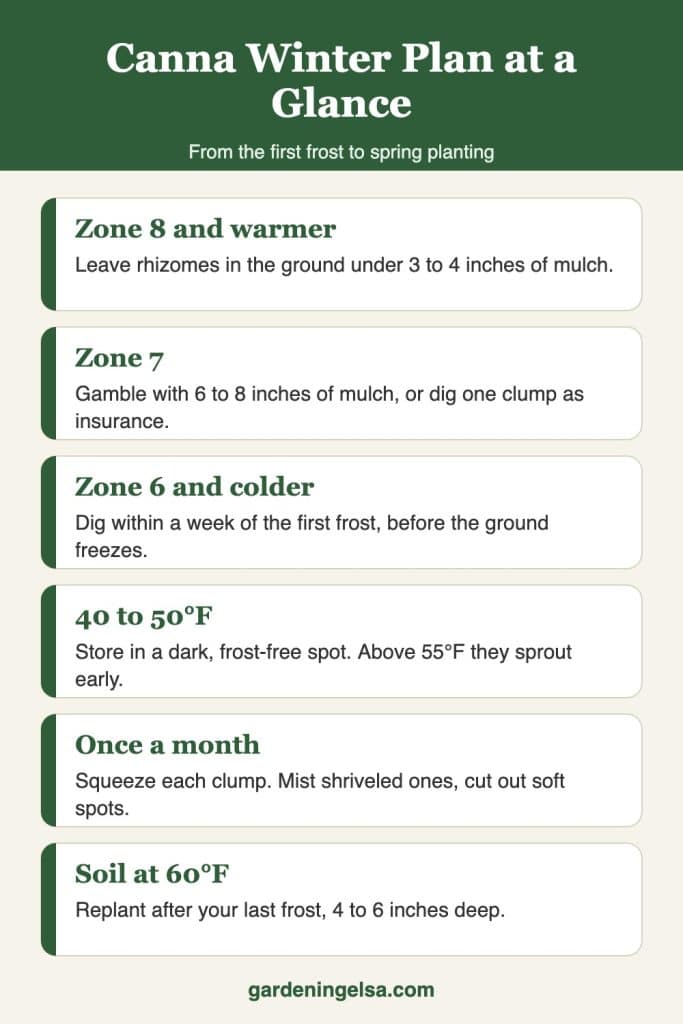
Cannas can stay in the ground anywhere the soil doesn’t freeze around the rhizomes, which means Zone 8 and warmer.
In Zone 7 it’s a gamble that pays off under a thick mulch, and in Zone 6 and colder you dig them after the first frost blackens the leaves and store them indoors at 40 to 50°F until spring.
By zone: leave them in Zones 8 to 11, mulch heavily or dig in Zone 7, and dig every year in Zones 3 to 6, usually between late September and early November.
Elephant ears, tuberous begonias and calla lilies come through winter much the same way, with small differences noted below. Caladiums are the odd one out.
Zone by Zone: Dig, Mulch or Leave Them
| Zone band | Typical first frost | What to do | Watch out for |
|---|---|---|---|
| 3 to 4 | Early to late September | Dig within a week of the first frost | A hard freeze can follow the first frost by days |
| 5 to 6 | Early to late October | Dig after the first frost, before the soil freezes | Wet clay soil rots rhizomes even in storage |
| 7 | Late October to mid November | Mulch 6 to 8 inches deep, or dig to be safe | One cold snap near 0°F can kill unprotected clumps |
| 8 | Mid to late November | Leave in the ground, mulch 3 to 4 inches | Soggy winter soil, not cold, is the usual killer |
| 9 to 11 | Rare or none | Leave in place, cut back dead stalks | Clumps get crowded and need dividing every 3 to 4 years |
Digging one clump is a short job, and the tool matters more than people think. A garden fork lifts the whole mass without slicing through rhizomes the way a spade blade does.

Push it in about 12 inches out from the stems and work around the clump before you lever.
Before you dig, cut the stalks down to about 6 inches with bypass pruners. The short stubs give you a handle to lift with and show you where each piece of the clump sits once it’s out of the ground.
How Cold Is Too Cold for Cannas?
The leaves are tender. A light frost around 32°F turns them black and limp overnight, and that’s your signal to plan the dig. The rhizomes underground are well insulated by soil, so a few frosty nights don’t hurt them.
What kills cannas is deep cold around the rhizome itself. Rhizomes are injured once they sit below about 25°F, and the fleshy tissue turns to mush.
That’s why Zone 7 is a gamble and Zone 6 is not. In Zone 8 the soil around them almost never gets that cold.
So the useful window is between the first frost and the first hard freeze. In most northern gardens that’s 1 to 3 weeks.
Waiting a few days after the frost gives the rhizome skin time to toughen, which helps it store better. Waiting too long means chipping clumps out of frozen ground.
Zone note: in Zone 7, a south-facing bed against a house foundation behaves more like Zone 8. Cannas there often come back every year with a heavy mulch, while the same variety in an open bed 30 feet away doesn’t.
Digging, Trimming and Curing
Lift the clump onto a tarp and shake off the loose soil. Don’t wash the rhizomes. Water left in the crevices is the most common start of storage rot, and the thin film of dry soil does no harm.
Trim any roots longer than a few inches and pull off dead leaf bases. Leave the clump whole for now.
A large clump stores better than separate pieces, because every cut is a new spot for rot to start.
I’d wait and divide in spring, when the pink growing eyes are easy to see and the cuts heal fast in warm soil.
Spread the clumps out somewhere dry, airy and frost-free for 3 to 7 days. A garage floor on cardboard works, or a shed with the door cracked. They’re ready when the outer skin feels dry and slightly papery and the cut stems have sealed over.
Storing Rhizomes Through Winter
Pack the cured clumps in a cardboard box, a milk crate lined with newspaper, or a plastic bin with the lid left loose. Bury them in barely damp peat moss, so each clump is covered and none touch each other.

Wood shavings, coir or dry vermiculite work too.
“Barely damp” means you can squeeze a handful and no water comes out. Dry peat pulls moisture out of the rhizomes over a long winter.
Wet peat rots them. If your storage spot is humid, a damp basement for example, use the packing material dry instead.
Aim for 40 to 50°F. Below 40°F, especially near freezing, the rhizomes can chill and break down. Above 55°F they start to sprout in midwinter and use up their stored food.
Most houses have one spot in that range, but it’s rarely where you’d guess. Leave a digital thermometer in the spot for a few days before you commit the box, and check the low reading, not just the daytime number.

| Spot in the house | Usual winter range | Good for cannas? |
|---|---|---|
| Attached garage (Zones 5 to 7) | 35 to 50°F | Yes, near the house wall |
| Detached garage or shed (Zone 6 and colder) | Can drop below 32°F | No |
| Unfinished basement | 50 to 60°F | Yes, on the coldest side |
| Crawl space | 40 to 55°F | Often, if it stays dry |
| Closet in a heated room | 65 to 70°F | No, too warm |
When the Calendar Lies
Frost dates are averages. In about half of all years the first frost comes earlier than the date your area lists, and in a warm fall it can come weeks later. Watch the plants and the forecast, not the calendar.
If an early freeze is forecast before you’ve had a frost, dig anyway. Cut the green stalks, lift the clumps, and cure them a few extra days, since green tops mean the rhizome hasn’t fully hardened.
If fall stays warm into November, the plants keep growing and you can leave them. Southern gardeners in Zones 8 and 9 sometimes see cannas bloom past Thanksgiving.
Spring is the other trap. Mother’s Day is a common planting date, and in Zones 5 and 6 it’s often too early for cannas.
They sit still in cold soil and can rot. Push a soil thermometer 4 inches deep in the morning, and plant when it reads 60°F.
That’s usually 2 to 3 weeks after the last frost.
Potted Cannas: Easier Than Digging
Cannas in containers skip most of this. After the first frost, cut them back to 4 to 6 inches and move the whole pot into an attached garage or basement at 40 to 50°F.
Water about once a month, just enough to keep the soil from going bone dry.
The soil in the pot acts as the packing material. In spring, bring the pot into the light 4 weeks before your last frost and start watering. You’ll have a plant several inches tall by the time it goes back outside.
You can also keep a potted canna growing in a very bright window all winter. It will look tired by February and rarely flowers indoors. I’d only do it for a variety you can’t replace.
If you have other tender plants coming inside, our guide on overwintering potted plants covers the move from patio to garage.
The Same Idea for Other Tender Bulbs
Dig most other summer bulbs at about the same time as cannas and keep them frost-free, but each has its own storage range.
| Bulb | When to dig | Cure | Store at |
|---|---|---|---|
| Gladiolus | Leaves yellowing, about 6 weeks after bloom | 2 to 3 weeks, warm and airy | 35 to 45°F, dry, in mesh bags |
| Elephant ears | After the first frost (hardy in Zones 8 to 11) | About 1 week | 45 to 55°F, barely damp peat |
| Tuberous begonias | After a light frost | Until stems drop off | 40 to 50°F, dry peat |
| Calla lilies | After frost (hardy in Zones 8 to 10) | 2 to 3 weeks, warm | 45 to 55°F, dry peat |
| Caladiums | Nights near 55 to 60°F, before any frost | About 1 week | 60 to 75°F, never below 50°F |
Caladiums are the exception that catches people out. Cold well above freezing damages them, so they belong in a closet inside the house, not the garage.
Dahlias store much like cannas but need more care with moisture. See our step-by-step on how to store dahlia tubers for the details. Geraniums come inside a different way, covered in our guide to overwintering geraniums.
Check Once a Month
Pick a day each month and squeeze each clump. Healthy rhizomes feel firm, like a raw potato. That 2-minute check catches almost every problem while it can still be fixed.
| What you find | What it means | What to do |
|---|---|---|
| Wrinkled, soft but dry | Too dry | Mist the packing lightly, or add damp peat |
| Mushy, dark, smelly | Too wet or too cold | Cut back to firm white tissue, dust with sulfur, dry out |
| Fuzzy white or gray mold | Too humid | Wipe off, air the box for a day, use drier packing |
| Pale sprouts in January | Too warm | Move to a cooler spot. Short sprouts are fine. |
| Fully collapsed, hollow | Dead | Throw it out away from the others |
Rot spreads. A mushy piece left in the box can ruin the clump next to it by the next check.
Waking Them Up in Spring
About 4 to 6 weeks before your last frost, divide the clumps. Snap or cut them into pieces with at least 2 or 3 eyes each, and let the cuts dry for a day.
You can plant them straight outside once the soil hits 60°F, or start them early. Set the pieces in pots of moist potting mix in a warm, bright room.
They’ll put up shoots in 2 to 3 weeks and bloom about a month sooner than rhizomes planted cold.
Plant outside 4 to 6 inches deep and 12 to 18 inches apart, in full sun, after your last frost. Water once, then wait until shoots appear before you water again. Most cannas flower about 10 to 12 weeks after planting.
For other bulbs that go in the ground in fall, see our guide on how to plant fall bulbs. And if a cold night catches you before you’ve dug, these tips on how to protect plants from frost buy you a few days.
Zone note: in Zones 9 and 10, skip storage completely. Cut cannas to the ground in late winter once the old leaves look ragged, and dig and divide the crowded clumps every few years in spring.
Mark Your Calendar
- First frost: watch the leaves. When they blacken, plan to dig within 1 to 2 weeks.
- Before the ground freezes: cut stalks to 6 inches, lift with a fork, don’t wash.
- Next 3 to 7 days: cure in a dry, frost-free spot.
- Storage day: pack in barely damp peat at 40 to 50°F.
- Monthly, November to March: squeeze, mist or trim as needed.
- 4 to 6 weeks before last frost: divide and start in pots indoors.
- Soil at 60°F: plant outside, 4 to 6 inches deep.
Timing and Climate Questions About Overwintering Cannas
Can I store canna rhizomes in the refrigerator?
Most fridges run 35 to 38°F and humid, which is colder and wetter than cannas like. Use one only for a few small pieces in a vented bag, kept away from fruit, and check them every couple of weeks.
Is it too late to dig cannas after a hard freeze?
Not if the soil itself hasn’t frozen. Leaves and stems can be dead and the rhizomes still fine. Dig one and squeeze it. If it’s firm with white flesh, lift the rest that day.
How long can canna rhizomes stay out of the ground?
Stored well, a full winter of about 5 to 6 months is normal. Past that they start to shrivel or sprout. Plant them out the same spring rather than holding them a second year.
Do I need to dig cannas growing in a pond or water garden?
In Zone 8 and warmer, pond cannas can usually stay put. Elsewhere, lift the pot before the water freezes, drain it, and store it like a potted canna at 40 to 50°F.
Are canna lilies toxic to pets?
The ASPCA lists cannas as non-toxic to dogs, cats and horses. Despite the name, they’re not true lilies, which are dangerous to cats. Calla lilies and caladiums, though, contain calcium oxalate crystals and do irritate the mouth if chewed.

Hello there! I’m Elsa, and gardenin